

Best Ethical Home Decor Online Shops: 2026 Guide
Yuatinia LeakTable of Contents
- What Defines Ethical Home Decor
- How to Identify Ethical Furniture Sourcing Before You Buy
- The Benefits of Artisan-Made Home Goods
- Best Ethical Home Decor Online Shops to Know in 2026
- Sustainable Materials to Prioritize in Ethical Home Decor
- Rental-Friendly Ethical Decor and End-of-Life Disposal
- Eco-Friendly Interior Design Tips for the Conscious Home
- Conclusion
Last Updated: August 24, 2026
Conscious consumerism has reshaped how discerning homeowners approach interior design. The best ethical home decor online shops offer far more than aesthetics. They connect buyers to living wage practices, supply chain transparency, and handcrafted goods built to outlast trends.
Quick Picks:
- Best for Organic Textiles: Shops prioritizing organic cotton, merino wool, and linen with traceable origins
- Best for Statement Furniture: Artisan-made solid wood pieces with verified sustainable sourcing
- Best for Decorative Accents: Fair trade certified shops with small-batch handcrafted details
What Defines Ethical Home Decor
Ethical home decor is home furnishings produced through fair labor practices, responsible material sourcing, and transparent supply chains. It encompasses organic textile pillows to hand-carved solid wood sideboards made by artisans paid a living wage.

The definition matters because the term is used loosely. A shop can call itself "ethical" without third-party verification. True ethical home decor requires that the entire production chain meets documented standards.
Fair Trade Certification and What It Actually Guarantees
Fair trade certification is not a marketing badge. It is a third-party verified standard requiring that producers receive fair payment, work in safe conditions, and operate without exploitative labor practices. According to Fair Trade USA's certification standards, certified goods must meet rigorous social, environmental, and economic benchmarks.
What certification actually guarantees:
- A minimum price floor protecting producers from market volatility
- Safe working conditions audited by independent third parties
- Community development premiums invested in local infrastructure
- Prohibition of forced and child labor
Certification covers the production stage, not always shipping logistics or retail markup. Treat it as a strong baseline, not a complete answer.
Supply Chain Transparency: The Standard Worth Demanding
Supply chain transparency is disclosing where, how, and by whom a product was made. It is the single most reliable signal that a brand's ethical claims are real.
Ask these questions before purchasing:
- Does the shop name the specific artisan communities or workshops involved?
- Is there documentation of material origins, including fiber sourcing?
- Are wages disclosed or independently audited?
Shops that cannot answer these questions clearly are relying on vague language rather than verified practice. Transparency costs brands nothing except accountability. When it's absent, that absence is the answer.
How to Identify Ethical Furniture Sourcing Before You Buy
Knowing how to identify ethical furniture sourcing means looking past the product page and evaluating the evidence behind it.
Recognizing Greenwashing in Home Goods
Greenwashing is presenting a product as more environmentally or socially responsible than it actually is. The Federal Trade Commission's Green Guides provide the regulatory framework for environmental marketing claims in the United States. Vague terms like "eco-conscious" or "sustainably inspired" carry no legal definition.
Specific greenwashing red flags to watch for:
- Claims like "natural" or "green" without material-specific detail
- Carbon offset language that replaces, rather than supplements, reduced emissions
- Certifications you cannot verify through the certifying body's own website
- Photography that implies handcraft without any artisan information
The honest shops name their makers. They show the workshop. They explain the process.
Regional Shipping Carbon Footprint and Why It Matters
A handcrafted piece made with organic materials still carries an environmental cost when shipped by air freight across continents. Regional shipping carbon footprint is the emissions generated by transporting goods from origin to your door.
Sea freight produces significantly lower emissions per kilogram than air freight. Consolidated shipping, where multiple orders travel together, reduces per-unit impact. Shops that disclose their shipping methods and offset programs are taking the issue seriously.
The Benefits of Artisan-Made Home Goods
Artisan-made goods occupy a different category from mass-produced home furnishings. The benefits of artisan-made home goods extend beyond aesthetics into durability, cultural preservation, and economic impact on the communities producing them.
Price-to-Longevity: The Case for Investing More Upfront
The most common objection to ethical home decor is price. It collapses under scrutiny.
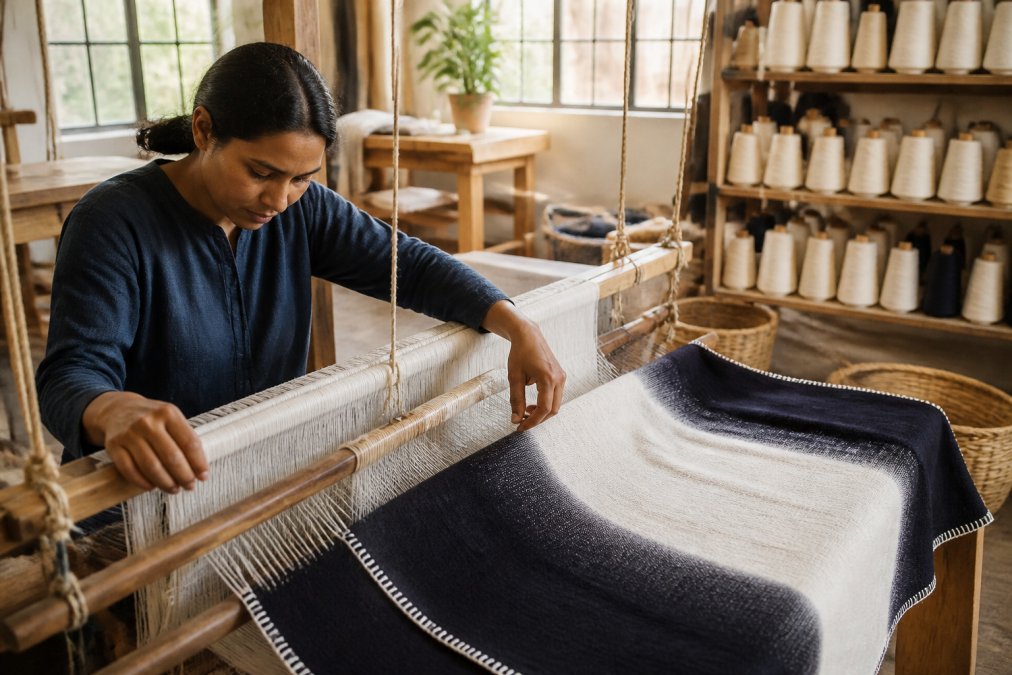
A mass-produced throw pillow needs replacing within two years. A handwoven mulberry silk pillow, naturally dyed in small batches by master artisans, remains beautiful for decades. The cost-per-year calculation almost always favors the higher upfront investment.
A piece that costs three times more but lasts ten times longer is not expensive. It is efficient.
| Item Type | Typical Lifespan | Long-Term Value |
|---|---|---|
| Mass-produced throw pillow | 1-3 years | Low |
| Handwoven artisan pillow | 10-15 years | High |
| Engineered wood sideboard | 3-7 years | Low |
| Solid mango wood sideboard | 25+ years | Very High |
| Synthetic table linen | 1-2 years | Low |
| Recycled cotton linen set | 8-12 years | High |
Cultural Heritage and Social Impact
Every artisan-made piece carries a history that mass production cannot replicate. A 700-year-old weaving technique used by a specific artisan cluster in India is a living tradition that disappears when demand for handmade goods disappears.
Purchasing from shops that work directly with artisan communities supports living wages, preserves craft heritage, and creates economic stability in communities where traditional skills are the primary income source. According to the World Fair Trade Organization's impact research, fair trade businesses directly improve the livelihoods of millions of artisans and farmers globally. Social impact is not a byproduct of ethical purchasing. It is the point.
Best Ethical Home Decor Online Shops to Know in 2026
The shops worth your attention share three qualities: verified sourcing, direct artisan relationships, and products built for longevity.
1. Shops Specializing in Organic Textiles and Natural Materials
Organic textile shops deserve priority consideration. Natural fibers like organic cotton, merino wool, linen, and mulberry silk are biodegradable, non-toxic, and produced without synthetic chemical inputs.
What to look for:
- GOTS (Global Organic Textile Standard) certification for organic cotton claims
- Azo-free dye documentation for colored textiles
- Small-batch production language, which signals quality control over volume
- Named artisan origins, not just a country of production
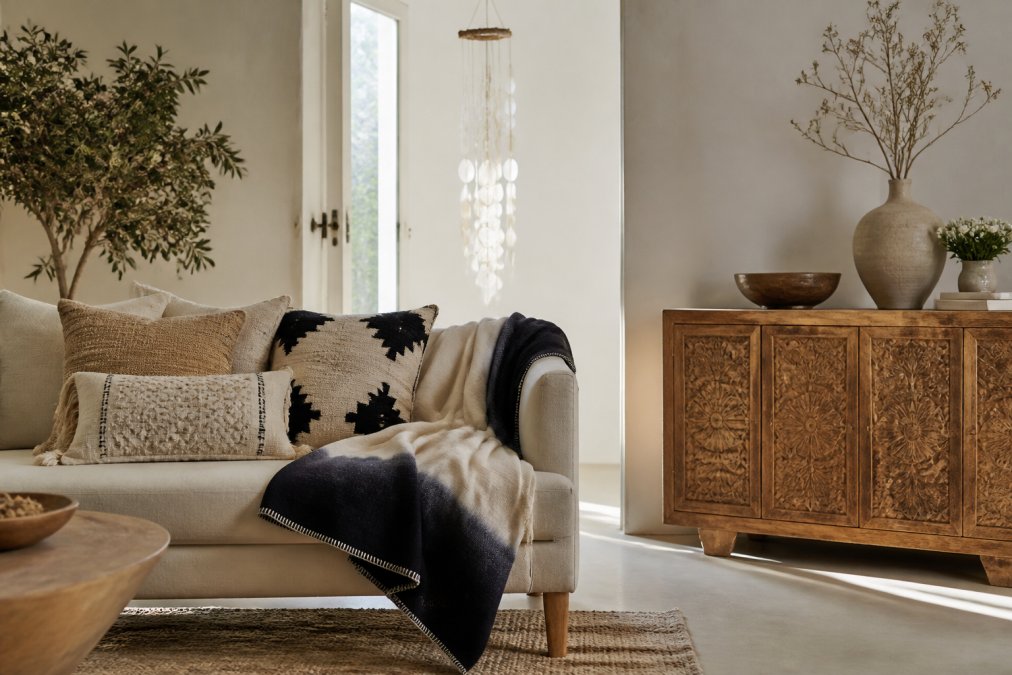
Fluent Trends leads this category with handcrafted organic textiles that name their makers and disclose materials with precision. The Chokor Nira Ochre Organic Cotton Handloom Pillow is woven using an ancient weaving technique by artisans. Natural dyes from flowers and herbs replace synthetic colorants entirely. The Arc Coral Shibori Print Mulberry Silk Pillow uses naturally dyed, small-batch mulberry silk, ethically handcrafted by master artisans. The Ink Black White Ombre Textured Throw is handwoven from 100% hand-spun merino wool sourced locally in Nepal.

These are not decorative approximations of ethical practice. They are the practice itself.
Pros: Traceable origins, biodegradable materials, women artisan employment, small-batch quality Cons: Higher price points than mass-produced alternatives; hand-wash care required for some pieces
2. Shops Focused on Handcrafted Furniture and Statement Pieces
Statement furniture is where ethical sourcing decisions carry the most long-term weight. A solid wood sideboard purchased today may still be in your home in 2056.
What separates genuine artisan furniture shops from the rest:
- Solid wood construction, not veneer over engineered substrates
- Named wood species with sourcing documentation
- Hand-carving or hand-finishing details that mass production cannot replicate
- Brass or natural hardware over plastic components
The Fluent Trends Amber Wavefront Artisan Solid Wood Sideboard is hand-carved from 100% solid mango wood, finished in warm Amber Oak with brass hardware. Mango wood is sustainable because it is harvested from fruit trees at the end of their productive cycle, reducing waste. The hand-carved wavefront pattern is a signature work, not a template applied by machine.
Pros: Investment-grade durability, genuine artisan craftsmanship, sustainably sourced mango wood Cons: Premium price point; lead time may apply for international artisan production
3. Shops with Verified Fair Trade Decorative Accents
Decorative accents are often where ethical sourcing is most neglected. Small items, frames, wind chimes, and table linens tend to attract less scrutiny than furniture. This is exactly where greenwashing concentrates.
Verified fair trade decorative accent shops distinguish themselves through:
- Fair trade certification on individual product pages, not just brand-level claims
- Artisan technique descriptions that demonstrate genuine craft knowledge
- Materials that are ethically sourced and traceable, including bone, shell, and natural fibers
The Chayana Moon Phase Mother of Pearl Wind Chime is handmade by artisans using age-old bell craft techniques and hand tools. The Artemis Picture Frame uses cruelty-free, ethically sourced bone in a mosaic chevron inlay. The Sustainable Kayseri Tablecloth Set is made from recycled cotton through a clean manufacturing process, with hand-tied tassels using traditional methods.
Pros: Accessible price points, fair trade verified, meaningful gifting options Cons: Decorative accents require more due diligence to verify claims at the product level
Sustainable Materials to Prioritize in Ethical Home Decor
Sustainable materials are the foundation of responsible production. Not all natural materials are equally low-impact, and not all synthetic materials are equally harmful.
Prioritize these materials:
- Organic cotton: Rain-fed, GOTS-certified, and free from synthetic pesticides
- Merino wool: Traceable to specific regions, hand-spun where possible
- Mulberry silk: Natural, biodegradable, and produced through centuries-old sericulture
- Mango wood: Harvested from post-productive fruit trees, reducing agricultural waste
- Jute and linen: Low-water crops with minimal chemical inputs
- Recycled materials: Recycled cotton and recycled paper reduce virgin resource demand
Materials to approach with scrutiny:

- Bamboo: Sustainable as a crop, but often processed with chemical binders in composite forms
- "Eco leather": Requires specific verification of what the base material actually is
- Recycled polyester: Reduces virgin plastic use but still sheds microplastics
According to the Environmental Protection Agency's sustainable materials management framework, reducing material waste across the product lifecycle is central to responsible consumption. Choosing biodegradable, naturally sourced materials aligns with this framework at the individual purchase level.
Rental-Friendly Ethical Decor and End-of-Life Disposal
Two angles that most ethical home decor guides ignore entirely: what happens when you move, and what happens when a piece reaches the end of its life.
Rental-friendly ethical decor prioritizes pieces that are portable, non-permanent, and adaptable across different spaces. Handwoven throw pillows, fair trade decorative accents, and organic textile table linens travel well. They do not require installation. They work across aesthetic contexts.
For renters, the practical shortlist includes throw pillows and blankets in natural fibers, freestanding furniture with clean lines, wall-hung decorative accents using removable hardware, and table linens that define a space without altering it.
End-of-life disposal is the conversation the ethical home decor industry consistently avoids. A truly sustainable purchase considers what happens when the piece is no longer wanted or usable.
Natural fiber textiles can be composted when they reach the end of their usable life. Solid wood furniture can be repaired, refinished, or donated. Pieces made from certified organic or natural materials do not introduce synthetic compounds into the waste stream.
Eco-Friendly Interior Design Tips for the Conscious Home
Eco-friendly interior design is not a style. It is a set of decisions made across every purchase in a space.
Practical principles for the conscious home:
- Buy less, buy better. One handcrafted statement piece outlasts a room full of disposable decor.
- Prioritize natural light. Sheer organic linen curtains and light-reflective surfaces reduce energy dependence.
- Layer natural textiles. Organic cotton, wool, and silk layer together without visual conflict.
- Choose pieces with repair pathways. Solid wood furniture can be refinished. Woven textiles can be mended.
- Audit your existing pieces before purchasing. Ethical consumption includes not purchasing unnecessarily.
- Support slow living through restraint. A curated collection of meaningful pieces outperforms a maximalist approach.
Minimalist design and ethical sourcing are natural complements. Both ask you to value what you keep. Both resist the cycle of trend-driven replacement that drives mass production. A conscious home is defined by the intentionality behind every piece that earns its place in the space.
Curating a home with genuine ethical integrity takes more than good intentions. It requires knowing what questions to ask, which certifications carry weight, and which materials will still look beautiful a decade from now. Fluent Trends was built around exactly this standard: a curated Artisan Collection of handcrafted goods that support women-owned businesses and global makers, using organic textiles, sustainably sourced wood, and fair trade verified production. Every piece in the collection is chosen because it meets the criteria this guide describes. Shop Now and bring intention to every corner of your home.
Frequently Asked Questions
Q: What defines an ethical home decor brand?
A: An ethical home decor brand pays living wages, maintains transparent supply chains, and uses responsibly sourced or recycled materials. Look for third-party certifications like Fair Trade USA or GOTS for organic textiles. Genuine brands document their artisan partnerships and production methods openly. Vague language like 'eco-conscious' without supporting evidence is a warning sign. The strongest shops share specific maker stories, material origins, and manufacturing practices directly on their product pages.
Q: How can I verify if a home decor shop is truly sustainable?
A: Start by checking for recognized certifications: Fair Trade USA, GOTS, or OEKO-TEX. Then read beyond the marketing copy. Ethical shops name their artisan partners, describe their production regions, and explain their material sourcing. If a brand claims sustainability but offers no verifiable detail, that is greenwashing. Shipping transparency also matters. Shops that offset carbon or use minimal, biodegradable packaging demonstrate a deeper commitment to responsible production than those that simply use the word 'eco-friendly.'
Q: Are fair trade home goods more expensive than mass-produced items?
A: Yes, fair trade and artisan-made home goods typically cost more upfront. That premium reflects living wages for makers, small-batch production, and quality natural materials. A handwoven merino throw or hand-carved solid wood sideboard is built to last decades, not seasons. When you calculate cost per year of use, ethically sourced pieces often outperform mass-produced alternatives significantly. Conscious consumerism means buying fewer, better things rather than replacing cheap goods repeatedly.
Q: What materials should I look for in sustainable home decor?
A: Prioritize organic cotton, linen, wool, jute, and mulberry silk for textiles. For furniture, sustainably sourced solid wood like mango wood is preferable to veneers or engineered substitutes. Look for non-toxic, natural dyes and finishes. Recycled materials, including recycled cotton and cotton-waste paper, also signal responsible production. Avoid items that list synthetic blends without disclosure, or those finished with coatings that cannot be verified as non-toxic.
Q: How do ethical home decor shops support global artisans?
A: The best ethical shops work directly with artisan clusters, bypassing intermediaries to ensure makers receive fair compensation. This direct trade model preserves traditional craft techniques, from Kashmiri hand embroidery to Nepalese handloom weaving. It also funds community infrastructure and supports women-owned cooperatives. Shops with genuine social impact commitments publish maker profiles, disclose wage structures, and reinvest in artisan training programs rather than simply sourcing from low-cost regions.
This article was written using GrandRanker