

The Citizenry Alternative for Home Decor
Yuatinia LeakTable of Contents
- Why Shoppers Look for a Citizenry Alternative
- What Makes a Home Decor Brand Ethically Different
- Eco-Friendly Materials and Textiles That Actually Last
- Durable Furniture for Daily Use: Built to Outlast Trends
- Sustainable Luxury Furniture Without the Greenwashing
- The Citizenry Alternative in Practice: What to Look For
- Budget-Conscious Ethical Shopping in Home Decor
- The Impact of Fast Furniture and the Circular Economy
- How to Curate a Conscious Home That Feels Personal
- Frequently Asked Questions
Last Updated: September 30, 2026
Why Shoppers Look for a Citizenry Alternative
You love the look. You're just not sure about the follow-through. That's the honest reason most people start hunting for a Citizenry alternative. The style is beautiful, the story sounds good, but something feels off when you dig deeper.
Maybe you just want more proof before you spend real money.
This guide from Fluent Trends is for the shopper who's past the inspiration phase. You're ready to buy. You just want to buy right.
Here's what most guides get wrong: they treat ethical shopping like a vibe. It's not. It's a set of verifiable choices. And once you know what to check, the whole process gets faster.
Below, we'll show you exactly what separates a real ethical brand from good marketing. You'll also see which pieces actually hold up in daily life.
What Makes a Home Decor Brand Ethically Different
An ethically different home decor brand is one that can prove where its materials come from, who made the piece, and how those makers were paid. Claims alone don't count. Documentation does.
That's the whole test. Everything else is decoration on top of decoration.
So what separates the real ones from the rest?
- Traceable materials. The brand knows the origin of its wood, cotton, or clay.
- Named makers. Artisans are credited, not hidden behind "crafted abroad."
- Fair pay. Workers earn a living wage, not a token payment.
- Low-waste methods. Traditional hand techniques produce less scrap than factory lines.
- Honest limits. A trustworthy brand tells you what it doesn't do yet.
Supply Chain Transparency and Responsible Sourcing
Responsible sourcing means a brand can trace a piece back to its origin, step by step. That includes the raw material, the workshop, and the hands that shaped it.
In practice, this looks like a product page that names the region and the technique. Bone inlay furniture, for example, should tell you where the bone came from and how it was collected. Fluent Trends sources bone inlay ethically from naturally deceased animals, and states that plainly on the product page.

That level of detail is the difference between a claim and a fact.
Fair Trade, Living Wage, and Artisan-Made Goods
Fair trade is a system that guarantees makers receive fair compensation and safe working conditions. A living wage goes further. It means a worker can actually support a household.
Artisan-made goods sit at the center of this. When you buy handcrafted pieces, more of the money stays with the maker. That's the point.
This matters most for women-owned workshops, which often lack access to larger retail contracts. Brands that partner directly with them change the math.
Eco-Friendly Materials and Textiles That Actually Last
Eco-friendly materials are natural fibers and responsibly sourced woods that endure rather than shed microplastics for years. The keyword is endure. Sustainability without durability is just a slower landfill.
So look for materials that get better with age:
- Organic cotton for bedding and upholstery, grown without synthetic pesticides
- Wool and jute for rugs, naturally durable and biodegradable
- Linen for a cool, breathable weave that softens over time
- Solid mango wood for furniture frames and tables
- Boucle for textured upholstery with a soft hand and real weight
- Milk and casein fiber for a silky, breathable feel that rivals synthetic blends
Here is what most guides skip. The fiber blend question matters more than the fiber name. A fabric can be natural and still fall apart in two years. Ask how the piece is finished, not just what it is made from.
Why Hypoallergenic Matters for Bedding and Upholstery
Hypoallergenic means a textile is less likely to trigger allergic reactions. That usually comes down to two things: what the fiber is and how it was processed.
Natural fibers like organic cotton, linen, and milk casein fiber resist dust mites better than synthetic blends. They also breathe, which keeps moisture from trapping allergens. But the finish matters too. A natural fiber treated with harsh dyes or chemical softeners can still irritate sensitive skin.
This is where OEKO-TEX comes in. It tests finished textiles for harmful substances, so you know what is touching your skin has been checked. For bedding, that matters every single night.
Portugal-woven bedding is a good example of getting this right. Portuguese mills have a long history with cotton and linen, and the weave quality shows in how the fabric holds up after dozens of washes. Look for OEKO-TEX certification on the label, not just a mention on the brand blog.
Certifications to Look For: GOTS, OEKO-TEX, and Fair Trade
Certifications are third-party proof that a claim has been checked by someone other than the seller. Three matter most for home textiles and furniture.
GOTS is the Global Organic Textile Standard. It covers organic fiber content and processing across the supply chain. OEKO-TEX tests finished textiles for harmful substances, which matters for anything touching your skin. Fair Trade certification verifies fair pricing and safe conditions for producers.
Here is the practical part. A brand that carries these certifications usually lists them near the product details, not buried in a blog post. If you have to hunt for it, that tells you something.
The Durability Test for Natural Fibers
Durability is not just about the fiber. It is about how the piece is built and finished. A solid mango wood frame with mortise-and-tenon joinery will outlast a particleboard frame with staples, even if both look similar in photos.
For textiles, check the weave density and the finish. Tight weaves last longer. Hand-applied finishes age gracefully. Sprayed-on coatings chip and peel.
Boucle furniture is a good test case. The looped yarn gives it texture and weight, but cheap boucle pills and flattens. Quality boucle holds its shape because the yarn is tightly spun and the backing is reinforced.
Bone inlay furniture works the same way. The bone should be ethically sourced and hand-set, not glued in place. Fluent Trends sources bone inlay from naturally deceased animals and states that plainly on the product page. That level of detail is the difference between a claim and a fact.
When you are comparing pieces, ask one question: will this look better in five years or worse? If the answer is better, you are on the right track.
Durable Furniture for Daily Use: Built to Outlast Trends
Durable furniture for daily use is built from solid materials and joined to survive real life, not a photo shoot. The difference shows up in year three, not week one.
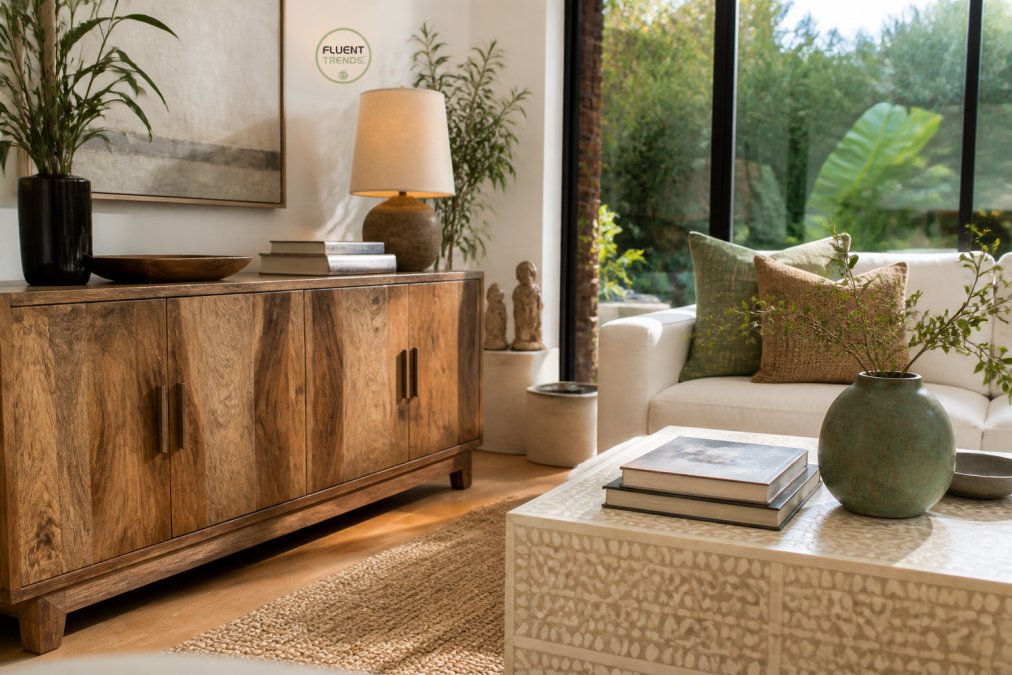
Think about what actually wears out. Legs loosen. Veneer peels. Drawers sag. Solid wood doesn't do that, because there's no thin layer to fail.
A few things to check before you commit:
- Solid wood, not veneer. The listing should say "100% solid" if it's true.
- Joinery you can see. Dovetails and mortise-and-tenon joints outlast staples.
- Weight. A heavy piece usually means real material inside.
- Finish quality. Hand-applied finishes age; sprayed-on coatings chip.
The Amber Wavefront Artisan Solid Wood Sideboard is a good example of this thinking. It's hand-carved from 100% solid mango wood, not engineered substitutes. Its weight and grain variation reflect genuine craftsmanship, and it's designed to age well rather than wear out.
Fluent Trends carries a full collection of durable furniture for daily use if you want to see how this plays out across a room.
Sustainable Luxury Furniture Without the Greenwashing
Sustainable luxury furniture is well-made furniture with a documented supply chain. The "luxury" and the "sustainable" should describe the same object, not two different marketing stories.
Greenwashing is when a brand makes an environmental claim it can't back up. It's common in home decor because the claims are hard to check and easy to print.
A Federal Trade Commission guide on environmental marketing claims sets the standard for how these claims should be made. Vague words like "eco-friendly" without specifics are a red flag.
Edessa Bone Inlay Coffee Table →
How to Verify Ethical Claims Before You Buy
Verification is a five-minute job if you know where to look. Here's the checklist to run before any purchase.
- Does the product page name the material origin?
- Is there a certification number you can look up?
- Does the brand name its maker partners?
- Are there real customer reviews with photos?
- Does the return policy cover damage in transit?
- Is the shipping process explained, including customs?
If a brand passes four of six, that's a good sign. If it passes two, keep looking.
The Citizenry Alternative in Practice: What to Look For
The best Citizenry alternative is a brand that pairs a curated aesthetic with proof you can check. Style gets you in the door. Verification keeps you there.
So what should you actually look for in a replacement?
- A tight, edited selection. Fewer pieces, chosen with intent.
- Product pages with real detail. Materials, dimensions, care, and origin.
- A clear point of view. The collection should feel like a room, not a warehouse.
- Pieces that mix across styles. Minimalist and bohemian should coexist.
- Honest lead times. Handmade takes longer, and the brand should say so.
That last one trips people up. Handcrafted items are often made in small batches, so restocking isn't guaranteed. A brand that tells you this upfront is being straight with you.
Here's a quick comparison of how the pieces in a considered collection differ by role:
| Piece | Material | Best For | Price |
|---|---|---|---|
| Edessa Bone Inlay Coffee Table | Solid mango wood, bone inlay | Living room focal point | $1,239.98 |
| Amber Wavefront Sideboard | 100% solid mango wood | Entryway storage and styling | $1,454.98 |
| Blackwash Wall Mirror | Mango wood, 4mm glass | Entryway or bedroom anchor | $400.98 |
| Wavy Wall Mirror | Mango wood, full length | Dressing areas, open plans | $546.22 |
| Faceted Gold Aluminum Vase | Premium aluminum | Shelf and console styling | $71.72 |
| 216 Ceramic Vase | Ceramic, matte finish | Mantels and tabletops | $29.95 |
Notice the range. You can start with a vase and build toward a sideboard over time. That's how a curated home actually comes together.

Budget-Conscious Ethical Shopping in Home Decor
Budget-conscious ethical shopping means buying fewer, better pieces and letting them do more work. It's not about spending less per item. It's about spending once.
The math is simple. A cheap table replaced three times costs more than one solid table bought once. Ethical shopping and smart shopping are the same habit.
Where to start if money is tight:
- Begin with accents. A handcrafted vase changes a room for under $100.
- Buy the anchor piece last. Live with the space before you commit.
- Watch for small-batch drops. They sell out, so timing matters.
- Skip the trend cycle. Buy what you'll still like in five years.
The Agadir Decorative Vessel is a good entry point. It's handcrafted in Portugal and brings warm, earthy tones without a big commitment. The Amil Vase, handmade in Tonalá, Mexico, does the same job for a similar spend.
A U.S. Environmental Protection Agency resource on reducing waste makes the broader case well. Buying durable goods and keeping them longer is one of the most effective things a household can do.
The Impact of Fast Furniture and the Circular Economy
Fast furniture is low-cost, trend-driven furniture designed to be replaced quickly. It is the home decor version of fast fashion, and it ends up in landfills at the same rate.
The circular economy is the alternative. It is a system where products are made to last, repaired when possible, and passed on rather than thrown out.
Here is where most sustainability conversations stop short. They focus on buying. They skip disposal.
End-of-Life Disposal: What Actually Happens to Old Decor
Most furniture does not get recycled. It gets landfilled. The reason is simple: mixed materials are hard to separate. A sofa with wood, foam, fabric, and metal staples is not recyclable in any practical sense.
So think about end of life before you buy:
- Can it be repaired? Solid wood can. Particleboard usually cannot.
- Can it be refinished? Hand-finished pieces can be sanded and re-oiled.
- Can it be passed on? Quality pieces resell. Cheap ones do not.
- Can it be recycled? Metal and glass yes. Mixed composites, rarely.
A solid mango wood sideboard can be sanded and re-oiled for decades. A bone inlay coffee table can be repaired if a piece comes loose. Boucle upholstery can be reupholstered. These are the pieces that stay out of landfills.
The Shipping Footprint Nobody Talks About
Shipping footprint matters too, and it is the angle almost nobody covers. A piece made overseas and shipped by sea has a very different footprint than one made nearby. Ask where it ships from and how.
Some brands consolidate shipments to reduce trips. Others do not. A Portugal-woven bedding set shipped by sea has a lower footprint per item than a single vase flown overnight. That is just math.
That is not a reason to avoid global artisans. It is a reason to ask better questions. Does the brand consolidate shipments? Does it offer slower shipping options? Does it tell you where the piece ships from?
A U.S. Environmental Protection Agency resource on reducing waste makes the broader case well. Buying durable goods and keeping them longer is one of the most effective things a household can do.
How to Build Circularity Into Your Home
Circularity is not just about buying better. It is about keeping what you buy in use longer. Here is how to do that:
- Buy pieces that can be repaired. Solid wood, hand-finished surfaces, and replaceable hardware.
- Learn basic care. Oil wood once a year. Rotate cushions. Fix loose joints early.
- Pass pieces on. Sell, donate, or gift. Quality pieces hold value.
- Upcycle before you replace. A new finish or new hardware can reset a piece.
- Avoid trend cycles. Buy what you will still like in five years.
The goal is not perfection. It is keeping one more piece out of the landfill. That is a win.
Fluent Trends builds its Artisan Collection around this idea: pieces that carry a cultural narrative and still fit a contemporary room. The durable furniture for daily use collection is a good place to see how this plays out across a room.
How to Curate a Conscious Home That Feels Personal
A conscious home is one where every piece has a reason to be there. Not a theme. A reason.
This is the part that separates a styled room from a showroom. Showrooms repeat a formula. Real homes layer meaning.
Start with one anchor and build outward:
- Pick the piece you love most. Usually a table, a mirror, or a sideboard.
- Choose a material story. Wood, ceramic, and natural fiber work together.
- Add texture, not color. Boucle, jute, and linen add depth without noise.
- Leave negative space. Empty walls make the pieces you own matter more.
- Add one thing with a story. A handcrafted piece from a named maker.
The minimalist-versus-bohemian worry is overblown. A sculptural mango wood mirror reads clean in a modern space and warm in a layered one. The Blackwash Wall Mirror's irregular silhouette does both, and its blackwash finish sits easily against neutral palettes.

Bone inlay furniture works the same way. The Edessa Coffee Table's geometric Nordic-inspired pattern reads modern. The hand-applied inlay reads artisanal. That combination is hard to fake and easy to live with.
Fluent Trends builds its Artisan Collection around exactly this idea: pieces that carry a cultural narrative and still fit a contemporary room.
The hard part isn't finding beautiful home decor. It's finding pieces you can trust, verify, and keep for years.
Frequently Asked Questions
How can I identify truly sustainable artisan-made furniture?
Look for solid wood construction rather than veneer or engineered substitutes. Check whether the brand names its materials, such as 100% solid mango wood or sustainably sourced hardwood. Ask about supply chain transparency and whether artisans are paid a living wage. Certifications like GOTS for organic textiles and OEKO-TEX for non-toxic finishes help verify claims. A trustworthy brand will explain where pieces are made and how materials are sourced without vague language.
What materials should I look for in durable, eco-friendly home decor?
Solid mango wood, reclaimed wood, organic cotton, wool, jute, and linen are strong choices. These natural fibers and renewable resources hold up well and biodegrade more easily than synthetic alternatives. For bedding, look for organic cotton and OEKO-TEX certification to confirm the fabric is non-toxic and hypoallergenic. For furniture, solid wood pieces with hand-carved or hand-finished details resist wear better than particleboard covered in veneer.
Are there home decor brands that prioritize fair trade and women-owned businesses?
Yes. Some brands build their entire model around artisan-made goods, fair wages, and women-owned workshops. You can verify these claims by checking whether the brand names its maker partners, publishes social impact reports, or holds Fair Trade certification. Brands that support global artisans and preserve craft heritage typically share maker stories and production details openly. If a brand cannot explain who made the piece and how, treat the ethical claim with caution.
How does artisan-made furniture compare to mass-produced decor?
Artisan-made furniture is crafted in small batches, often by hand, which means each piece carries unique variation in grain, finish, and detail. Mass-produced decor is standardized and often built with engineered wood or veneer that wears faster. Handcrafted pieces from sustainably sourced solid wood tend to last decades with proper care. They also support ethical manufacturing and preserve traditional techniques that mass production cannot replicate.
How can I avoid greenwashing when shopping for sustainable home decor?
Ask specific questions. A brand making real sustainability claims will name its certifications, materials, and production methods. Look for GOTS-certified organic textiles, OEKO-TEX labels, Fair Trade certification, and details about responsible sourcing. Vague phrases like eco-friendly or green without proof are a warning sign. Check whether the brand discusses carbon footprint, end-of-life disposal, or circular economy practices. Transparency about supply chains is the clearest signal that a brand is genuine.