

Curated Artisan Home Decor Collections: 2026 Guide
Yuatinia LeakTable of Contents
- Why Curated Artisan Home Decor Collections Are Worth It
- How We Evaluated These Handcrafted Home Decor Pieces
- 1. Chubby Vase and 216 Ceramic Vase: Earthy Clay Meets Minimalist Matte
- 2. Stacked & Chic Vase and Cosmos Vases: Statement Pieces With a Story
- 3. Agadir Decorative Vessel: Artisan Home Decor Brands Done Right
- 4. Mukhendu Bone Inlay Frame and Chayana Wind Chime: Small Accents, Big Impact
- 5. Hand Carved Sideboard: Durable Furniture for Daily Use
- Is Sustainable Home Decor Worth the Investment?
- How to Style Curated Artisan Home Decor Collections
- Conclusion: Where to Start With Artisan Home Decor
- Frequently Asked Questions
Last Updated: October 5, 2026
Why Curated Artisan Home Decor Collections Are Worth It
Curated artisan home decor collections solve that problem. They bring you pieces made by hand, built to last, and full of story. At Fluent Trends, we built our Artisan Collection around one belief: your home should feel personal, not catalog-ordered.
Here is the difference. A factory vase is identical to ten thousand others. An artisan vase carries the maker's fingerprint in every curve. That matters when you walk past it daily.
We keep our selection tight on purpose. Fewer pieces, better pieces, each one traceable to a real workshop. You shop with intention instead of scrolling endlessly.
How We Evaluated These Handcrafted Home Decor Pieces
We judged every piece against five practical standards. No hype, no filler.
- Material honesty: solid wood, real clay, natural fiber. Nothing pretending to be something else.
- Construction quality: joinery, glazing, and finishing that hold up to daily life.
- Provenance: we know the maker, the region, and the technique.
- Versatility: does it work in a minimalist room and a layered one?
- Care requirements: simple maintenance beats fragile showpieces.
Durability carried the most weight. A decorative object you replace every year is not a good buy, no matter how pretty it looks on arrival.
1. Chubby Vase and 216 Ceramic Vase: Earthy Clay Meets Minimalist Matte
These two vases prove that small ceramic pieces can anchor an entire shelf. The Chubby Vase ($99) comes from Al Centro Ceramica. It is wheelthrown from a blend of local clays and glazed only inside. The earth tones come from the kiln itself, not from paint.

That means no two are identical. The same batch can produce a range of shades. We think that is the point.
The 216 Ceramic Vase ($29.95) takes a different route. Two matte textures on the outside, a glossy interior, and clean lines throughout. At 7.5 inches tall, it fits mantels and nightstands without crowding them.
What Makes These Ceramic Vases Stand Out
Honest materials and honest variation. The Chubby Vase uses clay pigment instead of colored glaze, so the surface reacts to fire and heat. The 216 pairs matte and gloss for quiet contrast.
Both work in modern, minimalist, and earthy rooms. Both clean with a soft cloth. Pair them together at different heights for an instant vignette.
2. Stacked & Chic Vase and Cosmos Vases: Statement Pieces With a Story
Scale changes a room. The Stacked & Chic Vase ($275) stands 15.5 inches tall with a matte glaze and subtle speckles. It is watertight, so fresh blooms are an option. It is also handcrafted in Portugal, which brings us to a material story worth telling.
The Cosmos Vases ($295) go celestial. Each one is made from recycled aluminum with gold-plated detailing and a hand-applied starry pattern. Oyster and taupe enamel finishes keep them grounded. No two are exactly alike, and that is celebrated, not corrected.
Portugal-Woven Craft and Recycled Aluminum
The same care shows in our Portugal-woven bedding, where organic cotton and OEKO-Tex certified processes matter as much as the weave.
Recycled aluminum tells a similar story. Old material becomes a sculptural object with a gold finish. Low-waste by design, beautiful by result.
3. Agadir Decorative Vessel: Artisan Home Decor Brands Done Right
The Agadir Decorative Vessel ($135) is what happens when restraint meets color. An earthy honey base flows into a deep glossy green top. It measures 8 inches in diameter and sits beautifully on a shelf, mantel, or table.
It is not watertight, so treat it as sculpture. That is not a flaw. It is a clear instruction.
What separates real artisan home decor brands from marketing copy? Transparency. We tell you it is handcrafted in Portugal. We tell you how to clean it. We tell you it is decorative, not functional. You decide with full information. Understanding the provenance of these pieces often inspires a deeper appreciation for the raw craft supplies that form the foundation of every unique design.
4. Mukhendu Bone Inlay Frame and Chayana Wind Chime: Small Accents, Big Impact
Small pieces carry a room's personality. The Mukhendu 5x7 Picture Frame ($69) brings traditional Old Delhi bone inlay into a modern, grounding design. Ethically sourced bone tile meets a gold-finish brass bar. A two-way easel and d-ring mean it sits or hangs.
The Chayana Wind Chime ($25.50) is the most affordable way to add meaning. A crescent moon charm in natural mother of pearl hangs from a jute loop. Artisans shape and tune each bell by hand using traditional techniques.
Hang it indoors or under a covered patio. It makes a thoughtful housewarming gift too.
5. Hand Carved Sideboard: Durable Furniture for Daily Use
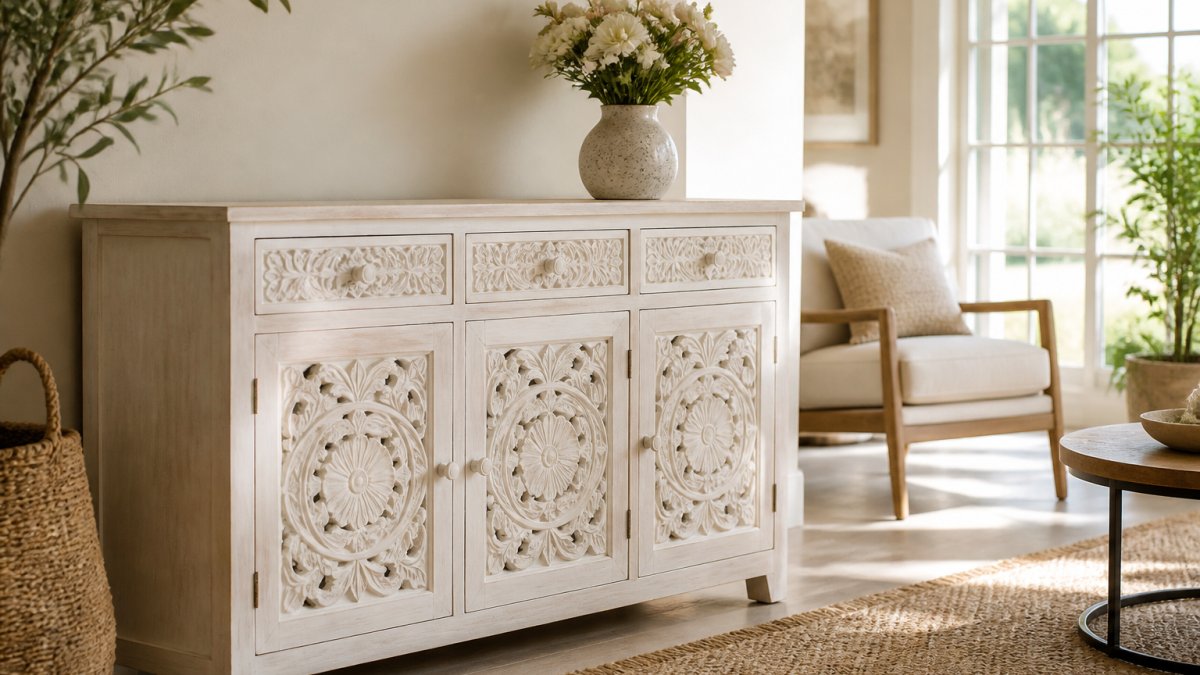
The Hand Carved Sideboard ($1,209.99) is our answer to disposable furniture. It is built from reclaimed acacia wood by skilled artisans, with hand-carved floral detailing and an antique white finish. Two doors and three drawers handle real storage.
Solid wood construction holds up in busy, high-traffic rooms. Iron hardware adds a rustic edge. At 60 inches wide, it works in entryways, dining rooms, and living rooms alike.
This is furniture built to last, the kind you pass down rather than replace. If you want more pieces in this spirit, browse our durable furniture for daily use collection. You will find the same standard: solid materials, honest joinery, and finishes that survive daily life.
Is Sustainable Home Decor Worth the Investment?
Yes, when the piece outlasts three cheap alternatives. But let us get specific. Sustainable home decor is not a label you slap on a product page. It is a set of material choices you can actually verify.
Start with the fiber. Organic cotton skips the synthetic pesticides used on conventional cotton. Milk and casein fiber is a protein-based textile that feels soft and breathes well. It is also hypoallergenic. OEKO-Tex certification means the finished fabric has been tested for harmful substances. That is a standard you can look up, not a marketing phrase.
Then look at the wood. Acacia wood is dense, water-resistant, and takes a hand-carved detail beautifully. Seesham wood is a hardwood that holds its shape in humid rooms. Both are sustainably sourced when the supplier replants and documents the harvest.
Now the practical case. A hand-carved acacia sideboard that lasts twenty years costs less per year than four cheap cabinets that sag and peel. Add easy care, and the math favors quality every time. A soft dry cloth handles most dust. Mild soap and water handles the rest.
We also look at who benefits. Our collection supports women-owned businesses and global makers through fair, consistent work. That is a supply chain you can feel good about.
One more thing. Durability is the most sustainable feature of all. A piece you keep for a decade beats a piece you replace every two years. That is true for boucle furniture, bone inlay furniture, and every Portugal-woven bedding set. Buy once, care for it simply, and let it age well.
How to Style Curated Artisan Home Decor Collections
Start with one anchor piece per room, then build outward. Here is the method we recommend.
| Room | Anchor Piece | Second Layer | Finishing Touch |
|---|---|---|---|
| Living room | Hand Carved Sideboard | Ceramic vases at varied heights | Bone inlay frame on top |
| Bedroom | Stacked & Chic Vase | Portugal-woven bedding in neutral tones | Agadir vessel on the nightstand |
| Entryway | Agadir Decorative Vessel | Woven basket for keys and mail | Wind chime near the door |
| Dining room | Cosmos Vases as a pair | Organic cotton table linens | Terracotta planter with herbs |
Three rules keep it cohesive. Repeat one material across the room. Vary heights, never widths. Leave empty space so each piece breathes.

Group in odd numbers. Three objects of different heights read better than four of the same size. Mix matte and glossy finishes for depth.
If your space leans minimalist, choose clean lines and neutral clay tones. If it leans warm and layered, add boucle textures and bone inlay. Both directions work with the same collection.
Now the part most styling guides skip. Before you buy, measure the space. A 15.5 inch vase needs breathing room on a shelf. A 60 inch sideboard needs a wall at least 72 inches wide. Write the dimensions down. Bring a tape measure to the room.
Check the care instructions before checkout. Ceramic glazes usually wipe clean with a soft dry cloth. Bone inlay needs a dry brush and no harsh chemicals. Acacia and seesham wood prefer a damp cloth and a quick dry. Portugal-woven bedding in organic cotton and OEKO-Tex certified fabric can go in the wash on cold. Milk and casein fiber blends need a gentle cycle and low heat.
Think about lead times too. Handmade pieces are often made to order. A hand-carved sideboard may take several weeks to arrive. That is normal for artisan work.
Conclusion: Where to Start With Artisan Home Decor
The hardest part is choosing your first piece. Pick one object you will see every day, like a vase on the kitchen counter or a frame by the bed. Live with it for a month. You will quickly learn what your room has been missing.
At Fluent Trends, we make that first step easy. Our Artisan Collection is ethically made, sustainably sourced, and handcrafted with real materials like reclaimed acacia wood, organic cotton, and OEKO-Tex certified textiles. Every piece supports women-owned businesses and global makers. Every piece is built to last, not to be replaced.
Start with one vase. Add the sideboard when you are ready. Shop Now and bring home something with a story.
Frequently Asked Questions
What makes home decor artisan-made?
Artisan-made home decor is created by skilled makers who shape each piece by hand, often using traditional techniques passed down through generations. The Chubby Vase, for example, is wheel-thrown by Al Centro Ceramica using local clay. You can see the maker's touch in subtle variations in color, texture, and form. These are not factory-stamped reproductions. Each piece carries the mark of the person who made it, which is why no two are exactly alike.
How can you tell if handcrafted home decor is well made?
Look for solid construction, natural materials, and details that show care. The Hand Carved Sideboard uses reclaimed acacia wood with hand-carved floral detailing and iron hardware. Check for weight, joinery, and finish consistency. A well-made piece like the Stacked & Chic Vase from Portugal has a matte glaze with subtle speckles that holds up over time. Ask about materials, origin, and care instructions before you buy.
What materials are best for durable furniture?
Solid wood like reclaimed acacia and seesham wood holds up best in high-traffic spaces. The Hand Carved Sideboard is built from reclaimed acacia with solid iron hardware, designed to handle daily use in entryways and dining rooms. Look for pieces with hand-finished surfaces and sturdy joinery. Materials like bone inlay, brass, and terracotta also add durability when crafted well. Avoid particleboard and veneers if you want furniture that lasts decades.
Is handmade home decor more sustainable?
Handmade decor often uses traditional low-waste methods and natural materials. The Wavy Planter is made-to-order in Honduras, which reduces overproduction. The Agadir Decorative Vessel is ethically handcrafted in Portugal using sustainable practices. Reclaimed acacia wood in the sideboard gives new life to old timber. Look for OEKO-Tex certified textiles and organic cotton when shopping for sustainable home decor. These choices support both the planet and the artisans behind each piece.
How do you style artisan decor without making a room feel cluttered?
Start with one statement piece per surface. A single Stacked & Chic Vase on a mantel or the Agadir Decorative Vessel on a shelf creates a focal point. Group smaller items like the Mukhendu picture frame and Chayana wind chime in odd numbers for balance. Stick to a cohesive color palette: earth tones, matte finishes, and natural textures. Let each handcrafted piece breathe. The goal is a layered look, not a crowded one.