

Ethical Decor for Small Business: 9 Pieces That Work
Yuatinia LeakTable of Contents
- Why Ethical Decor Matters for Your Business Space
- Quick Comparison: Ethical Decor Pieces for Small Businesses
- 1. Handwoven Rectangular Sisal Rug: Grounding Your Space
- 2. Lag Lamp Pendant Light: Organic Cotton Lighting That Lasts
- 3. Adu Planter: Hand-Carved Wood That Resists Damage
- 4. Bamboo Folding Desk: Sustainable Furniture for Daily Use
- Sustainable Home Decor Brands That Back Up Their Claims
- Women-Owned Home Decor Brands Changing the Game
- Fair Trade Home Goods: Verifying What's Real
- Conclusion: Build Your Business with Pieces That Matter
- Frequently Asked Questions
Last Updated: October 10, 2026
Why Ethical Decor Matters for Your Business Space
Your storefront tells a story before customers walk through the door. Ethical decor small business choices aren't just about aesthetics. It's about building trust with people who care where things come from and who made them.
When you choose handcrafted pieces for ethical decor small business spaces, you signal something real. Your space reflects values that matter to conscious consumers. They notice. They remember. They come back.
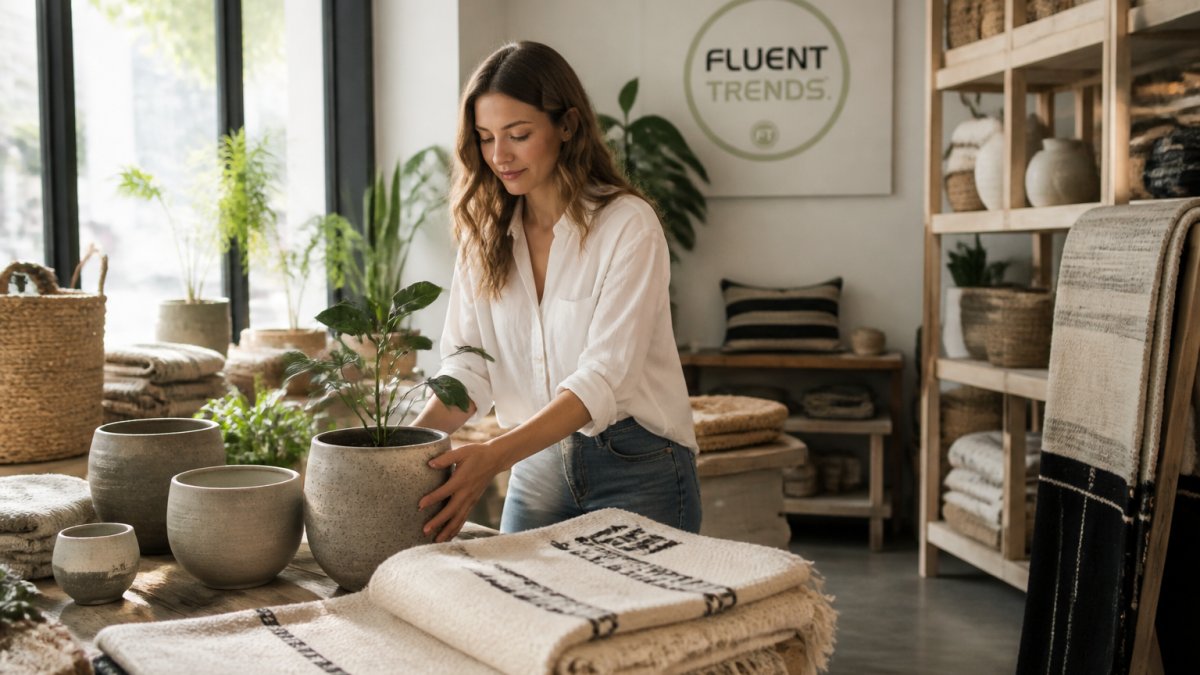
At Fluent Trends, we've watched small business owners transform their spaces with pieces that actually last. Not just visually, but structurally. Handwoven rugs from Rwanda. Hand-carved planters from Ghana. Organic cotton lighting from New York artisans. These aren't trendy purchases. They're investments in durability and authenticity.

The math is simple. A cheap rug falls apart in two years. You buy another. A handwoven sisal rug lasts decades. Same with furniture. Bamboo desks built to last withstand daily use without warping or splitting. Sheesham wood, with its Janka hardness score around 1,410, resists denting far better than softer woods. It absorbs the impacts of daily business life without chipping.
Your customers feel the difference between a space filled with disposable decor and one built with intention. Ethical pieces signal quality. They suggest you care about craft. About people. About lasting value.
Quick Comparison: Ethical Decor Pieces for Small Businesses
| Piece | Best For | Price Range | Key Benefit |
|---|---|---|---|
| Handwoven Sisal Rug | Grounding large spaces | $1,400 | Hypoallergenic, lasts decades |
| Organic Cotton Pendant | Creating ambiance | $540 | Sustainable materials, warm glow |
| Hand-Carved Planter | Display and character | $170 | Durable wood, artisan-made |
| Bamboo Folding Desk | Flexible workstations | $164.99 | Space-saving, sustainably sourced |
| Handwoven Napkins | Table settings | $99 | 100% cotton, artisan-loomed |
1. Handwoven Rectangular Sisal Rug: Grounding Your Space
A sisal rug anchors a room. It defines where customers pause. Where they feel welcome.
The Handwoven Rectangular Sisal Rug from Fluent Trends measures 80 by 120 inches. That's large enough to ground a full seating area or define an open-plan retail space. Handwoven from sisal fiber, extracted from Agave sisalana plant leaves, it's one of the strongest natural fibers available.
Here's what matters for your business: it's hypoallergenic, chemical-free, and dust mite resistant. No harsh treatments. No off-gassing into your storefront air. Customers with sensitivities won't react. Your space feels clean.
The rug resists wear because of how it's constructed. Flatweave means no pile to crush or shed. Artisans in Rwanda handwove each piece, which means no two are identical. That uniqueness becomes part of your brand story.
Care is straightforward. Vacuum using suction only, without the beater bar. Blot spills immediately. Rotate it 180 degrees every six months to ensure even wear. Professional dry cleaning handles deep cleaning when needed.
2. Lag Lamp Pendant Light: Organic Cotton Lighting That Lasts
Lighting shapes how customers experience your space. The wrong light feels cold. Harsh. Unwelcoming.
The Lag Lamp Pendant Light uses three translucent layers of unbleached, organic cotton. Each layer glows gently, creating warmth without the harshness of standard LED fixtures.
What makes this different: it's handcrafted by artisans in New York and Wisconsin. Organic cotton reflects Fluent Trends' commitment to sustainable practices. Just pure cotton that filters light beautifully.
You choose how to install it. The hardwired version includes a sleek black canopy for permanent placement. The plug-in option offers flexibility if you rearrange your space or move locations.
The light creates ambiance that encourages customers to linger. But beyond the psychology, this lamp simply lasts. Organic cotton doesn't degrade like synthetic fabrics. Proper care means dusting with a soft, dry cloth and avoiding harsh cleaners.
3. Adu Planter: Hand-Carved Wood That Resists Damage
A planter does more than hold plants. It's a statement about craftsmanship.
The Adu Planter is hand-carved from Sese wood in Ghana. Dimensions are 9.5 inches wide by 9.5 inches high. The artisans stain it using "soot," a traditional Ghanian method where they gather soot, boil it, filter it, and apply it as a natural stain. Then they finish it with wax polish.

Sese wood is dense and stable. Once properly seasoned, it resists warping, twisting, and splitting. The joints stay tight for decades. That matters in a business environment where pieces take daily handling and temperature fluctuations.
The heartwood produces natural compounds toxic to dry-wood termites and fungi. It protects itself from the inside out without chemical treatments.
Each piece varies slightly due to handmade nature. That's not a flaw. It's proof of authenticity. Your customers see that variation and understand they're in a space that values real craftsmanship.
Care is simple. Wipe clean or hand wash, then dry fully. Apply food-quality mineral oil every few months when the wood looks dry. Let it absorb for five to ten minutes, then wipe off excess. That's it.
4. Bamboo Folding Desk: Sustainable Furniture for Daily Use
Small business spaces demand flexibility. Your desk needs to work hard during business hours and disappear when you need the space back.
The Bamboo Folding Desk is crafted from premium, sustainably sourced bamboo with a walnut finish. It folds down to just 0.2 square meters for storage behind doors or in closets. When opened, it provides a sturdy surface for laptops, paperwork, and daily work.
Bamboo is stronger than many hardwoods. It's also renewable. Bamboo grows in three to five years, compared to decades for traditional timber. This desk represents sustainable furniture for daily use without compromise on durability.
The construction uses reinforced steel hinges. They withstand repeated folding without loosening. The open design includes a top platform for lamps and phones, plus integrated shelves for books and supplies. Everything you need stays organized and accessible.
It works in bedrooms, apartments, dorm rooms, and small offices. Whether you're working from home, running a side business, or managing client meetings in tight quarters, this desk adapts. The walnut finish complements both modern and traditional aesthetics.
Free shipping comes standard. That removes friction from the purchase decision for something this size.
Sustainable Home Decor Brands That Back Up Their Claims
Not every brand claiming ethics actually delivers. Verification matters.
Look for transparency about supply chains. Where are pieces made? Who makes them? What are the working conditions? Fluent Trends partners with artisans in Rwanda, Ghana, Kenya, and Honduras. They disclose these partnerships clearly. You can trace where your money goes.
Fair wages are non-negotiable. Fluent Trends invests 100% of profits into education programs for the women who handcraft products and youth in their communities. Since 2007, they've provided over 1,100 artisans and 250 young people with employment opportunities, entrepreneurship training, and access to global markets.
That's not marketing speak. That's impact you can verify.
Look for certifications. OEKO-Tex certification means textiles are tested for harmful substances (OEKO-TEX® STANDARD 100). Powered by People designation means the brand prioritizes artisan welfare.
When you see these badges, they mean something. They're third-party verification, not self-awarded claims.
Women-Owned Home Decor Brands Changing the Game
Women artisans make up the majority of the global craft sector. Yet most lack access to export markets and reliable buyer relationships. That's a gap you can fill while building a better-looking business space.
When you buy from women-owned makers, you're not buying charity. You're buying superior products from people who've perfected their craft over decades. The artisans who create Fluent Trends pieces are predominantly women. The Ahwiaa Wood Carvers Association in Ghana includes women continuing centuries-old traditions. The weavers in Rwanda and Kenya are women building livelihoods through their craft.
But here's what matters for your business: women-owned makers often offer flexibility that larger manufacturers don't.
How to find women-owned makers in your region.
Start with local craft associations and maker networks. Many cities have guilds for ceramicists, weavers, woodworkers, and textile artists. These groups often have directories listing members, their specialties, and contact information. Call three to five makers who match your aesthetic.
Ask them directly: Do you work with small businesses? What's your lead time? What's your minimum order? Can you customize pieces? Women makers appreciate straightforward questions. They're used to running their own businesses and making decisions fast.
Check their social media and websites for process photos. Women-owned makers typically document their work. They post studio shots, work-in-progress images, and customer installations. This gives you a sense of their quality and whether they can deliver what you need.
Evaluating reliability and customization.
Before committing to a large order, place a small test purchase. Order one piece or a small batch. Pay attention to communication speed, quality, and whether the finished product matches what was promised. This tells you whether the maker is reliable enough for ongoing business.
Discuss lead times honestly. If you need pieces in two months, say so. Women makers often work on longer timelines because they handcraft everything. That's not a flaw. That's the reality of artisan work. Plan accordingly.
Ask about restocking. If you love a piece and want to order more in six months, can they reproduce it? Some makers keep detailed records so they can replicate pieces exactly. Others create new designs each season. Know which type you're working with before you commit.
Negotiating terms that work for both of you.
Women makers often price fairly but not aggressively. They're not trying to undercut competitors. They're trying to cover their costs and earn a living wage. Respect that. Don't ask for discounts just because they're small. Instead, ask about volume pricing if you're ordering multiple pieces.
Discuss payment terms. Many women makers need payment upfront or at 50/50 split because they buy materials before production starts. That's not unusual. It's how artisan businesses work. Budget accordingly.
Be clear about your needs. If you need pieces that can handle heavy commercial use without damage, say so. Makers can adjust materials and construction to meet durability requirements. Sheesham wood, with its Janka hardness score around 1,410, resists denting far better than softer woods. If you need that level of durability, the maker can source it. But they need to know upfront.
Building a long-term relationship.
When you find a maker whose work fits your space and whose reliability you trust, invest in the relationship. Order regularly. Pay on time. Refer other business owners. Share photos of how their pieces look in your space.
Women makers remember customers who treat them fairly. They'll prioritize your orders. They'll give you first access to new designs. They might even create custom pieces specifically for your business.
This is how you build a supply chain that's both ethical and practical. You're not just decorating your space. You're creating a direct relationship with someone whose craft you respect and whose livelihood depends on customers like you.
Fair Trade Home Goods: Verifying What's Real
When you're shopping for ethical decor, claims pile up fast. "Fair trade." "Sustainable." "Artisan-made." The problem is none of those words are legally protected. Anyone can use them.
Here's how to separate real from marketing noise.
Check for third-party certification marks. Fair Trade USA and Fairtrade International certify specific practices. OEKO-Tex certification means textiles are tested for harmful substances. Powered by People designation confirms artisan wages and working conditions. These badges cost money to earn and maintain. Brands that display them have skin in the game.
But here's the catch: smaller artisan groups sometimes skip certification because the cost is prohibitive. That doesn't mean they're unethical. It means they operate below the certification radar.
Ask for supply chain transparency. Request the maker's name, location, and photos of the workspace. Ethical brands celebrate their artisans. They show faces, workshops, and stories. If a company stays vague about "overseas partners" or "fair-trade cooperatives" without naming them, that's a signal to dig deeper.
Compare price against material and labor. A handwoven rug costs more than a machine-made one because human hands did the work. That's not a markup. That's the real cost. If a "handmade" piece costs suspiciously low, someone in the supply chain is absorbing the loss. Usually the maker.
Ask the seller directly: What percentage of your purchase reaches the artisan? Ethical brands answer this. They know the number because they track it.
Look for impact reporting. Fluent Trends publishes how many artisans they employ, where they're located, and what programs they fund. Since 2007, they've provided over 1,100 artisans and 250 young people with employment opportunities, entrepreneurship training, and access to global markets. That's verifiable impact, not aspirational language.
When you see a brand that reports employment numbers, education investments, or community programs, they're putting numbers behind their claims. Request this from any brand you're considering. If they don't have it, ask why.
Verify organic and natural material claims. "Organic cotton" should come with certification from organizations like GOTS (Global Organic Textile Standard). "Natural dyes" means plant-based, not synthetic. "Sustainably sourced wood" means the forest is managed for long-term harvest, not clear-cut. These terms have meanings. Brands using them should back them up with documentation.
Sheesham wood, for example, comes from managed forests in India where the tree is harvested selectively. The heartwood produces natural compounds toxic to dry-wood termites and fungi, which means it protects itself without chemical treatments.
Compare warranties and durability claims. A brand confident in ethical production usually backs it with a warranty. If a piece is handmade and built to last, the maker should guarantee it for years.
This matters for your business because durability is part of ethics. A cheap piece that falls apart in two years creates waste. A well-made piece that lasts decades reduces your total environmental footprint and your replacement costs.
Conclusion: Build Your Business with Pieces That Matter
Your business space is a reflection of your values. It's where customers decide whether to trust you.
Fluent Trends offers ethical decor pieces that work harder and last longer than mass-produced alternatives. The Handwoven Rectangular Sisal Rug grounds your space with hypoallergenic, durable fibers. The Lag Lamp Pendant Light creates warmth using organic cotton handcrafted by New York and Wisconsin artisans. The Adu Planter brings hand-carved authenticity with wood that resists damage for decades. The Bamboo Folding Desk provides sustainable, space-saving functionality for flexible work environments.
Each piece tells a story about where it comes from and who made it. Each piece supports women artisans and global makers building sustainable livelihoods. Each piece is built to last, which means you're not replacing decor every few years.
Start with one piece. Let it anchor your space. Then build from there. Your customers will notice the difference between a space filled with intention and one filled with convenience. Fluent Trends Ethical Decor Collection makes it easy to shop pieces you can feel good about.
Frequently Asked Questions
How can I tell if ethical decor for small business is actually sustainably made?
Look for third-party certifications like OEKO-Tex. Ask makers directly about materials, production methods, and where items are made. Real ethical brands share supply chain details without hesitation. Check if they mention specific artisan communities or fair wages. If a brand won't answer these questions, that's your signal to shop elsewhere.
What durable furniture for daily use works best in a busy business?
Choose pieces made from high-hardness woods like sheesham, which scores 1,410 on the Janka hardness scale and resists scratching better than teak. Look for reinforced joints, organic cotton textiles, and materials like sisal that handle foot traffic. Bamboo folding desks work well because they're sturdy yet flexible. Handwoven rugs from natural fibers last longer when properly cared for than mass-produced alternatives.
Which women-owned home decor brands actually support artisans fairly?
Fluent Trends partners with women-led artisan groups and invests 100% of profits into education programs for female makers. Look for brands that name specific communities, share maker stories, and guarantee fair wages. Avoid brands that use 'women-owned' as a marketing phrase without proof. Real ethical brands publish impact reports and let you trace your purchase back to the person who made it.
Why should I pay more for fair trade home goods?
Fair trade pieces last longer because they're handmade with care and quality materials. You're not just buying an object; you're supporting artisan livelihoods and preserving craft traditions. A handwoven rug from Rwanda or a hand-carved planter from Ghana will outlast cheaper imports. The durability alone saves money over time. Plus, your customers notice when your space reflects real values, not just trends.