

Homeware Decorations: 9 Curated Ideas for 2026
Yuatinia LeakTable of Contents
- Why Intentional Homeware Decorations Matter in 2026
- Artisan-Crafted Decor: The Heart of a Curated Home
- OEKO-Tex Certified Bedding and Hypoallergenic Comfort
- Boucle Furniture Trends: Texture That Transforms a Room
- Sustainable Sourcing: Organic Cotton, Bone Inlay, and Beyond
- Styling Homeware Decorations Room by Room
- Small-Space Solutions and the Psychology of Color
- Budget-Friendly DIY Decor Transformations
- Conclusion
- Frequently Asked Questions
Last Updated: September 24, 2026
Why Intentional Homeware Decorations Matter in 2026
Homeware decorations are the curated objects and textiles that give a house its character, from hand-painted ceramics to woven throws. At Fluent Trends, we have watched buyers move away from filling carts with disposable accents. They want fewer pieces, chosen with care. That shift defines how people shop for homeware decorations in 2026.
The reason is simple. A room assembled slowly feels calmer than one ordered in a single afternoon. Each object earns its place. Nothing shouts for attention. This guide walks through nine curated directions for the year ahead, from artisan craftsmanship to small-space styling.
Below, we show you exactly how to spot genuine handwork, choose safe textiles, and layer texture without clutter. The common mistake is buying decor before deciding how the room should feel. Start with the feeling. The objects follow.
Artisan-Crafted Decor: The Heart of a Curated Home
Artisan-crafted decor is any piece made substantially by hand, where the maker's decisions shape the final object. That definition matters because the word "handmade" gets stretched thin in retail copy. A genuinely crafted piece carries small irregularities. Those irregularities are the signature, not the flaw.
Consider how a hand-painted vase differs from a printed one. The brushwork varies. The glaze pools differently at the base. No two are identical, and that is the point. Mass-produced homeware decorations repeat perfectly. Handcrafted ones repeat beautifully.
How to Spot Genuine Handcrafted Pieces
Look for evidence of the maker's hand before you look at the price tag.
- Check the underside. Thrown pottery shows concentric rings; cast pieces show seams.
- Run a finger along edges. Hand-finished wood feels uneven in a good way.
- Ask about the maker. Real artisans have names, workshops, and a story.
- Compare two units. True handwork never matches exactly.
- Read the material list. Vague terms like "premium blend" usually signal factory output.
A common mistake is assuming a high price guarantees handwork. It does not. Ask questions instead.
OEKO-Tex Certified Bedding and Hypoallergenic Comfort
OEKO-Tex certification means a textile has been tested for harmful substances against published limit values. For bedding, that testing covers every thread, button, and dye. If you sleep eight hours a night against a fabric, this standard is not optional. It is basic diligence.
Hypoallergenic bedding goes further. It reduces the materials most likely to irritate sensitive skin. Organic cotton, washed linen, and milk or casein fibre all fit here. Casein fibre comes from milk protein and feels remarkably soft against the skin. It breathes well and resists the dust buildup that plagues synthetic fills.
Portugal-woven bedding deserves specific mention. Portuguese mills have woven linen and cotton for generations. The result is a tighter, cooler fabric that softens with every wash. When you shop for homeware decorations, bedding counts. It is the textile you touch most.
Boucle Furniture Trends: Texture That Transforms a Room
Boucle furniture remains the most requested texture of the year. Boucle is a looped, nubby fabric, usually woven from wool or a wool blend. It absorbs light rather than reflecting it. That single quality changes how a room feels at dusk.
The fabric works best on a single statement piece. A boucle armchair beside a linen sofa reads intentional. An entire boucle suite reads heavy. Pair it with smooth surfaces instead: a glass side table, a steel fruit bowl, a bare wood shelf.

Durability is the honest caveat. Looped weaves can pill where arms and backs get constant friction. Look for tight, dense loops and a firm backing. Commercial-grade furniture construction, the kind built for hotel lobbies, handles this far better than decorative-grade frames.
Sustainable Sourcing: Organic Cotton, Bone Inlay, and Beyond
Sustainable sourcing means the material, the maker, and the method all hold up to scrutiny. That is a high bar. Greenwashing thrives precisely because the bar is easy to fake. Certifications, named workshops, and traceable fibers are what separate a genuine claim from a slogan.
Most guides treat sustainability as a label. We treat it as a chain. Every link matters. Where the fiber grows. How it is processed. Who does the work. What happens to the offcuts. Break one link, and the whole claim weakens.
Organic Cotton: What the Label Actually Means
Organic cotton is grown without synthetic pesticides or fertilizers. That matters for the soil, the water, and the people who farm it. But the label alone does not tell you how the fiber was spun, dyed, or finished. Those steps can reintroduce chemicals.
Look for OEKO-Tex certification on the finished textile. That standard tests for harmful substances against published limit values. It covers every thread, button, and dye. If a brand claims organic cotton but cannot show OEKO-Tex or equivalent testing, the claim is incomplete.
Organic cotton also feels different. The fibers are often shorter and softer. It breathes well. It washes clean without the chemical residue that can irritate sensitive skin. For bedding, that difference matters. You sleep against it for eight hours a night.
Bone Inlay: Heritage Craft and Low-Waste Production
Bone inlay furniture shows how heritage craft and sustainability can align. Artisans cut and set fragments by hand into wood frames, a technique passed down through generations. The process is slow. It creates almost no waste, because offcuts become smaller inlay patterns. Each piece takes weeks, not minutes.
The material itself is a byproduct. Bone inlay typically uses bone that would otherwise be discarded. That is a different story from materials harvested specifically for decor. The craft turns waste into something beautiful and durable.
Durability is the other sustainability lever. A piece that lasts thirty years does not need to be replaced. That is the opposite of fast decor. When you invest in homeware decorations, favor pieces that will outlive the trend cycle.
Milk and Casein Fibre: The Quiet Alternative
Milk or casein fibre comes from milk protein. It feels remarkably soft against the skin. It breathes well and resists the dust buildup that plagues synthetic fills. For hypoallergenic bedding, it is a strong option.
The trade-off is care. Casein fibre needs gentle washing and low heat. It is not as forgiving as polyester. But it is renewable and biodegradable, which polyester is not. That trade-off is worth knowing before you buy.
Portugal-Woven Bedding: Why the Mill Matters
Portuguese mills have woven linen and cotton for generations. The result is a tighter, cooler fabric that softens with every wash. The weaving density is the difference. A tighter weave lasts longer and feels smoother against the skin.
When you shop for homeware decorations, bedding counts. It is the textile you touch most. A Portugal-woven set in organic cotton, OEKO-Tex certified, is the kind of piece that earns its place. It is not decorative. It is daily.
How to Spot Greenwashing
- Vague terms like "eco-friendly" with no certification
- Claims about one material but silence on the rest
- No named workshop or region of origin
- Prices that are too low for the labor described
- No information about end-of-life or repairability
Organic cotton, jute, wool, and linen round out a responsible material list. All are renewable, biodegradable, and produced without the heavy chemical load of synthetics. Pair them with commercial-grade furniture construction, and you get pieces that hold up to daily life. That is the real sustainability test. Not the label. The lifespan.
Styling Homeware Decorations Room by Room
Styling works best when each room gets one clear job. The living room should feel inviting. The bedroom should feel restful. Everything else follows from that. Get the function right, and the aesthetic settles into place.
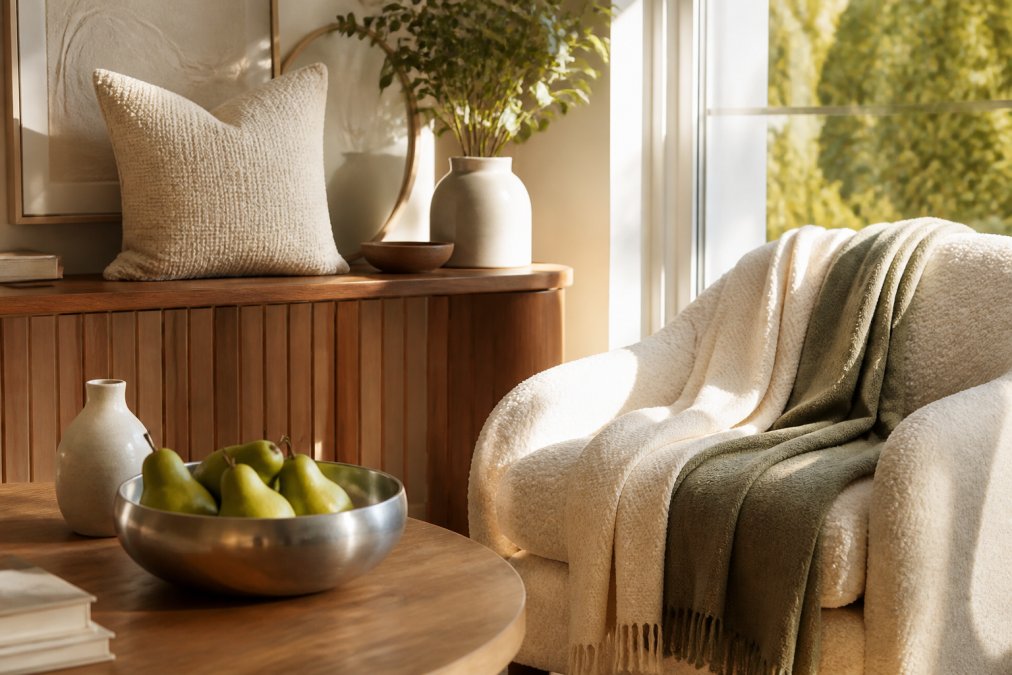
Living Room: Layering Textiles and Sculptural Accents
Start with a neutral base, then layer. A textured throw pillow in ivory cotton adds softness without introducing a new color. Sculptural accents, such as a bird's nest style steel bowl, give the eye somewhere to rest. Group objects in odd numbers. Three small pieces read better than four.
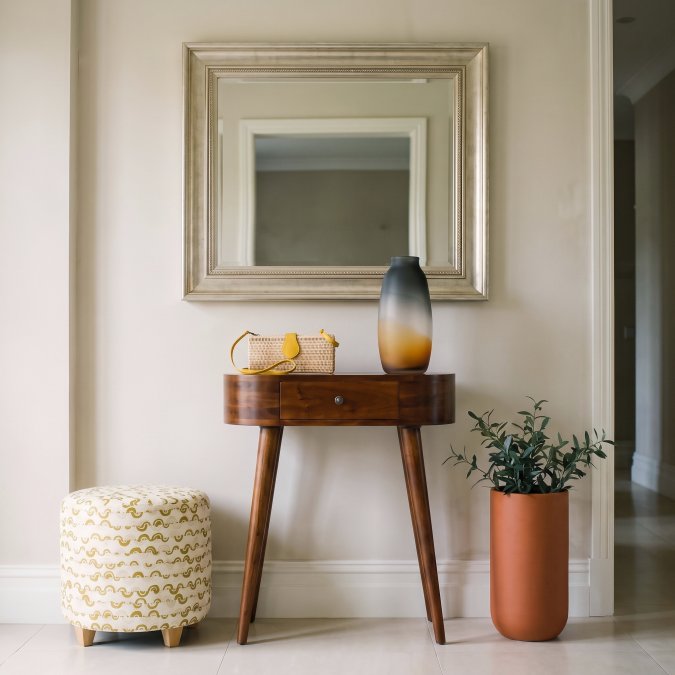
The Retro Curved Wood Console Table anchors this approach. Its 43-inch tabletop holds a lamp, a tray, and one sculptural object without crowding. Three pre-assembled drawers hide the clutter that ruins most styled rooms. Solid pine legs and a birch veneer top give it the durability daily life demands.
Bedroom: Portugal-Woven Bedding and Ambient Lighting
Bedrooms need restraint. Choose OEKO-Tex certified bedding in a single palette. Layer a light throw at the foot of the bed for texture. Ambient lighting should sit low and warm, never overhead. A small lamp on each nightstand beats a single bright ceiling fixture.
Keep decorative objects minimal here. One trinket tray for jewelry. One scented candle. One piece of wall decor above the headboard. The bedroom is not the place for a maximalist display.
Small-Space Solutions and the Psychology of Color
Color changes how large a room feels, and this is not opinion. Lighter values reflect more light and make walls recede. Deeper tones pull surfaces closer and create intimacy. Neither is wrong. The mistake is mixing both without a plan.
Here is the mechanism. Your eye reads contrast before it reads color. High contrast between walls and trim makes a small room feel chopped up. Low contrast makes the boundaries blur. That is why a monochromatic scheme reads larger. It removes visual stops.
For small rooms, choose one dominant tone and repeat it. Earthy tones such as clay, sand, and sage work especially well. They feel grounded and calm. Add contrast through texture instead of color. A boucle cushion on a linen sofa creates visual interest without visual noise.
Vertical storage is the other small-space lever. A console table with an open lower shelf holds baskets, books, or a folded throw. Wall-mounted shelves keep floors clear. Every surface you free up makes the room read larger.
But storage is not just about floor space. It is about sightlines. A clear path from door to window makes a room feel bigger than its square footage. Block that path with a chair, and the room shrinks. Move the chair, and it grows. Same room. Different feeling.
The Psychology of Color in Small Rooms
Color affects mood, and mood affects how you use a room. This is the part most guides skip. A room that feels calm gets used for rest. A room that feels energizing gets used for work. The color sets the tone before you place a single object.
Warm tones like terracotta and ochre raise the energy of a space. Cool tones like sage and slate lower it. Neutral tones like sand and bone sit in between. They let the objects do the talking. That is why neutral walls work so well with handcrafted decor. The piece becomes the focal point, not the paint.
A common pattern is to choose a color you love, then wonder why the room feels off. The issue is usually saturation, not hue. A muted version of the same color reads calmer. A saturated version reads louder. Same color family. Different effect.
Small-Space Styling That Actually Works
Start with the largest surface you can control. In a small living room, that is usually the sofa or the rug. Choose one neutral base. Then layer texture on top. A Portugal-woven linen throw adds softness without adding visual weight. A boucle armchair adds depth without adding bulk.
Scale matters more in small rooms than large ones. A too-small rug makes a room feel disjointed. A too-large lamp overwhelms a side table. Measure before you buy. Most people guess, and most people guess wrong.
Mirrors are the oldest trick, and they still work. Place one opposite a window to double the light. Place one opposite a dark wall to soften the contrast. Avoid placing a mirror where it reflects clutter. It will double that too.
What to Avoid in Small Spaces
- Heavy curtains that block light and eat wall space
- Matching furniture sets that make the room feel like a showroom
- Too many small objects scattered on every surface
- Dark rugs on dark floors with no contrast
- Oversized art that crowds the wall it hangs on
A common mistake is buying storage to solve a clutter problem. Remove first. Buy second. That rule works in every room, at every size.
Budget-Friendly DIY Decor Transformations
You do not need a full renovation to change a room. Most transformations come down to three moves: swap, group, and light. Swap one tired accent for something handcrafted. Group existing objects into a single styled vignette. Change the lighting temperature from cool to warm.
Here is a simple weekend checklist.
- Clear every surface completely, then return only what you love
- Move one large object to a different room and see how it reads
- Group three small pieces on a tray instead of scattering them
- Swap cool white bulbs for warm ones in the main living space
- Add one textile with visible texture, such as a woven throw
- Rotate seasonal accents rather than buying new ones
A common mistake is buying storage to solve a clutter problem. Remove first. Buy second.
Conclusion
Curating a home takes patience, and the reward is a space that feels genuinely yours. Fluent Trends exists for exactly that kind of buyer. Our Artisan Collection brings together ethically made, handcrafted pieces that support women-owned businesses and global makers. You will find organic cotton textiles, Portugal-woven bedding, and bone inlay furniture made through traditional, low-waste techniques. Every piece is built for everyday beauty and meant to last. Shop now to discover our collection.
Frequently Asked Questions
What are the most popular homeware decorations right now?
Textured throw pillows, artisan-crafted ceramics, boucle furniture, and OEKO-Tex certified bedding lead current demand. Earthy tones and natural materials like organic cotton, jute, and linen dominate. Sculptural accents such as bone inlay boxes and hand-painted trinket trays add character. Ambient lighting and scented candles complete the layered look.
How do I style homeware decorations for a cohesive look?
Start with a neutral base, then layer textures and heights. Group items in odd numbers, mix materials like wood, steel, and organic cotton, and repeat one color across rooms. A 20-inch ivory cotton throw pillow can anchor a sofa while a steel fruit bowl adds contrast on the dining table. Keep surfaces uncluttered.
What are the benefits of choosing artisan-crafted decor?
Artisan-crafted decor supports women-owned businesses and preserves cultural heritage. Each piece carries unique details no factory can replicate. Traditional low-waste techniques reduce environmental impact. Materials like bone inlay and hand-painted finishes age gracefully. You invest in durability and a narrative that mass-produced items lack.
Why is OEKO-Tex certification important for home textiles?
OEKO-Tex certification confirms bedding and textiles are free from harmful substances. For hypoallergenic households, this matters. Portugal-woven bedding with OEKO-Tex approval combines old-world craftsmanship with verified safety. Organic cotton and milk/casein fibre options further reduce irritation risk. Always check labels before buying.
How can I update my decor on a budget?
Swap throw pillow covers instead of buying new inserts. Rearrange existing sculptures and trinkets. Add a steel fruit bowl or scented candle for a fresh focal point. Rotate seasonal accents from storage. DIY projects like painting a frame or reupholstering a stool cost little. Small changes shift the mood without new furniture.
The challenge is not finding decor. It is choosing pieces worth keeping for a decade. Fluent Trends curates luxury furniture and home decor that answers that question, from OEKO-Tex certified bedding to hypoallergenic casein fibre textiles and commercial-grade furniture built for daily use. Get started with Fluent Trends and build a home where every object earns its place.