

How to Choose Lighting Fixtures for a Unified Home
Yuatinia LeakQuick Summary
Choose lighting fixtures for a unified home by mapping each room's job first, then matching sizes and hanging heights. Pick two or three finishes and repeat them throughout the house. Keep color temperature consistent, and use dimmers so each room's light stays calm and cohesive.
- Write down each room's main use before you buy any lighting fixtures.
- Hang a pendant about 30 to 36 inches above the table surface.
- Choose two or three finishes and repeat them in every room.
- Aim for about 10 to 20 lumens per square foot for ambient light.
- Keep the same color temperature across living spaces for a connected feel.
Table of Contents
- Why Your Lighting Makes or Breaks a Cohesive Home
- Step 1: Map Each Room's Job Before You Shop
- Step 2: Get the Size and Height Right
- Step 3: Pick a Finish Palette and Stick to It
- Step 4: Set Lumens and Color Temperature Room by Room
- Step 5: Mix Lighting Styles Without Clashing
- Step 6: Plan Lighting for Open Floor Plans
- Your Next Step: Build a Room-by-Room Lighting Plan
- Frequently Asked Questions
Last Updated: November 7, 2026
Lighting can make or break a home that's supposed to feel pulled together. Walk into a room where the pendant, the lamps, and the sconces all look like they came from different stores, and you feel it right away. Choosing lighting fixtures for a unified home is less about finding the "perfect" light and more about making each piece feel like it belongs with the rest.
Here's the good news. You don't need a designer's eye or a big budget to get this right. You need a simple plan, a few measurements, and a willingness to let your fixtures share a common thread. Below, we'll walk through six steps that take you from a messy pile of ideas to a home where every light feels intentional.
Why Your Lighting Makes or Breaks a Cohesive Home
Lighting shapes how a room feels more than most people realize. A warm glow makes a space feel calm. A harsh, cold light makes it feel like an office. When every fixture in your home sends out the same kind of light, the whole house starts to feel connected.
That connection doesn't happen by accident. It comes from repeating a few key choices, like materials, finishes, and light color, from room to room. Think of it as a quiet thread that ties everything together.
Most homes fall apart in the lighting department for one simple reason: people shop one room at a time. They buy a bright white ceiling light for the kitchen and a warm brass lamp for the living room, then wonder why the house feels off. We'll fix that by planning first.
Step 1: Map Each Room's Job Before You Shop
Before you buy anything, ask one question for each room: what do I do here? A kitchen needs bright, focused light for cooking. A living room needs softer light for relaxing. A bedroom needs gentle light for winding down.
Write down the main job of each room. Then note the activities that happen there most often. This gives you a clear picture of what each space needs from its lighting.
Use this quick list to plan each room:
- Main use: Cooking, reading, working, relaxing, or sleeping
- Light levels: Bright, medium, or soft
- Light types needed: Overhead, task, or accent light
- Existing fixtures: What's already there and what stays
This simple map keeps you from buying too much or too little. It also helps you spot where one fixture can do double duty, which saves money and keeps the room calm.
Step 2: Get the Size and Height Right
Size and height are where most lighting mistakes happen. A fixture that's too small looks lost on a big wall. One that's too big overwhelms a small table. Getting the scale right makes the difference between a room that looks planned and one that looks random.
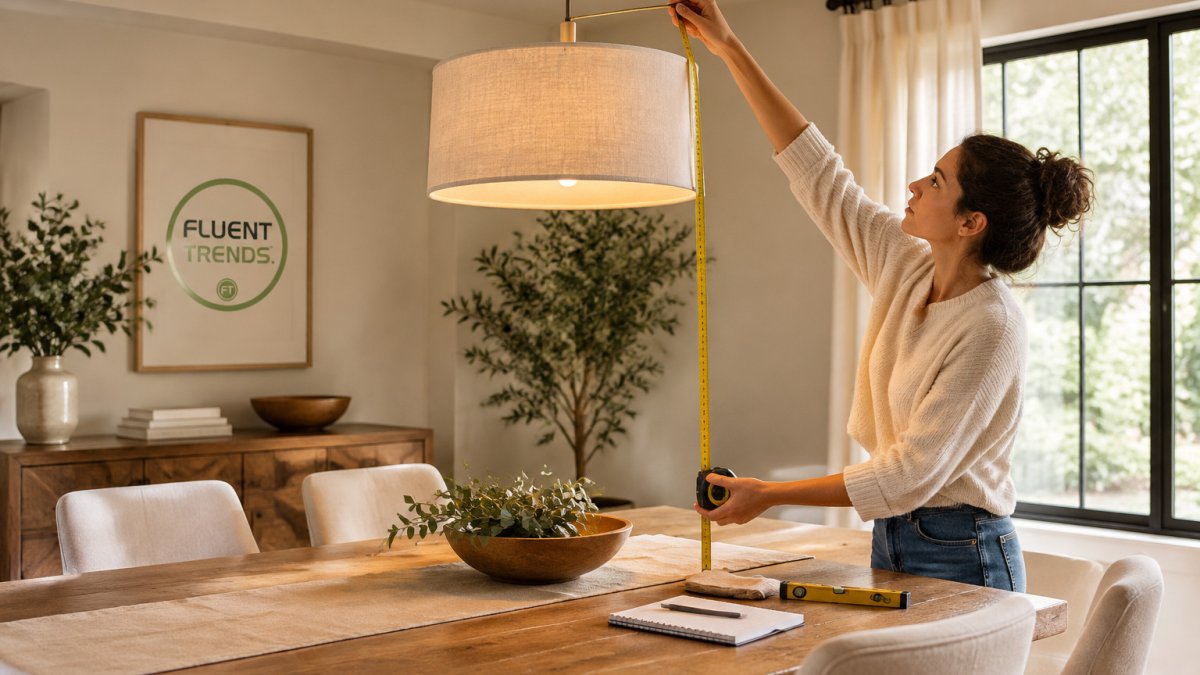
!A warm living room with a linen-shaded pendant hung at a comfortable height above a dining table, a homeowner measuring the space with a tape measure nearby
Sizing a Pendant or Chandelier
A good rule of thumb is to measure your table or the space below the fixture. Then match the fixture's width to the table or space. For a dining table, aim for a pendant about one-half to three-quarters of the table's width. This keeps the light balanced and the room feeling open.
Ceiling height matters too. In rooms with high ceilings, you can go a bit larger, since the fixture has more room to fill. In rooms with low ceilings, a smaller, slimmer pendant keeps things from feeling cramped.
Hanging Heights That Feel Right
For a pendant over a dining table, hang the bottom of the fixture about 30 to 36 inches above the table surface. Over a kitchen island, a range of 30 to 36 inches also works well. Measure from the table to the bottom of the shade, not the bottom of the bulb or the wire.
The Ripple Ceramic Pendant Light is a good example of how size and shape work together. Its compact 7.5 x 5 profile makes a strong statement without taking over a room.

Step 3: Pick a Finish Palette and Stick to It
Once the sizes are set, pick a small group of finishes and repeat them across the house. Two or three finishes are usually enough. More than that starts to look busy. The goal is continuity, not a matching set.
A simple palette might include brass, warm white, and natural fabric. Brass brings warmth, white keeps things light, and fabric adds softness. Every fixture in your home can lean on one of these three. You can also build a palette around wood tones, like acacia or sheesham, paired with one metal and one soft neutral.
Here is a framework that works in almost any home. Pick one dominant finish, one secondary finish, and one accent material. Repeat the dominant finish in every room. Use the secondary finish for larger pieces. Save the accent for small moments like a sconce or a lamp base.
For example, make brass dominant, warm white secondary, and natural fabric the accent. Then a brass pendant in the kitchen, a brass table lamp in the living room, and a brass sconce in the hall all feel related. The white shades and fabric textures keep it from looking heavy.
Wood is a finish too, and it carries real weight in a room. Acacia brings warm, streaked grain that pairs well with brass and black metal. Sheesham is denser and more uniform, with a Janka hardness around 1,410 lbf. That makes it harder and more scratch-resistant than teak, which scores around 1,000 lbf. When your lighting sits near furniture like that, the finishes should feel just as grounded.
Watch out: mixing too many metals, like chrome, brass, and black iron in one room, is the fastest way to make a home look scattered. If you love more than two metals, keep the third to a tiny accent like a switch plate or a single small lamp.
Texture counts as a finish too. Boucle, bone inlay, organic cotton, and Portugal-woven bedding all add softness that makes metal and wood feel warmer. A hypoallergenic, OEKO-Tex certified throw or pillow near a lamp can tie the palette together without adding another hard finish.
The Tokyo I Table Lamp fits neatly into this kind of plan. It comes in solid brass or recycled steel, with an unbleached cotton shade that diffuses a warm, even glow. The Lag Lamp Pendant Light uses unbleached organic cotton that layers well with the same neutrals.

Write your palette down before you shop. A simple note like brass, warm white, natural fabric, and acacia wood keeps every purchase on track. When a fixture does not fit the list, it is usually a sign to walk away.
Step 4: Set Lumens and Color Temperature Room by Room
Brightness and light color matter just as much as style. Two lamps can look identical in a store and feel totally different at home because of the bulbs inside them. This is where most guides stay vague. We will give you numbers you can actually use.
Brightness is measured in lumens. Color temperature is measured in Kelvin (Understanding LED Color-Tunable Products). Warm light sits around 2700K, which feels cozy and works well in living rooms and bedrooms. Neutral light, around 3000K to 3500K, suits kitchens and bathrooms. Cooler light above 4000K feels crisp and is better for workspaces.
Here is a simple room-by-room starting point. These are common ranges most practitioners find comfortable, not hard rules.
- Living room: 1,500 to 3,000 total lumens, layered across overhead and lamps, at 2700K
- Kitchen: 3,000 to 6,000 total lumens, with 3000K to 3500K over counters and islands
- Bedroom: 1,000 to 2,000 total lumens, at 2700K, kept soft and dimmable
- Bathroom: 2,000 to 4,000 total lumens, at 3000K to 3500K near mirrors
- Home office: 3,000 to 6,000 total lumens, at 3500K to 4000K for focus
- Hallway or entry: 1,000 to 2,000 total lumens, at 2700K to 3000K
A quick way to estimate is to aim for roughly 10 to 20 lumens per square foot for ambient light. Then add task light where you read, cook, or work. A 200 square foot living room, for example, lands around 2,000 to 4,000 lumens total when you combine the ceiling fixture and lamps.
Try to keep the same color temperature across your home. Mixing a warm 2700K bulb in one room with a cool 4000K bulb in the next can make the house feel disjointed, even when the fixtures match perfectly. Pick one temperature for living spaces and one for work areas, then repeat them.
Dimmers do more for a unified home than almost any other control. They let you drop brightness at night without changing bulbs. Look for dimmable LED bulbs and a dimmer rated for LED loads. Older dimmers built for incandescent bulbs can cause flicker or buzzing with LEDs.
Watch out: cheap LED bulbs often list a color temperature but drift cooler over time, so buy from a brand that states a tight Kelvin range and a high color rendering index.
Bulb shape matters too. A bulb that is too wide can peek out of a slim shade. Check the maximum wattage and bulb base on each fixture before you buy. The Tokyo I Table Lamp and Lag Lamp Pendant Light both work with warm, dimmable bulbs that keep the glow soft and even.
If you want to go further, smart bulbs and smart switches let you set scenes for dinner, reading, or winding down. They help unify lighting across rooms because you can match brightness and warmth from one app. Just confirm the bulb fits the fixture and the switch works with your chosen platform.
Here is a quick reference for the lumen and color temperature ranges covered above.
| Room | Total lumens | Color temperature |
|---|---|---|
| Living room | 1,500 to 3,000 | 2700K |
| Kitchen | 3,000 to 6,000 | 3000K to 3500K |
| Bedroom | 1,000 to 2,000 | 2700K |
| Bathroom | 2,000 to 4,000 | 3000K to 3500K |
| Home office | 3,000 to 6,000 | 3500K to 4000K |
| Hallway or entry | 1,000 to 2,000 | 2700K to 3000K |
Total lumens
Step 5: Mix Lighting Styles Without Clashing
You don't need every fixture to match. In fact, a home where everything matches can feel flat. The trick is to mix styles that share a common element, such as material, color, or shape.
For example, you can pair a clean-lined pendant with a more textured table lamp. Both work because they share a neutral tone or a natural material. A ceramic piece can sit next to a linen shade, and the two feel related even though they look different.
Here's a simple way to test a mix:
- Do the fixtures share at least one finish or color?
- Does each piece have a similar level of formality?
- Would the room still feel calm if you removed one fixture?
If you answered yes to all three, your mix is working. If not, swap one piece for something that shares more with the rest.
The Lag Lamp Pendant Light shows how this works. Its unbleached organic cotton layers pair naturally with the neutral tones in the Tokyo I, so the two feel related without looking copied.
Step 6: Plan Lighting for Open Floor Plans
Open floor plans make lighting harder. One big space has to handle cooking, dining, lounging, and sometimes working. Without a plan, the room can feel like it's lit by accident.
The fix is to split the open space into zones, even if there are no walls. Each zone gets its own light source. The dining area gets a pendant. The lounge area gets a floor lamp or table lamp. The kitchen gets task lighting under cabinets or over the island.
Each zone should have its own light level and color, but the fixtures should still share a finish or material. That shared thread keeps the open plan feeling like one home instead of several rooms squeezed together.
Keep the layers balanced. Use overhead light for general brightness, task light for close work, and accent lamps for mood. Together, these layers make a large space feel warm and easy to use.
Your Next Step: Build a Room-by-Room Lighting Plan
You now have everything you need to plan lighting for a unified home. Start by mapping each room's job, then set your sizes and heights. Pick a simple finish palette, set your light levels, and mix styles with a shared thread.
Write it all down in one place. A simple table or list for each room works well. Include the fixture type, size, finish, bulb color, and brightness. This plan becomes your shopping guide and keeps every purchase on track.
When you're ready to start, browse the Lag Lamp Pendant Light, the Tokyo I Table Lamp, and the Ripple Ceramic Pendant Light. You can also explore the Corduroy Handcrafted Stoneware Table Lamp, made in the USA, for a textured accent in any room.
Frequently Asked Questions
Do light fixtures need to match throughout a house?
They do not need to be identical, but they should share a finish palette and a design language. Pick two or three metals, such as brushed brass and matte black, and repeat them across rooms. Keep bulb color temperature consistent, usually around 2700K to 3000K for warm living spaces. Small shifts in shape are fine. Matching finishes and warmth is what makes a home feel unified.
How do you choose the right light fixture size for a room?
A common rule for a dining table is a chandelier about 12 to 18 inches narrower than the table, or roughly 30 to 36 inches wide for a standard table. In a bedroom or hallway, a fixture diameter in the 12 to 20 inch range often works. Measure your room in feet, then compare against the fixture's listed dimensions. When in doubt, go slightly larger for high ceilings, since oversized fixtures usually look more intentional than undersized ones.
How can you mix different lighting styles in one home?
Anchor the mix with one shared element, such as a common metal finish or a repeated material like cotton or stoneware. Vary the shapes so each room has its own character. A ceramic pendant in the living room can sit beside a woven shade lamp in the bedroom without clashing. Keep the number of distinct styles small, and let your rugs, textiles and wall art carry the eclectic feel.
