

Luxury Handcrafted Home Goods Online: 2026 Expert Guide
Yuatinia LeakTable of Contents
- Curated Collections: Navigating Luxury Handcrafted Home Goods Online
- Artisan Home Decor Brands: What Sets Them Apart
- Sustainable Luxury Furniture: Materials That Matter
- Handcrafted Interior Design Accents for Every Room
- Globally Inspired Home Decor: From Portugal to Milwaukee
- How to Choose Luxury Home Decor: A Buyer's Framework
- Investment Value of Handcrafted Goods and Material Provenance
- Care and Maintenance of Luxury Materials
- Frequently Asked Questions
Last Updated: September 19, 2026
Curated Collections: Navigating Luxury Handcrafted Home Goods Online
Shopping for luxury handcrafted home goods online should feel like visiting a trusted gallery, not scrolling a warehouse. At Fluent Trends, we built our Curated Collections around one belief: fewer, better pieces. Each item earns its place through material, maker, and longevity.
Curation means an editor chose every piece for a reason. A marketplace lists everything and lets you sort it out alone. That difference shapes what you find, how it arrives, and how long it lasts.
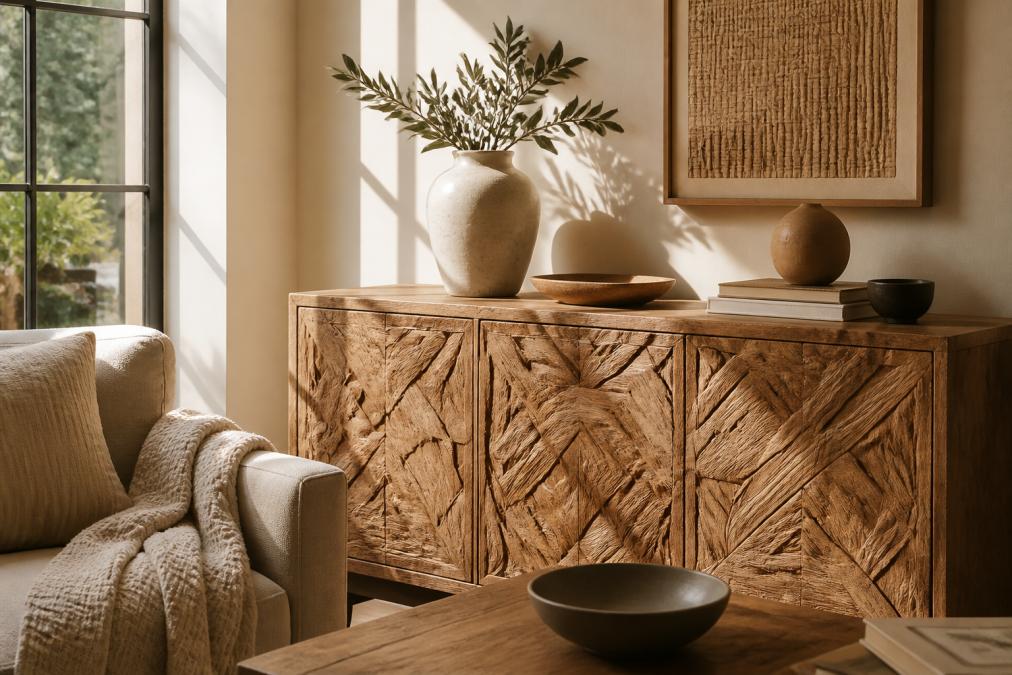
The Difference Between Curation and a Marketplace
A marketplace answers "what exists?" Curation answers "what deserves your home?" The first overwhelms you with options. The second narrows hundreds of pieces to a considered few. Look for a point of view in any collection you browse. If everything is listed, nothing is chosen.
Artisan Home Decor Brands: What Sets Them Apart
Artisan home decor brands build around people, not production lines. A single maker often shapes one piece from start to finish. That shows in small variations, and those variations are the point.
What most guides miss is how much this changes the buying experience. When you buy hand-thrown dinnerware, like the Thetis Ceramic Dinnerware Set, you see the maker's hand in every glaze pool. Each piece differs slightly from the next. That is not a flaw. It is proof of handwork.

- Hand-thrown or hand-carved construction
- Natural grain and tone variation between pieces
- Small-batch runs instead of endless restock
- Traceable studio or workshop origins
Sustainable Luxury Furniture: Materials That Matter
Sustainable luxury furniture starts with what it is made from. Solid wood, organic cotton, linen, wool, and jute age well and carry less environmental weight than engineered substitutes. The material list is your first honesty test.
Mango Wood, Acacia, and Organic Textiles
Mango wood and sheesham are dense, durable, and beautifully grained. The Solid Sheesham Wood Coffee Table | Natural Wax Finish is carved from 100% solid sheesham wood, not veneer, with a natural wax finish. Sheesham appears in the Raven Sheesham Solid Wood Sideboard | Light Teak Finish, handcrafted and naturally termite resistant.
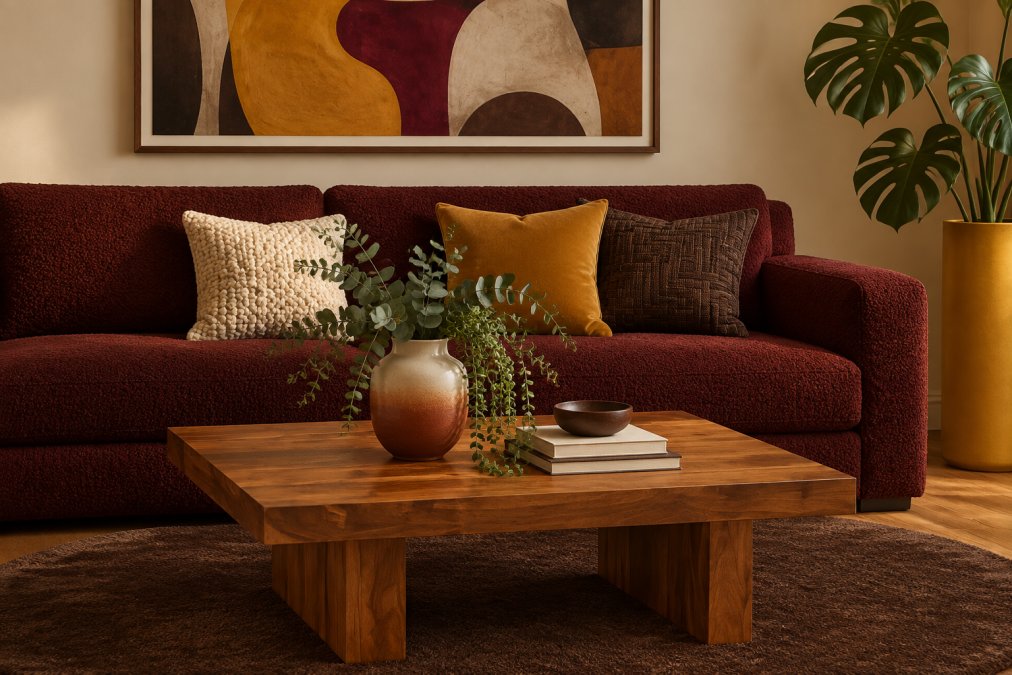
Textiles deserve the same scrutiny. Organic cotton, linen, and wool support traditional low-waste methods. Many buyers now look for OEKO-Tex certification, which verifies a fabric has been tested for harmful substances. Hypoallergenic fibers matter too, especially in bedrooms and nurseries. Portugal-woven bedding and Portugal-made ceramics share a long craft heritage worth seeking out.
Material |
Why It Lasts |
Where You See It |
|---|---|---|
Solid mango wood |
Dense grain, ages richly |
Sideboards, mirrors |
Sheesham wood |
High structural density, natural termite resistance |
Coffee tables, sideboards |
Organic cotton and linen |
Breathable, low-waste |
Bedding, textiles |
Handcrafted ceramic |
Fired for daily durability |
Dinnerware, vases |
Handcrafted Interior Design Accents for Every Room
Handcrafted interior design accents do the quiet work in a room. They add texture, warmth, and a focal point without demanding space. The right accent makes a minimalist room feel intentional rather than empty.
Ceramic vases are the easiest starting point. The Mosco Light Brown Vase is watertight and handcrafted in Portugal. The Chubby Vase is wheel-thrown from local clay, so its earth tones shift with the kiln fire. For walls, the Blackwash Mango Wood Wall Mirror uses an irregular silhouette and sustainably sourced mango wood to anchor an entryway. Sculptural lighting, like the Ripple Ceramic Pendant Light, turns a ceiling fixture into a piece of art.

Globally Inspired Home Decor: From Portugal to Milwaukee
Globally inspired home decor carries a story you can trace. That traceability is what separates cultural craft from costume. A piece should honor its origin, not borrow it.
Most guides stop at the aesthetic. They show you a Portuguese vase and a Wisconsin planter and call it a global collection. What they skip is provenance: the paper trail behind the object. Provenance is the difference between a story and a slogan.
What Provenance Actually Means
Provenance answers four questions. Where was the material sourced? Who shaped it? Under what working conditions? And how will it age?
Sustainably sourced mango wood, ethically made ceramics, and fair-wage workshops all signal a supply chain you can trust. At Fluent Trends, our Artisan Collection supports women-owned businesses and global makers through sustainable practices. That is provenance you can verify, not just a label.
Portugal: A Ceramic and Textile Tradition
Portugal's ceramic tradition shows in the Milan White Sculptural Vase and the Santorini Bowl, both ethically and sustainably handcrafted there. The country's clay and kiln culture stretches back centuries.
Look for makers who name the region, not just the country. A studio in Caldas da Rainha tells you more than a generic "made in Portugal" stamp.
American Studio Craft: Milwaukee and Beyond
American studio craft appears in the Wrap Planter, made by hand at the Misewell studio in Milwaukee, Wisconsin. Small American studios often publish their material sources and finishing methods. That transparency is a competitive advantage over imported lookalikes.
How to Verify a Provenance Claim
Use this short test before you buy:
- Named maker: Is there a studio, a city, and a person behind the piece?
- Named material: Is the wood species or fiber content stated, or is it vague?
- Named process: Hand-thrown, hand-carved, or hand-woven are specific. "Artisan-inspired" is not.
- Certification: OEKO-Tex certification on textiles verifies testing for harmful substances.
- Longevity statement: Does the maker explain how the piece ages, or only how it looks new?
Why Provenance Protects Your Investment
Investment value in handcrafted goods comes from durability, scarcity, and provenance. A solid wood sideboard made by named artisans holds value that a veneer cabinet never will. Mass-produced furniture is designed to be replaced. Handcrafted furniture is designed to be inherited.
Grouping traceable origins in one room creates a narrative, not a theme. A Portuguese vase beside a Milwaukee planter tells a story about craft traditions that still exist. That story is the piece's real value, and it is the one thing a mass retailer cannot copy.
How to Choose Luxury Home Decor: A Buyer's Framework
Choosing luxury home decor comes down to four questions. Who made it? What is it made from? How will it age? Does it fit your space? Run every piece through those filters before you buy.
The framework matters because most online listings are built to sell a photograph. A buyer's job is to look past the styling and read the object. That takes a few specific habits.
Read the Material List Like a Contract
Start with the substrate, not the finish. Solid wood, organic cotton, linen, and wool age well and carry less environmental weight than engineered substitutes. Veneer over particleboard is not the same product, even when the photo looks identical.
Look for these signals:
- Solid versus veneer: A listing that says "solid mango wood" or "100% solid acacia" is making a claim you can verify. "Wood finish" or "wood veneer" is not.
- Fiber content: Organic cotton, linen, and wool outperform polyester blends over a decade of washing.
- Certification: OEKO-Tex certification verifies a fabric has been tested for harmful substances. It is one of the few labels with a published standard behind it.
- Origin of weave: Portugal-woven bedding and Portugal-made ceramics share a long craft heritage worth seeking out.
Test the Maker, Not the Marketing
Ask any artisan brand how many makers touch a single piece. One or two names means real handwork. A vague answer usually means a factory with artisan styling.
A common pattern among trustworthy makers is a named studio, a stated city, and a small-batch restock cycle. If a listing cannot tell you where and by whom a piece was made, treat the claim as marketing until proven otherwise.
Weigh Durability Against Daily Life
Durability standards exist for a reason. Hospitality buyers specify pieces that survive years of daily use. That same logic applies at home, especially in entryways, dining rooms, and family living spaces.
Ask yourself three things:
- Can this be repaired or refinished, or is it disposable by design?
- Will the finish survive sunlight, spills, and regular cleaning?
- Does the scale suit the room, not just the photo?
Match the Piece to the Room
Modern minimalist spaces can carry globally inspired pieces when the palette stays neutral and the lines stay clean. Choose one statement piece, then let quieter accents support it. Both reward a restrained room.
Use the Six-Point Checklist
- Is the maker named, or is the origin vague?
- Is the material solid, or a veneer and engineered substitute?
- Will this survive a decade of daily use?
- Does the scale suit the room, not just the photo?
- Can I clean and maintain it easily?
- Does it tell a story I actually care about?
If a piece fails two or more of these, walk away. If it passes all six, you are likely looking at an heirloom rather than a purchase.
Investment Value of Handcrafted Goods and Material Provenance
Investment value in handcrafted goods comes from durability, scarcity, and provenance. A solid wood sideboard made by named artisans holds value that a veneer cabinet never will. Mass-produced furniture is designed to be replaced. Handcrafted furniture is designed to be inherited.
Material provenance is the paper trail behind a piece. Sustainably sourced mango wood, ethically made ceramics, and fair-wage workshops all signal a supply chain you can trust. At Fluent Trends, our Artisan Collection supports women-owned businesses and global makers through sustainable practices. That is provenance you can verify, not just a label.
Care and Maintenance of Luxury Materials
Care and maintenance protect the value you just invested in. Most luxury materials need less than people fear, but they do need the right habits. Get these right and a piece looks better in year ten than year one.
- Solid wood: dust with a soft cloth, keep away from direct sun, and re-oil occasionally.
- Handcrafted ceramic: clean gently with a soft, dry cloth, damp only if needed.
- Mango wood mirrors: wipe the frame dry and avoid harsh cleaners on the finish.
- Acacia serveware: hand-wash with mild soap and dry thoroughly after each use.
- Organic textiles: wash cold and line dry to protect fibers.
OEKO-Tex certified textiles are the easiest to maintain because they resist the buildup that traps irritants.
Frequently Asked Questions
What defines luxury handcrafted home goods?
Luxury handcrafted home goods are defined by three things: the maker, the material, and the method. Each piece is shaped by hand rather than produced on an assembly line. Materials are chosen for longevity, such as solid mango wood, acacia, or organic cotton. The result is a piece with subtle variations that mass production cannot replicate. Look for hand-thrown ceramics, hand-carved wood, and finishes applied by hand. These details signal true artisan craftsmanship rather than a factory finish.
How can I verify the authenticity of handcrafted furniture online?
Start with the product listing. Reputable sellers name the maker, the studio, and the material. A solid wood sideboard should state that it is 100% solid mango wood, not veneer. Ceramics should name the studio, such as Misewell in Milwaukee. Look for certifications like OEKO-TEX for textiles. If a listing is vague about origin or materials, treat that as a warning sign. Transparency about sourcing is the clearest proof of authenticity.
Are handcrafted home goods more durable than factory-made alternatives?
Often, yes. Solid wood construction resists warping and holds up to daily use far better than engineered substitutes. Hand-thrown ceramics are denser and less prone to chipping. The key is material quality, not just the handcrafted label. A hand-carved solid mango wood sideboard will outlast a veneer piece by decades. Proper care extends that lifespan further. Think of these pieces as investments, not disposable decor.
How do I style luxury handcrafted pieces in a modern home?
Let one piece anchor the room. A tall, irregular mango wood mirror can set the tone for an entryway. Pair it with neutral walls and natural textures. Group ceramic planters in varied sizes for a gallery-quality vignette. Mix a sculptural vase with a matte glaze bowl on a console. Keep the palette restrained so the craftsmanship stands out. The goal is refined living, not clutter. Fewer, better pieces always win.
What are the benefits of investing in sustainably sourced home goods?
Sustainably sourced pieces reduce environmental impact through traditional, low-waste techniques. They also support fair wages and preserve craft heritage. Materials like organic cotton and responsibly harvested mango wood are renewable and durable. These goods often carry certifications such as OEKO-TEX, which verifies safe textile production. Beyond ethics, you get a piece built to last generations. That longevity is the real return on your investment.
Furnishing a home with pieces that last takes patience and a good eye. Fluent Trends makes that search simpler with a curated selection of ethically made, handcrafted goods. Our Artisan Collection features organic cotton, wool, jute, and linen, plus commercial-grade furniture built for durability. Every piece supports women-owned businesses and global makers through sustainable practices. Shop Now and bring home objects with a story worth keeping.