

Shop Ethical Women-Owned Home Brands: 2026 Guide
Yuatinia LeakTable of Contents
- Why Ethical Women-Owned Home Brands Matter in 2026
- How to Verify Ethical Claims Before You Buy
- Fair Trade Practices and the Women Behind the Craft
- Sustainable Luxury Home Decor: Materials That Last Generations
- Durable Commercial Grade Home Decor for Everyday Living
- Curated Pieces from Fluent Trends' Artisan Collection
- Budget vs. Investment: What Ethical Home Decor Actually Costs
- Lifecycle and Circularity: Decor That Stays Out of Landfills
- Frequently Asked Questions
Last Updated: September 16, 2026
Why Ethical Women-Owned Home Brands Matter in 2026
The case for shopping ethical women-owned home brands has never been stronger. Conscious consumerism has moved from niche preference to mainstream expectation. Shoppers now ask harder questions about who made their furniture and under what conditions.
This guide from Fluent Trends examines how to shop ethical women-owned home brands with confidence. We cover verification standards, fair trade practices, sustainable materials, and what ethical home decor actually costs. Every recommendation here is built on transparency, not marketing language.
Women-owned businesses in home goods tend to reinvest in their communities. They often prioritize ethical labor practices and small-batch production over volume. That difference shows in the finished piece.
How to Verify Ethical Claims Before You Buy
Verification starts with documentation, not branding. A credible ethical claim comes with a paper trail you can inspect. Ask for it directly.
Here is what separates real accountability from greenwashing:
- Named certifications with verifiable registration numbers
- Supplier disclosure listing specific workshops or artisan clusters
- Material sourcing details naming the fiber, origin, and processing method
- Fair wage statements describing how makers are compensated
- Third-party audits conducted by independent organizations
A common mistake is trusting a homepage badge with no link or reference. If a brand cannot name its certifying body, treat the claim as unverified.
Certifications That Signal Real Accountability
OEKO-Tex is a testing and certification system for textiles. It verifies that finished fabrics are free from harmful substance levels. For bedding and textiles, it is one of the clearest signals available.
Fair Trade certification confirms that producers meet specific social, economic, and environmental standards. It covers fair wages, safe conditions, and community development requirements.
Global Organic Textile Standard (GOTS) tracks organic fiber from harvest through finished product. It also includes wastewater and chemical restrictions during processing.
Look for a certification number you can verify on the issuing body's own site. That step takes two minutes and eliminates most risk.
Fair Trade Practices and the Women Behind the Craft
Fair trade is a trading partnership built on minimum prices, safe conditions, and long-term buying commitments. In home goods, it most often protects women working in textile, ceramic, and basketry production. The difference is structural, not sentimental.
Here is how the mechanism actually works. A fair trade buyer agrees to a price floor that covers cost of production plus a living wage. That floor holds even when market prices collapse. Buyers typically extend advance payment, often covering a portion of raw material costs before production begins. That advance removes the need for makers to borrow at high interest rates.
A social premium sits on top of the base price. Producer cooperatives vote on how to spend it. Common uses include workshop equipment, childcare, and clean water infrastructure. The premium is not charity. It is a negotiated line item in the trading agreement.
Women artisans in textile clusters often hold specialized knowledge passed down through generations. Block printing, handloom weaving, natural dyeing, and bone inlay work are skills that take years to master. When those makers are paid properly, the craft survives. When they are not, the knowledge disappears within a generation.
How to Verify a Fair Trade Claim
Fair Trade USA and the World Fair Trade Organization are the two certifying bodies most often referenced in home goods. Each maintains a public database of certified producers and brands. A legitimate claim includes a certification number you can look up directly on the issuing body's site.
Watch for these signals of a real partnership:
- Named producer groups with a stated region, not vague references to "artisans abroad"
- Multi-year buying relationships rather than one-off sourcing arrangements
- Published wage information or a stated wage floor
- Cooperative ownership structures where makers hold equity
- Advance payment terms disclosed in supplier documentation
A common pattern is the "artisan-washed" label. It borrows the language of fair trade without the certification or the price floor. If a brand cannot name its producer group or its certifying body, treat the claim as marketing rather than commitment.
Sustainable Luxury Home Decor: Materials That Last Generations
Sustainable luxury home decor is furniture and textiles built from responsibly sourced materials and designed to remain in use for decades. The sustainability comes from longevity, not from a label. A piece that lasts thirty years uses far fewer resources than three replacements.
Natural fibers age well when they are cared for properly. Wool, linen, jute, and organic cotton all develop character rather than degrading. Solid wood frames can be refinished. Hand-stitched details can be repaired.
Organic Textiles and OEKO-Tex Standards
Organic cotton is grown without synthetic pesticides and processed under restricted chemical rules. Rain-fed organic cotton goes further, relying on rainfall rather than irrigation. That lowers water demand and the associated carbon footprint.
Durable Commercial Grade Home Decor for Everyday Living
Commercial-grade home decor is built to hospitality durability standards. It is engineered for daily use in hotels and restaurants, where furniture and tableware take constant punishment. That same construction translates directly into residential value.
Durability shows up in specific details. Chip-resistant glazes, reinforced joinery, and dense weave structures all extend service life. Commercial-grade furniture often carries higher upfront cost and far lower replacement frequency.
Fluent Trends prioritizes this standard across its Artisan Collection. Pieces are selected for how they hold up, not just how they photograph. That distinction matters when you are furnishing a home you actually live in.
Ink Black White Ombre Textured Throw →
| Category | Durability Signal | What to Look For | Typical Lifespan |
|---|---|---|---|
| Seating | Frame joinery | Solid hardwood, mortise-and-tenon joints | 15-25 years |
| Bedding | Weave density | Long-staple fibers, OEKO-Tex certification | 5-10 years |
| Tableware | Glaze quality | Chip-resistant, non-toxic finish | 10-20 years |
| Textiles | Fiber content | Natural fibers, reinforced hems | 10-15 years |
Curated Pieces from Fluent Trends' Artisan Collection
A curated collection solves a real problem: too much choice. Fluent Trends narrows its Artisan Collection to pieces that meet verified standards for sourcing and construction. Each item carries a documented origin and a maker story.
Bedding and Throw Blankets
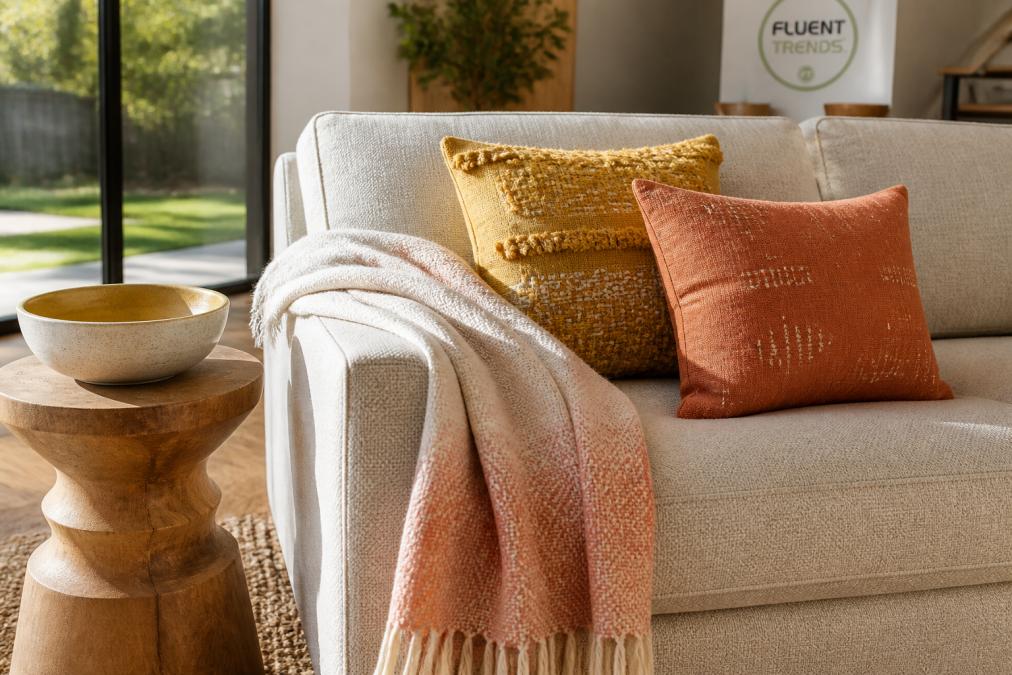
The Ink Black White Ombre Textured Throw is handwoven in Nepal from hand-spun Merino wool. It uses eco-friendly Swiss dyes and a reversible design with hand-stitched hems. Limited small-batch runs keep waste low.

The Chokor Nira Ochre Pillow uses 100% rain-fed organic cotton and natural dyes made from flowers and herbs. It is handwoven by artisans in India using a 700-year-old technique. The Arc Coral Shibori Pillow applies the same standard to mulberry silk.
Tableware and Kitchen Accents
The Ava Silver Flatware 20-Piece Set is handcrafted in India from premium stainless steel. It is built for years of daily use rather than occasional display. The Lhasa Mug is shaped by hand in a woman-owned workshop in Turkey from Limoges porcelain.
For serving, the Fors Studio White Ceramic Deep Serving Bowl is hospitality grade and chip resistant. It is oven safe up to 475F and made with partially recycled local clay. The Sustainable Kayseri Tablecloth Set uses 50% recycled cotton with hand-tied tassels.
Budget vs. Investment: What Ethical Home Decor Actually Costs
Ethical home decor costs more upfront because the price reflects real labor and materials. The relevant comparison is cost per year of use, not sticker price. A handwoven throw used for a decade costs a fraction of its price annually. A mass-market throw replaced every two years costs more per year and ends up in a landfill.
Most guides mix price points into one list. That makes it hard to plan. Segmenting by tier helps you build a collection without overspending in year one.
The Accessible Tier: Entry Points Under $100
This is where you test a maker's quality before committing to larger pieces. Tableware, small textiles, and kitchen accents live here. A handcrafted ceramic bowl, a porcelain mug, or a set of hand-tied napkins lets you assess craftsmanship at low risk.
Look for OEKO-Tex certified organic cotton in napkins and table linens. Look for chip-resistant glazes in ceramics. These signals tell you whether the maker applies the same standard across the catalog.
The Mid Tier: Bedding and Table Linens
Portugal-woven bedding and rain-fed organic cotton sheets sit in this range. The jump in price reflects longer staple fibers, tighter weave density, and certified processing. Hypoallergenic natural fibers resist dust mite accumulation better than many synthetics. That matters for anyone with sensitive skin or respiratory concerns.
This tier is where cost per year of use starts to favor the ethical option. A well-made sheet set that lasts five to ten years beats a cheap set replaced annually on both cost and waste.
The Heirloom Tier: Furniture and Flatware
Commercial-grade furniture and handcrafted flatware represent the highest investment. The durability is engineered, not implied. Solid hardwood frames with mortise-and-tenon joinery, reinforced upholstery, and chip-resistant finishes all extend service life well beyond mass-market equivalents.
Lifecycle and Circularity: Decor That Stays Out of Landfills
Circularity means designing a product so its materials retain value after first use. In home decor, that starts with repairability and material purity. A piece made from a single natural fiber is easier to repair, resell, or recycle than a bonded composite.
Most guides skip this entirely. They focus on what a product is made of and ignore what happens at end of life. That is the gap that matters most for waste reduction.
Practical circularity looks like this:
- Choose pieces with replaceable components
- Prefer natural fibers that can be repaired or composted
- Buy from makers who offer repair or resale programs
- Pass pieces on rather than discarding them
- Avoid finishes that prevent refinishing
Fluent Trends selects for this standard. Sustainably sourced materials and traditional low-waste techniques mean each piece can have a second life.
The challenge is simple: most home decor is built to be replaced, not kept. Fluent Trends takes the opposite approach, curating pieces that hold their value and their beauty for decades. The Artisan Collection offers OEKO-Tex certified organic cotton bedding, hypoallergenic natural fibers, Portugal-woven textiles, and commercial-grade furniture built for daily durability. Boucle and bone inlay pieces sit alongside handcrafted tableware, each with a documented maker story. Get started with Fluent Trends and build a home where every piece earns its place.
Frequently Asked Questions
How can I verify if a home decor brand is truly ethical?
Look for third-party certifications like OEKO-Tex for textiles, Fair Trade Certified for labor practices, and B Corp status for overall accountability. Check whether the brand names its artisan partners and publishes supply chain details. Ethical women-owned home brands typically share maker stories, disclose materials, and welcome questions about production. If a brand makes vague claims without documentation, treat that as a warning sign.
What certifications should I look for in sustainable home goods?
OEKO-Tex Standard 100 confirms textiles are free from harmful substances. Fair Trade Certified verifies fair wages and safe working conditions. Global Organic Textile Standard (GOTS) covers organic fiber sourcing and processing. For furniture, look for FSC-certified wood. These certifications require independent audits, so they carry more weight than self-reported claims about sustainable luxury home decor.
Why choose women-owned businesses for home furnishings?
Women-owned businesses often prioritize community empowerment and ethical labor practices. When you shop ethical women-owned home brands, your spending supports fair wages, skill preservation, and economic independence for artisans. Many women-led brands also invest in small-batch production, which reduces waste and maintains heirloom quality. The ripple effect reaches farming families, weaving clusters, and local economies.
What are the benefits of buying artisan-made home decor?
Artisan-made pieces carry cultural narratives and traditional techniques that mass production cannot replicate. Each item supports ethical manufacturing and keeps heritage crafts alive. Artisan-made decor also tends to be more durable because makers use time-tested methods and quality materials. You get unique pieces with heirloom quality, and your purchase directly funds artisan communities rather than factory intermediaries.
How do I avoid greenwashing when shopping for ethical home brands?
Greenwashing relies on vague terms like 'natural' or 'eco-friendly' without proof. Ask specific questions: Where was this made? What materials were used? Who made it? Look for named certifications, transparent supply chains, and brands willing to share their sourcing process. Durable commercial grade home decor from verified makers is a safer bet than unverified claims. If a brand cannot answer basic questions, keep looking.