

Signs of Heirloom Quality Furniture: 2026 Expert Guide
Yuatinia LeakTable of Contents
- What Defines Heirloom Quality Furniture
- Types of Furniture Joinery for Durability
- How to Identify Solid Wood Furniture
- The Importance of Solid Hardwoods
- Durability and Longevity Factors
- The Role of Craftsmanship in Furniture
- Sustainable and Eco-Conscious Materials
- Finishing Techniques and Low-VOC Materials
- Restoration and Repairability
- Hardware and Upholstery Longevity
- Visual Inspection Checklist for Non-Experts
- Best Ethical Home Decor Online Shops
- Conclusion
- Frequently Asked Questions
Last Updated: September 11, 2026
What Defines Heirloom Quality Furniture
Heirloom quality furniture is built to survive generations, not seasons. It relies on solid hardwood, traditional joinery, and hand-finishing rather than veneer and staples. This guide from Fluent Trends explains how to spot those markers before you buy.
Most shoppers judge a piece by its silhouette. That instinct fails them. The real signals hide underneath: the joinery, the grain, the finish, the hardware. Learn to read those details and you will never overpay for a disposable dresser again. Below, we break down exactly what separates a future heirloom from a future landfill.
The distinction matters more than ever. Furniture is discarded at staggering rates, and much of it fails within a decade. Mass-produced pieces use particleboard and glue that simply cannot survive a move, let alone a childhood.
The Three Pillars of Lasting Value
Every genuinely durable piece rests on three foundations: material, joinery, and finish. Remove any one and longevity collapses.
- Material: solid hardwood, properly dried, with grain that runs the full length of the board
- Joinery: mechanical connections like dovetails and mortise and tenon that lock without relying on glue alone
- Finish: a repairable surface that protects the wood without sealing it under plastic
A piece can look expensive and still fail all three. A piece can look plain and pass every test. That gap is where smart buyers win.
Types of Furniture Joinery for Durability
Joinery is the single most reliable predictor of longevity. A drawer joined with dovetails will outlast one stapled and glued, often by decades. This is where you separate craftsmanship from assembly-line output.
Dovetail Joints: The Gold Standard
Dovetail joints interlock drawer corners with angled pins and tails. The shape resists pulling force mechanically, so the joint tightens under load rather than loosening. Look for tails that are evenly spaced and cut cleanly, with no filler or wood putty hiding gaps.
Hand-cut dovetails show slight irregularity. That imperfection is a signature, not a flaw. Machine-cut dovetails are perfectly uniform and equally strong. Both beat a stapled corner every time.
The joints should also be visible. If a manufacturer hides the drawer corners behind a glued-on face, ask why.
Mortise and Tenon: Strength in Silence
Mortise and tenon joins a rail to a leg by inserting a shaped tenon into a cut mortise. It carries the entire weight of a table or chair with almost no visible hardware. A well-fitted tenon needs no screws, and the joint only gets tighter as wood expands and contracts with the seasons.
Run your hand along the underside of a table apron. If you feel metal brackets and screws doing the structural work, the frame is not built to last.
How to Identify Solid Wood Furniture
Solid wood furniture reveals itself through grain continuity, weight, and the way it sounds when tapped. Veneered pieces show repeating patterns and feel light for their size. Learn these tells and you can assess any piece in a showroom without a salesperson's help.

Reading the Grain and End Grain
Start with the end grain, the exposed cross-section at a board's edge. Solid wood shows tight growth rings that continue through the thickness. Veneer shows a thin layer glued over a different core, often particleboard or medium-density fiberboard.
Check the top surface next. On solid wood, the grain pattern on the top should align with the grain on the sides if cut from the same board. Repeating, mirrored patterns usually mean a printed or veneered surface.
Weight tells the rest of the story. Solid hardwood is heavy. A solid oak dining table will feel substantially denser than a veneered one of identical size. Pick up a drawer if you can.
| What You See | What It Means | What to Do |
|---|---|---|
| Grain continues through the edge | Likely solid wood | Confirm with weight and sound |
| Repeating mirrored pattern | Veneer or printed surface | Ask about the core material |
| Visible seams at corners | Veneer over particleboard | Expect swelling near moisture |
| Tight, irregular growth rings | Slow-grown hardwood | Strong candidate for an heirloom |
The Importance of Solid Hardwoods
Solid hardwoods determine how a piece ages. Oak, mahogany, walnut, maple, and cherry all offer the density and stability that softwoods and composites lack. They resist warping, hold joinery, and accept refinishing decades later.
Species matters less than how the wood was dried. Wood must be kiln-dried to a stable moisture content before construction. Wood that is too wet will shrink and crack as it dries in your home. Wood that is too dry can swell in humid rooms.
Ask about moisture content directly. Reputable makers track it. If nobody can answer, that silence is your answer.
Warp resistance comes from grain orientation and proper drying together. A wide tabletop made from narrow, quarter-sawn boards moves far less than one cut from a single wide slab. That is engineering, not luck.
Durability and Longevity Factors
Longevity comes from how a piece handles movement. Wood expands and contracts with humidity all year. Good construction allows that movement instead of fighting it.
Watch for these factors when you evaluate a piece:
- Floating panels in tabletops and cabinet backs that can shift without cracking
- Corner blocks that reinforce frames without rigidly locking the wood
- Leg attachment that uses joinery rather than a single bolt into end grain
- Drawer runners made of wood or quality metal, not plastic tracks
Structural integrity shows up in small ways. Sit on the chair. Open and close the drawer ten times. Rock the table gently. A well-built piece will feel solid and silent. A weak one will creak, shift, or wobble.
According to U.S. Environmental Protection Agency guidance on wood products, how wood is finished and treated affects both durability and indoor air quality. That link between construction and health runs through everything below.
The Role of Craftsmanship in Furniture
Craftsmanship is not a mood. It is a series of measurable decisions made at the bench. You can count them, feel them, and compare them across pieces in the same showroom.
Start with the parts nobody photographs. Turn the chair upside down. Look at how the seat frame meets the legs. A hand-built frame shows fitted joinery, chamfered edges, and sanded surfaces. A mass-produced frame shows staples, glue blocks, and rough mill marks left in place.
What to Count and Compare
Numbers tell the story faster than adjectives. Use these benchmarks when you evaluate two pieces side by side:
- Drawer corners: Four dovetail corners per drawer, eight drawers per dresser, thirty-two hand-fitted joints. Staples replace all of them in seconds.
- Sanding grit: A hand-finished surface is typically taken through progressively finer grits, often ending around 220 or higher before finish. Skip-sanded surfaces feel rough under a fingertip.
- Joinery count: A dining table with four legs, aprons, and a stretcher may carry eight to twelve mortise and tenon joints. Count the visible pegs.
- Drawer bottoms: A floating panel set in a groove allows seasonal movement. A nailed or stapled bottom does not.
Where Machine Work Belongs
Machine precision is not the enemy. A CNC-cut dovetail is square, tight, and strong. A factory planer produces consistent thickness. The problem starts when machines replace joinery altogether.

A useful test is to ask what holds the piece together. If the answer is glue and fasteners, the piece is assembled. If the answer is interlocking geometry, the piece is built. Assembly is fast. Building takes time, and time is what you are paying for.
Reading the Maker's Hand
Small irregularities signal human involvement. A slightly uneven hand-rubbed finish. A drawer front whose grain flows into the one beside it. A peg driven by hand that sits a fraction off center.
These are not defects. They are evidence. Uniformity across every surface usually means a sprayed coating and a production line.
Sustainable and Eco-Conscious Materials
Sustainability in furniture is about longevity first. The most sustainable piece is the one you never replace. Beyond that, look for responsibly harvested wood and low-impact materials.
FSC-certified wood confirms that a forest was managed to a recognized standard. Ask for the certification, not just the claim. Natural materials like wool, linen, jute, and organic cotton also carry lower environmental costs than synthetic alternatives, and they age beautifully.
Traditional, low-waste techniques matter too. Hand-joinery produces less waste than panel-cutting operations. Natural oil finishes avoid the solvents in mass-market lacquers. These choices reduce environmental impact and improve how a piece ages.
The Forest Stewardship Council certification standards provide a framework you can verify rather than trust. When a maker can name their source, that transparency is worth more than a marketing badge.
Finishing Techniques and Low-VOC Materials
A finish decides whether a piece can be repaired or must be stripped. Low-VOC finishes protect the wood while keeping indoor air cleaner, and they age in a way you can maintain at home.
Here is how the main options compare:
| Finish Type | Look | Repairability | Best For |
|---|---|---|---|
| Hardwax oil | Matte, natural | Spot-repairable | Daily-use tables |
| Danish oil | Satin, warm | Recoat by hand | Walnut, teak, mahogany |
| Water-based lacquer | Smooth, clear | Full recoat | Modern, low-sheen pieces |
| Conversion varnish | Glossy, hard | Difficult | High-traffic commercial |
Hand-finished surfaces feel different. Run your fingertips across the top. A hand-rubbed oil finish has depth and slight variation. A sprayed plastic coating feels uniformly slick and cold.
Low-VOC finishes matter for bedrooms and nurseries especially. The U.S. EPA information on volatile organic compounds explains how these compounds affect indoor air. A natural oil finish releases far less than a solvent lacquer.
Restoration and Repairability
Repairability is the most overlooked sign of heirloom quality. A piece that can be restored will outlive one that cannot, regardless of how it looks on day one. This is where most buying guides stop, and where the real value begins.
Ask three questions before you buy. Can the finish be spot-repaired? Can the joints be tightened without dismantling the frame? Can the hardware be replaced with standard parts? Three yeses mean a piece you can keep.
Solid wood can be sanded and refinished many times. Veneer cannot. Once veneer chips or lifts, repair becomes a specialist job. Solid hardwood simply takes another coat of oil and keeps going.

Upholstered pieces deserve the same scrutiny. A sofa with a removable, replaceable cushion core and a hardwood frame can be reupholstered repeatedly. One built on a plywood frame with glued foam cannot.
Hardware and Upholstery Longevity
Most buying guides stop at the wood. That is a mistake. Hardware and upholstery fail first, and they decide whether a piece can be kept or must be replaced. This is the part of the assessment almost nobody covers.
Evaluating Hinges, Slides, and Pulls
Hardware is a wear item. Treat it like one. The question is not whether it looks good today, but whether it can be tightened, adjusted, or replaced in ten years.
- Solid brass and bronze: Heavy for their size, develop a patina, and can be polished or left alone. They take machine screws cleanly.
- Plated zinc and pot metal: Light, prone to flaking, and strip easily when a screw is overtightened.
- Steel: Durable when solid, but check for plating quality and rust resistance in humid rooms.
Look at how the hardware attaches. A machine screw threading into a brass insert or a captured nut will outlast a wood screw driven directly into soft material. The insert distributes load. The wood screw does not.
Drawer slides deserve the same scrutiny. Wood runners on wood guides are traditional, quiet, and repairable with a block plane and paraffin. Side-mount ball-bearing slides are smooth and rated by cycle count, often in the tens of thousands. Undermount slides hide the mechanism and keep the drawer box clean. Plastic tracks are the failure point to avoid.
Test the action. Pull the drawer out fully and push it back with one finger. It should glide without wobble, rattle, or a grinding feel. Open and close it ten times. A quality slide feels the same on the tenth pass as the first.
Reading Upholstery for the Long Haul
The frame underneath is the real commitment. Fabric is the cheapest thing to change. A hardwood frame with traditional joinery can be reupholstered several times across its life. A plywood frame with glued foam cannot.
Ask what the frame is made of and how the corners are joined. Then look at the cushion construction:
- Removable, replaceable cores: A wrapped foam or down core in a zippered casing can be replaced without rebuilding the sofa.
- Glued foam: Once it compresses, the seat is done.
- Eight-way hand-tied springs: Traditional, repairable, and a strong longevity signal.
- Sinous wire or webbing: Lighter and cheaper, with a shorter service life.
Fabric choice is a trade-off, not a ranking. Performance fabrics resist stains and clean easily. Natural fibers like linen and wool age with character and can be cleaned by a professional. Neither is wrong. What matters is whether the cover can be removed, repaired, or replaced.
The Replacement Test
Before you commit, ask one question: if this component fails, can it be fixed? Hinges, slides, pulls, cushion cores, and covers should all have an answer. If the answer is no, the piece is not heirloom quality, no matter how it looks on the floor.
Visual Inspection Checklist for Non-Experts
You do not need to be a woodworker to assess quality. Use this checklist in any showroom, and you will catch what most buyers miss. It takes about five minutes per piece.
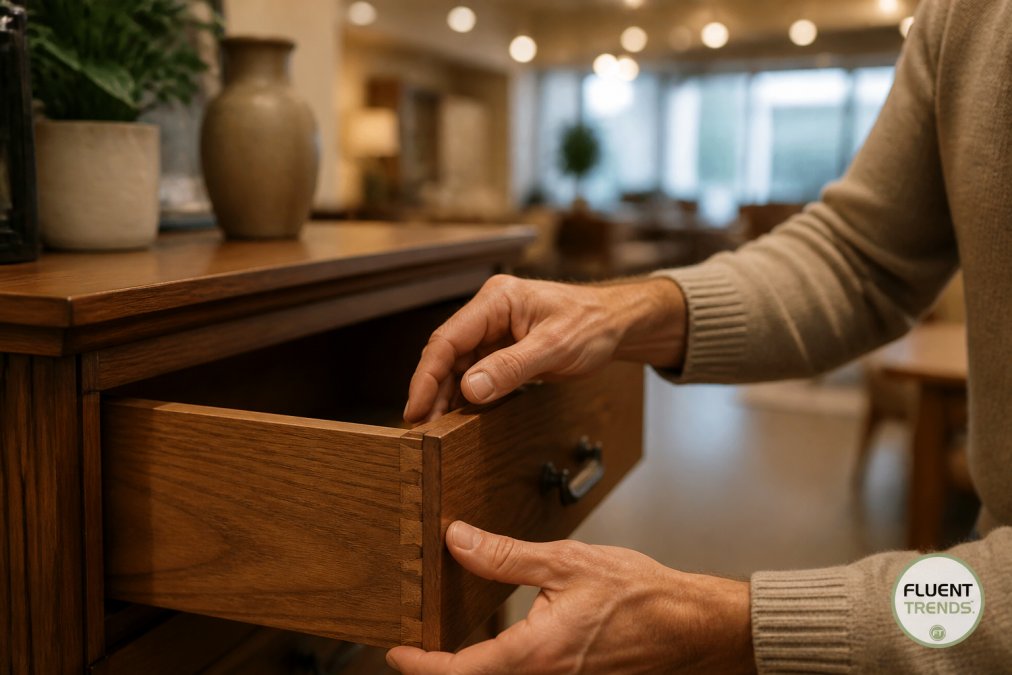
Work through it in order:
- Open every drawer and look at the corner joints. Dovetails or mortise and tenon are good. Staples are not.
- Check the end grain at board edges for continuous growth rings, not a thin veneer layer.
- Lift a drawer or chair. Real hardwood feels heavy for its size.
- Run a hand under the tabletop and along the apron. Look for brackets instead of joinery.
- Tap the surface. Solid wood sounds dense and dull. Veneer over particleboard sounds hollow.
- Inspect the finish for even coverage and a matte or satin sheen you could repair.
- Test the hardware. Solid brass has weight; plated metal feels light.
- Rock the piece gently. It should feel silent and immovable.
Best Ethical Home Decor Online Shops
Finding furniture that is both heirloom quality and ethically made takes more than a good eye. It requires knowing where a maker sources materials and how they treat the people who build. That combination is rare, which is why curation matters.
Fluent Trends curates exactly this kind of collection. The Artisan Collection features handcrafted pieces from women-owned businesses and global makers, built with traditional techniques and natural materials. Every item carries a story and a provenance you can trace.
The catalog reflects that standard. Consider the Solid Wood Bedroom Furniture | Mahogany Chest and Double Dresser, which pairs solid mahogany construction with felt-lined drawers and dovetail joinery. It is the kind of piece the checklist above was written for: honest material, visible craft, built to be handed down.
For dining, the 66 Inch Natural Oak Double Pedestal Dining Table uses solid oak and a traditional double pedestal base. It balances modern minimalism with time-tested engineering, the exact marriage of form and durability that heirloom pieces require.
Smaller pieces carry the same discipline. The Solid Wood Ribbed Bedside | Brass Accents is crafted from solid mango wood with ribbed drawer fronts and slender brass handles. Brass hardware, as noted above, is a longevity marker in itself.
Where the collection stands apart is verification. Fluent Trends works directly with makers who support fair wages and preserve craft heritage, using eco-friendly materials like organic cotton, wool, jute, and linen. That is a supply chain you can question and get answers about.
Conclusion
Judging furniture by appearance alone leaves you guessing. Judging it by joinery, material, and repairability gives you certainty. The pieces that last are the ones built by people who expected them to.
At Fluent Trends, every piece in the Artisan Collection is chosen for exactly those qualities: handcrafted construction, ethically sourced materials, and makers who support women-owned businesses and preserve traditional craft. You invest in something built to be repaired, refinished, and passed down.
Browse the Black Solid Wood King Bedroom Set or the Harvard Quilted Three-Drawer Leather Chest to see the standard in practice. Shop Now and furnish your home with pieces that earn their place for decades.
Frequently Asked Questions
What is considered heirloom furniture?
Heirloom furniture is any piece built to last for generations, typically made from solid hardwoods and joined with traditional techniques like dovetails or mortise and tenon. It resists wear, can be repaired, and often improves with age. Look for signs such as heavy weight, visible joinery, and a finish that penetrates the wood rather than sitting on top. These pieces are meant to be passed down, not replaced.
How to tell if furniture is high quality?
Check the joints first. Dovetail and mortise-and-tenon joints signal durability, while staples and screws are red flags. Lift the piece: solid wood feels heavy. Examine the grain on the end grain to confirm it is not veneer. Open drawers and feel for smooth, solid movement. Look for a low-VOC finish that feels like wood, not plastic. These signs separate heirloom quality from mass-produced furniture.
What are the signs of superior furniture joinery?
Superior joinery uses interlocking cuts that hold without glue alone. Dovetail joints have multiple pins and tails that resist pulling apart. Mortise and tenon joints fit tightly and often include pegs. You should see no gaps, no metal fasteners in primary joints, and no wobble when you apply pressure. These techniques, common in heirloom quality furniture, allow the piece to expand and contract with humidity without breaking.
How can you tell if wood furniture is built to last?
Test its weight and stability. Solid hardwood furniture is heavy and does not rack or twist. Check the underside: a finished back and corner blocks show care. Look for wood expansion gaps in table tops and frame joints. Ask about the moisture content of the wood, ideally 6-8% for indoor furniture. These factors, along with traditional joinery, indicate a piece that will endure decades of use.
Why is solid wood preferred for heirloom pieces?
Solid wood can be sanded and refinished multiple times, unlike veneer or particleboard. It holds joinery better and develops a patina over time. Solid hardwood also resists warping and moisture damage when properly finished. This repairability means a scratch or dent can be fixed rather than replaced. For furniture meant to last generations, solid wood is the only reliable foundation.
How does ethical sourcing impact furniture durability?
Ethical sourcing often means wood is harvested responsibly and dried correctly, which reduces defects and extends the life of the piece. Artisan makers who receive fair wages are more likely to use time-tested joinery and quality finishes. When you buy from best ethical home decor online shops, you support practices that prioritize longevity over quick production. That directly affects how well the furniture holds up.