

Sustainable Interior Design Tips 2026: A Complete Guide
Yuatinia LeakTable of Contents
- Why Sustainable Interior Design Matters in 2026
- Earthy and Natural Color Palettes for a Calm Home
- Reclaimed and Recycled Materials: Character with a Past
- Biophilic Design Integration: Bringing the Outdoors In
- Circular Design Principles: Furniture That Comes Full Circle
- Low-VOC and Non-Toxic Finishes for Healthier Indoor Air
- The Benefits of Milk Fiber Textiles in Your Home
- Durable Furniture for Daily Use: Built to Last
- How to Source OEKO-Tex Certified Home Goods
- Space-Saving and Functional Layouts for Smaller Footprints
- Vintage and Antique Sourcing: The Art of the Find
- Budget-Friendly Sustainable DIY Projects
- How to Calculate Your Carbon Footprint at Home
- End-of-Life Disposal and Recycling for Furniture
- Regional Sourcing: Why Local Matters
- Frequently Asked Questions
Last Updated: September 26, 2026
Why Sustainable Interior Design Matters in 2026
Sustainable interior design is the practice of furnishing and finishing a home with materials, methods, and pieces that reduce environmental harm and last for years. It favors natural fibers, reclaimed timber, low-VOC finishes, and craftsmanship over disposable trends. At Fluent Trends, we see buyers asking harder questions about where things come from.
That shift matters because furniture is heavy. It travels far, gets replaced often, and ends up in landfills when it breaks. Choosing better means buying less, buying smarter, and repairing what you own.
Below, we'll show you exactly how to apply sustainable interior design tips that actually work in a real home. You'll get sourcing advice, budget projects, and disposal options you can act on this week. But first, here's what most guides get wrong: they treat sustainability as an aesthetic. It isn't. It's a set of decisions about materials, longevity, and where your money lands.
Earthy and Natural Color Palettes for a Calm Home
Color is the cheapest sustainable upgrade you can make. You are not replacing a sofa or ripping out cabinets. You are changing how a room feels with a can of paint and a few textiles.
Start with the base. Warm off-white, oatmeal, or bone gives you a soft backdrop that hides scuffs better than bright white. Stark white shows every mark, which pushes people to repaint sooner. A warmer base buys you years.
Then layer in mid-tones. Clay, sand, sage, and mushroom work because they echo what you already see outside. They also age well. A trendy color can feel dated in two seasons, but earth tones tend to settle in.
Finish with one deeper accent. Rust, charcoal, or deep olive adds weight without shouting. One accent is enough. Two competing accents make a room feel busy, and busy rooms get redecorated fast.
Here is a simple formula to follow:
- Base: warm off-white, oatmeal, or bone
- Mid-tone: clay, sage, sand, or mushroom
- Accent: rust, charcoal, or deep olive
- Texture: boucle, jute, linen, or raw wool
Now the part most guides skip. Where the color comes from matters as much as which color you pick. Conventional paints and dyes can carry volatile organic compounds that off-gas for weeks. Look for low-VOC or zero-VOC paint, and ask about the pigment base. Natural dyes generally carry lower chemical loads than synthetic alternatives.
Texture does the heavy lifting in an earth-tone room. Flat color on flat walls feels lifeless. A boucle chair, a linen throw, a jute rug, and a raw wool cushion give the eye something to rest on. Your hands should find something soft or nubby at every turn.
Organic shapes help too. A curved chair or a rounded mirror softens a boxy room fast. You do not need to replace everything. One curved piece against straight lines is often enough.
One more move that costs nothing. Pull your palette from a piece you already love. A rug, a bowl, a painting. Building around something you own keeps you from chasing trends and keeps money in your pocket.
Reclaimed and Recycled Materials: Character with a Past
Reclaimed wood gives you something new furniture can't: a history. Each plank carries grain patterns, knots, and a weathered patina that no factory finish can copy. It also keeps usable timber out of the waste stream.

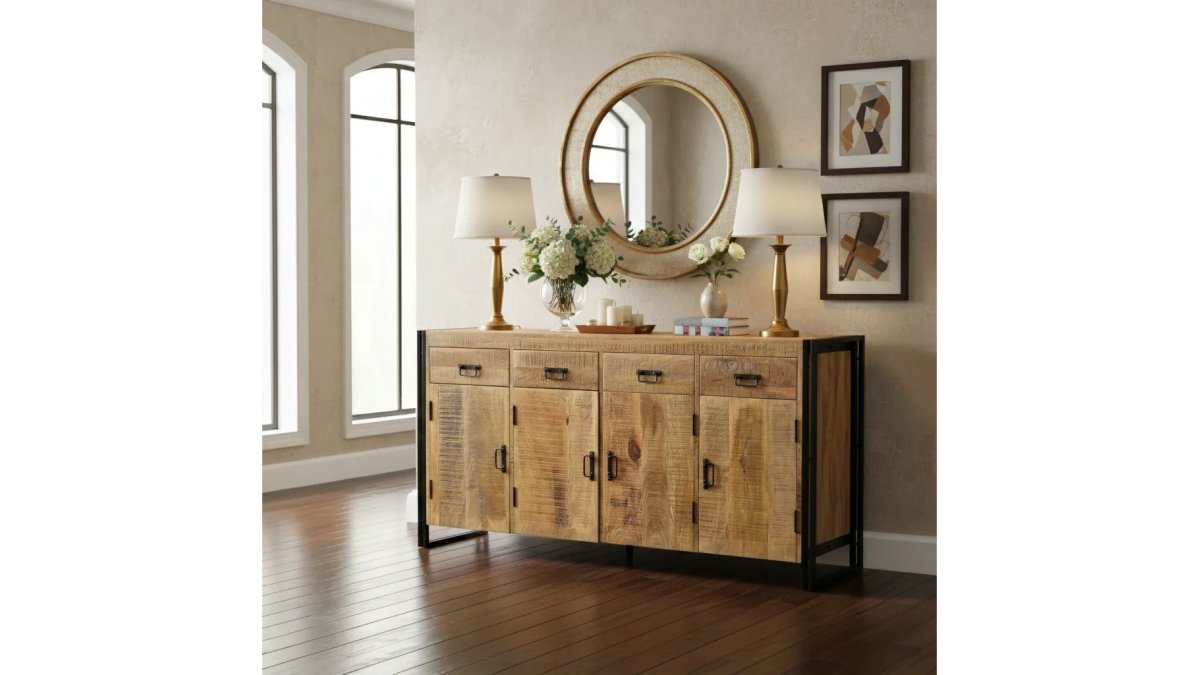
Look for solid construction over veneer. Dense species like mango wood resist daily wear and hold their structure for decades. An industrial iron frame adds alignment and handles heavy display weight without bowing.
A good example is the Reclaimed Wood Sideboard. Its four-door, four-drawer layout hides dinnerware or media gear, and the salvaged planks make it a genuine statement piece. It works in dining rooms, entryways, or formal living areas.
Choosing salvaged furniture is one of the simplest circular economy moves you can make. You're buying material that already exists.
Biophilic Design Integration: Bringing the Outdoors In
Biophilic design is the practice of connecting indoor spaces to nature through light, plants, natural materials, and views. It's not about filling every corner with greenery. It's about making a room feel alive.
Start with daylight. Keep window treatments light and pull furniture away from glass. Add living plants in breathable containers, then layer in wood, stone, wool, and clay.
The Orion Hexagonal Plant Pot is a practical pick here. It's 3D printed with PLA, a thermoplastic from upcycled materials like corn, beets, and wheat grass. It is 100% biodegradable, recyclable, and compostable. Its 35 precision openings prevent overwatering and root rot. Ten colors are available, so it fits most palettes.

Then there's the REVOLVE Eco-Friendly Watering Can. It's made from 60% corn-derived bioplastic and 40% recycled wood fibers, with a natural wood look and aroma. The elongated spout gives you precise watering without splashing shelves.
Layer tactile surfaces next. A boucle chair, a linen throw, a jute rug. Your hands should find something soft or textured at every turn.
Circular Design Principles: Furniture That Comes Full Circle
Circular design means building pieces that can be repaired, refinished, resold, or recycled instead of thrown away. It's the opposite of fast furniture, which is engineered to be replaced.
Ask three questions before you buy:
- Can this be repaired if a joint fails?
- Are replacement parts or hardware available?
- Can the materials be separated and recycled at end of life?
Modular furniture scores well here. So does anything with visible, replaceable hardware rather than glued seams. Heirloom quality isn't a marketing phrase; it's a construction standard.
Conscious consumption also means resisting the seasonal refresh. Buy one considered piece instead of three cheap ones. Your room looks better, and your waste drops.
Low-VOC and Non-Toxic Finishes for Healthier Indoor Air
Indoor air quality takes a hit when finishes off-gas. Conventional paints, adhesives, and sealants release volatile organic compounds for weeks after application. Low-VOC and zero-VOC options cut that exposure significantly, and the difference is measurable.
Here is the catch. "Low-VOC" is not a single standard. It is a range. A product can carry the label and still release more than you expect. So read the actual number, not just the badge.
What to look for on the can or spec sheet:
- VOC content in grams per liter, not just a marketing claim
- Water-based rather than solvent-based formulas
- Plant-oil sealants and natural waxes for wood
- Hardwax oil instead of polyurethane for floors and tables
- Paints labeled low-VOC or zero-VOC with the number printed
For wood, a hardwax oil protects the surface while letting grain breathe. It also touches up easily. A scratched polyurethane finish usually means sanding the whole piece. A hardwax oil finish means spot repair with a cloth.
For walls, choose paint labeled low-VOC and check the number. Then think about the whole system. Primer, paint, caulk, and adhesive all contribute. If you upgrade the paint but use a solvent-based adhesive, you have not solved much.
Ventilation matters as much as product choice. Open windows during and after application, and run fans for several days. New furniture deserves the same treatment. Let it air out in a garage or spare room before it lands in your bedroom.
One more thing people miss. Finishes that hold up better mean you refinish less often. A durable, repairable finish is a sustainability feature, not just a health one. You keep the piece, you skip the replacement, and you skip a whole new round of off-gassing.
The Benefits of Milk Fiber Textiles in Your Home
Milk fiber textiles are fabrics made from casein, a protein extracted from milk. The fiber is soft, breathable, and naturally hypoallergenic, which makes it a strong choice for bedding and throws.
Here's why it works. Casein fiber regulates moisture and temperature well, so it feels comfortable across seasons. It drapes beautifully and holds dye evenly, giving you rich, lasting color. For anyone with sensitive skin or allergies, a hypoallergenic textile removes a daily irritant.
Pair milk fiber with organic cotton or linen for a bedding set that breathes. Portugal-woven bedding is a good benchmark here. You get tight, durable construction and a soft hand that survives repeated washing.
Natural fibers also break down better at end of life than synthetic blends. That's the quiet advantage: comfort now, less waste later.
Durable Furniture for Daily Use: Built to Last
Durability is the most underrated sustainability feature. A sofa that lasts twenty years uses far fewer resources than four that last five years each. Longevity is environmental policy you can sit on.
What signals real durability? Solid hardwood frames. Mortise-and-tenon or doweled joints. High-density cushioning that holds shape. Metal hardware that won't strip. And finishes that can be touched up instead of replaced.
Bone inlay furniture is a good case study. Each piece is assembled by hand, with individual pieces set into the surface, and the result is dense and structurally solid. It's the kind of work that survives decades of daily use.
Fluent Trends stocks a collection of durable furniture for daily use built around exactly this idea. Think pieces engineered for real households, not showrooms.
How to Source OEKO-Tex Certified Home Goods
OEKO-TEX certification verifies that a textile has been tested for harmful substances (OEKO-TEX® STANDARD 100). If you want a shortcut past greenwashing, this is it.
Here's how to source certified goods in five steps:
- Check the label for the specific OEKO-TEX standard name
- Ask the retailer for the certificate number
- Verify that number in the OEKO-TEX label directory
- Confirm the certified item matches the product you're buying
- Ask whether the certification covers the finished product or just the fabric
That last point trips people up. A certified fabric doesn't guarantee a certified finished good, because dyes, trims, and assembly can introduce new substances. Ask directly.
Reputable makers answer these questions without hesitation. If a brand gets vague, treat that as your answer.
Space-Saving and Functional Layouts for Smaller Footprints
A smaller home can be a more sustainable one. Less square footage means less heating, cooling, and stuff to fill it. The trick is making every zone work harder.
Start with multi-purpose pieces. A sideboard doubles as a media console and a bar. A bench with storage handles seating and shoe overflow. Modular furniture adapts when your needs change.
Keep walkways clear at roughly 36 inches. Float furniture away from walls where you can, which makes rooms feel larger and improves airflow. Vertical storage uses wall height instead of floor area.
Minimalism isn't about emptiness. It's about intention. Own fewer things, and make each one earn its place.
Vintage and Antique Sourcing: The Art of the Find
Vintage furniture is the original circular purchase. It's already been manufactured, shipped, and used. Anything you buy secondhand avoids new production entirely.
Estate sales, local auctions, and consignment shops are your best hunting grounds. Go early, bring a tape measure, and inspect joints, drawers, and undersides before you commit. Smell matters too; a strong chemical odor can signal old finishes that need stripping.
Upcycling extends the life further. A new coat of low-VOC paint or fresh upholstery can turn a dated piece into a centerpiece. Keep original hardware when you can; it's often the most valuable part.
The one thing nobody tells you about vintage sourcing is patience. The right piece shows up when you stop forcing it.
Budget-Friendly Sustainable DIY Projects
You don't need a big budget to make greener choices. Some of the best moves cost very little and take an afternoon.
Try these projects:
- Refinish a worn wooden table with hardwax oil instead of replacing it
- Sew cushion covers from organic cotton or linen remnants
- Build simple shelves from reclaimed wood offcuts
- Repot plants into breathable, recyclable containers
- Swap plastic storage bins for woven jute or cotton baskets
The STREAM Eco-Friendly Minimalist Pencil Holder and Planter is a good small-project anchor. It's made to order, fully recyclable, and works as both a planter and a desk organizer. The Sculpt Mirror is another easy upgrade; its frame uses sustainable bioplastic with up to 40% natural wood fibers, and it comes with mounting hardware and a leveling template.

Small swaps add up. A room built from repaired and reused pieces has more personality than one ordered from a catalog.
How to Calculate Your Carbon Footprint at Home
A home carbon footprint is the total greenhouse gas emissions generated by your household, measured in carbon dioxide equivalent. You can estimate it without special tools.
Use this formula as a starting point:
Annual home emissions = (electricity kWh × grid factor) + (gas therms × 5.3) + (miles driven × 0.4) + (goods purchased × estimated intensity)
Then break down the furnishing piece specifically:
- Weight of the item in kilograms
- Distance shipped in kilometers
- Transport mode (sea freight is far lower impact than air)
- Material type (recycled and reclaimed content lowers the total)
End-of-Life Disposal and Recycling for Furniture
Every piece you own will eventually leave your home. Planning for that day is part of buying well.
Your options, roughly in order of preference:
- Repair or refinish it
- Donate to a charity or shelter
- Sell through a consignment shop or marketplace
- Give it away through a local buy-nothing group
- Recycle metal, glass, and clean wood components
- Dispose as a last resort
Many municipalities run bulky-item pickup or annual collection events. Check your local waste authority's rules before you haul anything to the curb. Mattresses, upholstered items, and treated wood often have separate handling requirements.
Natural fiber textiles and untreated solid wood break down more readily than synthetic blends and composite boards. That's another reason material choice matters at the point of purchase.
Regional Sourcing: Why Local Matters
Local sourcing cuts the distance between maker and home. Fewer miles means lower transport emissions, and it usually means better accountability too.
Regional sourcing also supports nearby economies and preserves craft traditions that would otherwise disappear. A handcrafted piece from a maker you can actually contact is worth more than an anonymous import.
Ask where materials originate, not just where the item ships from. A locally assembled piece made from imported components has a very different footprint than one built from regional timber and fiber.
This is where the artisan model earns its keep. Traditional, low-waste techniques, fair wages, and women-owned workshops keep skills alive while producing goods built to last. Fluent Trends builds its Artisan Collection around that idea, supporting global makers through sustainable practices and handcrafted detail.
Frequently Asked Questions
What are the top sustainable home decor trends for 2026?
Look for earthy tones, biophilic design with plants, reclaimed wood pieces, and low-VOC finishes. Milk fiber and Portugal-woven bedding are gaining attention for being hypoallergenic and durable. Boucle and bone inlay furniture made from sustainably sourced materials are also trending. Focus on items that are built to last and support circular design.
How do I identify truly sustainable furniture materials?
Check for certifications like OEKO-Tex for textiles. Look for reclaimed or recycled content, low-VOC finishes, and durable construction. Ask about the supply chain. Brands that prioritize ethical manufacturing and transparency help you avoid greenwashing. For example, mango wood and reclaimed teak are good choices.
Why is milk and casein fiber becoming popular in home textiles?
Milk and casein fiber are popular because they are hypoallergenic, breathable, and sustainable. They come from renewable resources and are biodegradable. These fibers offer a soft, luxurious feel similar to silk but are more durable. They also regulate temperature, making them great for bedding and upholstery.
What makes Portugal-woven bedding a sustainable choice?
Portugal-woven bedding often uses organic cotton and natural fibers. Many Portuguese mills hold OEKO-Tex certifications, ensuring no harmful chemicals. The durability of the weave means the bedding lasts longer, reducing waste.
How can I ensure my furniture is built to last?
Look for solid wood construction. Durable furniture for daily use often uses kiln-dried hardwood and reinforced frames.
Are boucle and bone inlay furniture considered sustainable?
It depends on the source. Boucle made from natural wool or organic cotton is sustainable. Bone inlay can be sustainable if the bone is a byproduct and ethically sourced. Look for brands that use reclaimed materials and non-toxic finishes. Always ask about the origin and production methods.