

What Is Contemporary Furniture Design A Simple Guide
Donna MaloneIf you've ever heard the term "contemporary furniture," you might think of it as just another design buzzword. But it’s much simpler than that. Contemporary design is quite literally the style of right now. It's a living, breathing design language that reflects how we live today, defined by its crisp lines, quiet sophistication, and a less-is-more attitude.
Defining the Here and Now in Furniture Design
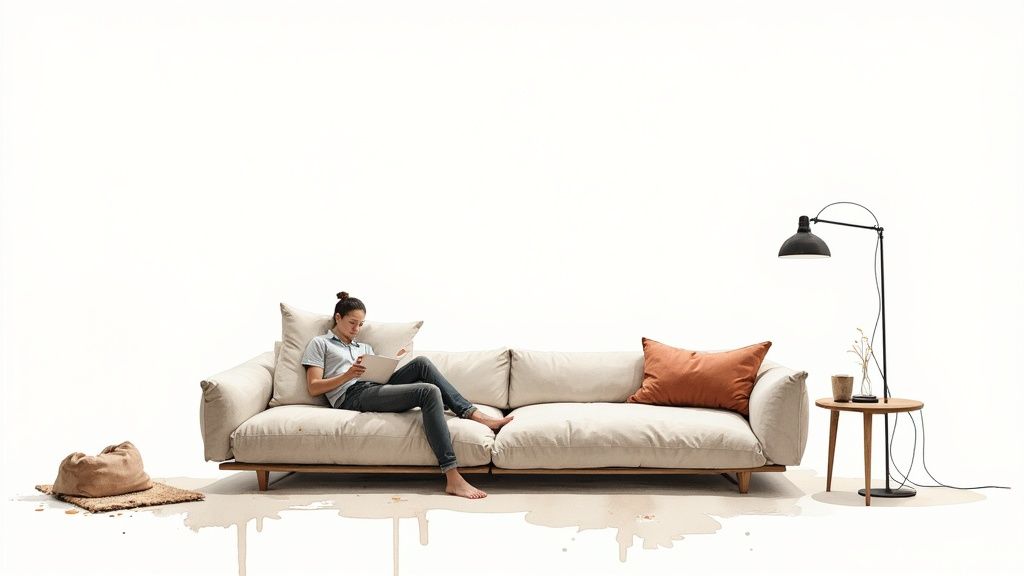
To really get what contemporary furniture is, we first have to clear up what it isn't. The biggest point of confusion? People often use "contemporary" and "modern" as if they mean the same thing. They don't. Getting this distinction right is the first step to truly appreciating this ever-evolving style.
Modern design refers to a very specific, historical period—mostly the mid-20th century. Its story has already been written. Think of it like a classic film; the script is finished, the aesthetic is set in stone. The iconic Eames Lounge Chair is pure modernism.
Contemporary design, on the other hand, is the style of this moment. Its story is still being written, and we're all a part of it. While it definitely takes cues from modernism's love for clean lines and simplicity, it also borrows from other design movements and whatever is currently trending.
The Core Principles of Contemporary Style
At its heart, contemporary design is all about creating spaces that feel open, airy, and sophisticated without being fussy. It pulls this off with a few key ingredients:
-
Clean Lines: You'll see smooth surfaces and sharp, straight lines or, occasionally, soft, organic curves. What you won't see is a lot of extra ornamentation or fussy details.
-
Neutral Color Palette: The look is often built on a foundation of neutrals—think black, white, gray, and cream. This calm backdrop really lets the shape of the furniture do the talking.
-
Emphasis on Form: Unlike styles that try to hide a piece's construction, contemporary design often puts it on display. A sculptural armchair or a coffee table with a unique, geometric base can easily become the star of the room.
The key takeaway is its fluidity. What looks contemporary today might feel dated in twenty years, because the style is constantly adapting to new materials, technologies, and cultural shifts.
This constant evolution is what makes it such an exciting and dynamic choice for any home. Once you understand its core ideas, you can start to see and appreciate its unique beauty everywhere. To see how contemporary stacks up against other popular looks, our comprehensive furniture style guide is a great place to continue exploring.
The Story Behind Contemporary Style
Contemporary furniture design didn't just pop up overnight. It's more like a running conversation between different design movements, with each decade adding its own unique perspective. To really get what contemporary furniture design is all about, we have to look back at the styles that set the stage, especially its famous older sibling, modernism.
The whole story kicks off around the mid-20th century. Modern design, particularly the Mid-Century Modern look we all know and love, was a huge deal. It was driven by a simple, powerful idea: "form follows function." This movement was all about clean lines, soft organic shapes, and an honest use of natural materials like wood.
While contemporary design definitely inherited this love for simplicity, it decided to toss out the strict rulebook that modernism lived by.
From Modernism's Rules to Postmodernism's Rebellion
Fast forward to the 1970s and 1980s. A new, rebellious energy was in the air, and Postmodernism burst onto the scene as a direct challenge to modernism's seriousness. It was fun, a little wild, and wasn't afraid to be ironic. Postmodernism brought a sense of freedom, showing everyone that design didn't have to be so buttoned-up.
Contemporary style soaked up this playful spirit. It took the clean, functional base of modernism and mixed in Postmodernism's courage to experiment with new shapes and materials. This is why you might see a contemporary sofa that has a simple, modern frame but sits on surprisingly sculptural legs—it's a little nod to breaking the rules.
Contemporary design is a blend of influences. It has the disciplined DNA of modernism, the creative spirit of postmodernism, and the focused simplicity of minimalism, all adapted for the way we live right now.
This unique mix is what allows contemporary pieces to feel both timeless and totally of-the-moment.
The Rise of Minimalism and Beyond
A bit later, Minimalism joined the chat with its unforgettable "less is more" mantra. This philosophy doubled down on the idea of uncluttered rooms, the power of negative space, and a laser focus on only what’s absolutely essential. Contemporary design fully embraced this, which you can see in its clean color palettes and total lack of fussy decoration.
But contemporary style isn't as rigid as pure minimalism. It leaves more room for comfort, texture, and a bit of personality. It’s like it went through the design history books and cherry-picked the best ideas from each major movement:
-
From Modernism: A deep respect for clean lines and practical forms.
-
From Postmodernism: The artistic freedom to bend and break the rules.
-
From Minimalism: An appreciation for simplicity and using space with purpose.
By weaving these powerful influences together, contemporary design became the flexible, ever-evolving style we see today. It isn't stuck in one period of history. Instead, it’s a living reflection of our current culture, technology, and how we actually live our lives. This journey is exactly what gives contemporary furniture its special talent for feeling both sophisticated and effortlessly current.
5 Key Characteristics of Contemporary Furniture
To really get contemporary furniture design, you have to learn its visual language. It’s a style built on intentional choices that create a feeling of calm, sophisticated cool.
Unlike the ornate or fussy styles of the past, contemporary design doesn’t shout for attention. It speaks in a quiet, confident voice, focusing on form, texture, and the space around each piece.
1. It Starts With Clean Lines
The absolute foundation of contemporary furniture is clean lines. Think smooth surfaces, crisp geometric shapes, and gracefully flowing curves.
You simply won’t find any intricate carvings, heavy ornamentation, or complicated details here. The beauty is in the pure form of the object itself—whether it's the sharp, defined angle of a console table or the soft, inviting arc of an armchair. This simplicity lets each piece feel like a standalone sculpture.
2. A Sophisticated Mix Of Materials
Another signature move is the deliberate mix of materials, often pairing something natural and textured with a sleek, man-made finish. It’s this contrast that creates a dynamic, layered look that feels both grounded and incredibly current.
This trend is a direct reflection of what's happening in the global furniture market. That market, valued at roughly USD 540 billion in 2025, is expected to climb to USD 684.5 billion by 2035. While wood is still king, making up 57% of sales, the growing use of metals, glass, and sustainable composites is a true hallmark of contemporary taste. You can learn more about these industry trends and how they’re shaping design.
Some classic combinations you’ll see are:
-
Wood and Metal: A light maple dining table paired with polished chrome legs.
-
Glass and Stone: A minimalist glass coffee table anchored by a solid marble base.
-
Leather and Steel: A plush leather sofa resting on a barely-there stainless steel frame.
This thoughtful fusion adds a ton of visual interest without creating clutter, which is always the goal.
3. Neutral Palettes With A Purpose
Color in contemporary design is all about restraint and intention. The foundation is almost always a neutral color palette, which immediately creates a serene, spacious feel.
Think of the neutral base as the canvas for the entire room. Shades of white, cream, beige, gray, and black are used for walls, floors, and big anchor pieces like sofas. This lets the room's architecture and the furniture's form take center stage.
But don't mistake neutral for boring! This calm canvas is the perfect backdrop for a bold, intentional pop of color. Imagine an all-gray living room that suddenly comes alive with a single armchair in a deep sapphire blue, or a bright piece of abstract art.
It's all about creating impact through contrast, not by overwhelming the eye with a bunch of competing colors.
Contemporary Design Vs Modern Design At A Glance
People often use "contemporary" and "modern" interchangeably, but in the design world, they mean very different things. Modern design refers to a specific historical period (roughly the 1920s-1950s), while contemporary design is all about the now.
This table breaks down the key distinctions.
| Characteristic | Contemporary Design | Modern Design |
|---|---|---|
| Time Period | Constantly evolving, reflects the "now" | A specific era, primarily Mid-Century Modern (1920s-1950s) |
| Color Palette | Mostly neutral with bold pops of color | Earthy tones: olive, rust, brown, mustard yellow |
| Lines | A mix of clean, straight lines and soft curves | Crisp, clean, straight lines are dominant |
| Materials | Natural & industrial mix: metal, glass, stone, light woods | Natural materials: wood (especially teak, walnut), leather, plastic |
| Overall Vibe | Calm, spacious, uncluttered, and sophisticated | Warm, organic, and retro-functional |
Understanding these differences is the key to really appreciating what makes each style unique.
5. Open Space and Natural Light
Finally, contemporary design is as much about the space around the furniture as the furniture itself. It favors open-concept layouts that let a room breathe.
Furniture is often arranged to create a sense of flow and is sometimes "floated" away from the walls. Large, unadorned windows are also a key feature, letting in as much natural light as possible to make the space feel bright, airy, and connected to the outdoors.
How Sustainability Is Reshaping Today's Furniture
The clean lines and calming palettes we love in contemporary furniture are getting a serious update, driven by two huge demands of modern life: sustainability and smart functionality. This isn't just a passing phase; it’s a real shift in how we think about the things we invite into our homes. We're looking past pure aesthetics and asking our furniture to be both beautiful and responsible.
This growing desire for more mindful living has designers completely rethinking their approach to materials and manufacturing. Eco-friendly resources are now front and center, with things like reclaimed wood, recycled fabrics, and cool new composites becoming the norm. The conversation has broadened to cover the entire lifespan of a piece, from where the materials come from to whether it can be recycled down the road.
The big idea is circularity—designing furniture that not only looks great now but is built and can be broken down in a way that’s gentle on the planet for years to come.
You can see this thoughtful approach everywhere, from dining tables crafted from salvaged timber to modular sofas covered in fabrics made from old plastic bottles. We’ve actually put together a whole guide on sustainable furniture brands that are leading the charge.
Smarter Designs for Modern Living
At the same time, the realities of city living have created a huge need for multifunctional furniture. When your living space is on the cozier side, every last inch matters. Contemporary design has met this challenge head-on with brilliant, adaptable pieces that do more than one job without cramping your style.
Picture a sleek coffee table that smoothly rises to become a perfect work-from-home desk, or a stylish ottoman that pops open to reveal a ton of hidden storage. These aren't the clunky, awkward convertible pieces from decades past. They are elegant, clever solutions that blend right into a polished, modern home.
Globally, this growing eco-consciousness is pushing makers to adopt circular design—think less waste and more recycled materials. This push for sustainability is perfectly matched by the boom in the multifunctional furniture market, which hit a value of USD 15.9 billion in 2024. This corner of the market, filled with foldable and convertible pieces, is set to grow at a 4.9% rate every year through 2034. It's a clear sign that we need versatile furniture for our smaller, smarter homes.
Ultimately, sustainability and multifunctionality aren't two separate trends. They're two sides of the same coin, both answering our collective call for a more intentional way of living. Contemporary design is proving, once and for all, that you don’t have to pick between a beautiful home and a responsible one—the best designs give you both.
Bringing Contemporary Style Into Your Home
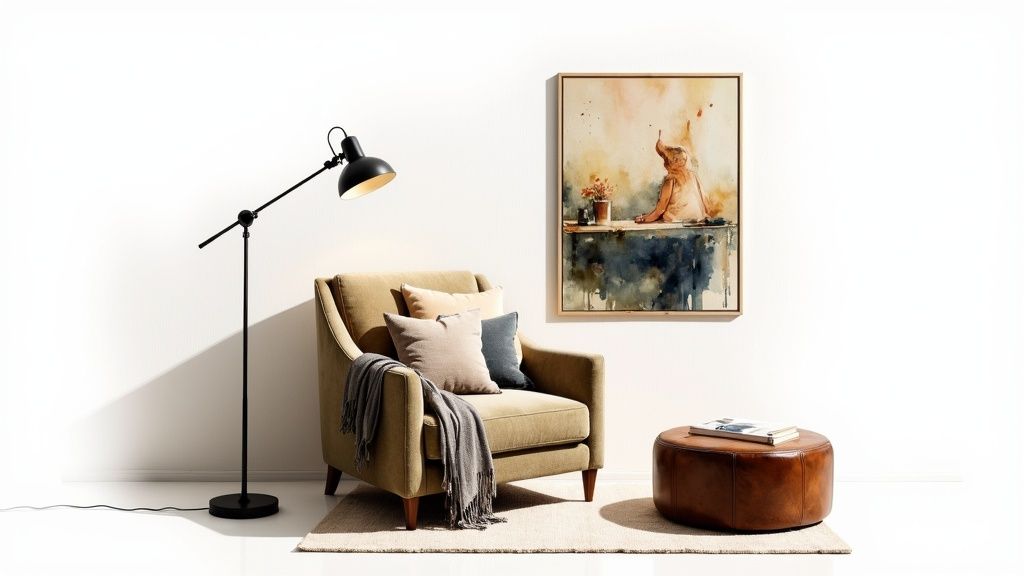
It’s one thing to admire the theory behind contemporary design, but actually bringing that clean, sophisticated vibe into your own home can feel like a totally different ballgame. The good news? You don’t need to start from scratch. It’s all about making a few smart, deliberate choices that work together to create a calm, cohesive feel.
First things first, let's set the stage. Contemporary style really shines when it has a quiet backdrop to play against, so start with your walls and floors. Think soft grays, warm whites, or other muted neutrals. This simple palette creates a canvas that lets the unique shapes and materials of your furniture become the real stars of the show.
Select a Hero Piece to Anchor the Room
With your foundation in place, it’s time to pick one show-stopping "hero" piece. This is the item that will anchor the entire room and set the tone for every other element you bring in. Go for something with a bit of an artistic, sculptural quality.
Here are a few ideas to get you started:
-
A sculptural armchair with dramatic curves or an unusual silhouette.
-
An artistic light fixture that feels more like a hanging sculpture.
-
A statement coffee table crafted from interesting mixed materials, like marble and metal.
Choosing one impactful piece like this is how contemporary design comes to life in a real space. It immediately injects personality and prevents the room from feeling bland or generic.
Layer Textures for Warmth and Depth
One of the biggest misconceptions about contemporary interiors is that they can feel cold or clinical. The secret to fighting that sterile feeling is all about texture. Layering different materials is what adds warmth, visual interest, and that touchable quality that makes a room feel like a home.
Try to create a subtle contrast by mixing soft and hard surfaces. Think about a plush wool rug under a sleek leather sofa, or tossing a few bouclé pillows on a chair. A smooth ceramic vase on a console table made of natural wood does the trick, too. It’s this mix of textures that creates a rich, inviting atmosphere that still feels clean and uncluttered.
And finding these pieces has never been easier. The global furniture industry was valued at over USD 691 billion as of 2025 and is expected to climb to USD 902.09 billion by 2030, with a huge part of that growth coming from online shopping. This boom gives you access to an incredible variety of contemporary designs, from modular sectionals to smart-home-integrated furniture. You can learn more about these furniture industry growth trends and see how they’re shaping the way we decorate.
Got Questions About Contemporary Design? Let's Clear Things Up.
Even after you get the basics down, contemporary furniture can feel a little elusive. It’s a style that’s always changing and loves to borrow from other aesthetics, which naturally leads to a few questions.
Let’s tackle some of the most common points of confusion. Getting these straight will have you spotting and styling contemporary pieces like a seasoned pro.
What’s The Real Difference Between Contemporary And Modern Furniture?
This is, without a doubt, the biggest mix-up in the design world. But there’s a super simple way to remember it: modern design is a specific style from the past, while contemporary design is what’s happening right now.
"Modern" refers to a finished chapter in design history, mainly the Mid-Century Modern movement that spanned from the 1920s to the 1950s. Its characteristics are set in stone—think warm, earthy color palettes and a heavy use of woods like teak and walnut.
Contemporary style, on the other hand, is a living, breathing thing. It takes inspiration from modernism's love of clean lines but runs in a different direction with a cooler, more neutral palette. It also loves to mix those natural materials with industrial elements like metal and glass.
Is Contemporary Furniture Just Another Name For Minimalist?
Not quite. While they both appreciate simplicity and a "less is more" attitude, they aren't the same. Think of minimalism as the more hardcore of the two. It's a true philosophy focused on stripping everything back to its most basic function, which can sometimes look a bit stark.
Contemporary design is much more relaxed. It celebrates that same uncluttered feeling but happily makes room for gentle curves, a variety of textures, and pops of bold color.
You could say minimalism is a major influence on contemporary style, but contemporary design gives you way more freedom to show personality and get comfortable. It’s a softer, more livable approach to simplicity.
This is exactly why a contemporary room can feel both spotlessly clean and wonderfully inviting at the same time.
What Kinds Of Materials Are Used In Contemporary Furniture?
One of the hallmarks of contemporary furniture is its bold and often contrasting mix of materials. Instead of sticking to one look, designers love to create a dynamic interplay between different textures.
You’ll almost always find a combination of:
-
Natural Elements: Light-colored woods like maple and birch are favorites, along with stones like marble and travertine. These bring an organic, grounding feel to a room.
-
Industrial Touches: Metals are a must. Sleek stainless steel, polished chrome, and nickel are all over the place, used for legs, frames, and accents that add a sharp finish. Glass is also a go-to for tabletops and shelving.
-
Forward-Thinking Textures: As designers push boundaries, you’ll see more innovative materials like concrete composites, acrylics, and even recycled plastics making an appearance.
The magic happens in the contrast—the coolness of metal playing off the warmth of wood, or the smoothness of glass next to the texture of stone.
How Do I Keep A Contemporary Room From Feeling Cold?
This is a common worry. With all the neutral colors and clean lines, how do you stop a space from feeling like an art gallery instead of a home? Luckily, it’s easy to dial up the warmth.
Your best friend here is texture. Bring in soft things that make you want to reach out and touch them. A plush area rug, some velvet or bouclé throw pillows, or a chunky knit blanket can instantly soften the room's edges.
Next, think about your lighting. Ditch the single harsh overhead light and layer your lighting instead. A few well-placed floor lamps and table lamps will cast a warm, inviting glow. And finally, make it yours! Add artwork, family photos, and a few green plants to bring life and personality into the space. That’s what turns a stylish room into a home.
At Fluent Trends, we believe creating a beautiful, contemporary home should be an inspiring journey. Explore our curated collection of designer-approved furniture and décor to find the perfect pieces that reflect your personal style. Shop our new arrivals today and start building a space you'll love.