

Why Choose Ethically Sourced Home Goods: A 2026 Guide
Yuatinia LeakTable of Contents
- Why Choose Ethically Sourced Home Goods? The Real Reasons
- The Benefits of Sustainable Home Decor Go Beyond Aesthetics
- Durable Materials for Home Interiors That Actually Last
- How to Identify Ethically Made Furniture Without Getting Fooled
- Eco-Certifications and How to Read Them
- Greenwashing and the Limits of Certification
- Worker Welfare, Fair Wages, and Safe Working Conditions
- Lifecycle Trade-Offs and End-of-Life Options
- A Category-by-Category Buying Guide
- Conclusion
- Frequently Asked Questions
Last Updated: October 7, 2026
Why Choose Ethically Sourced Home Goods? The Real Reasons
Walk into any home store and you will see words like "natural" and "green" on almost everything. That noise makes it hard to tell what is real. Ethically sourced home goods are products made with verified materials, fair labor, and production methods that limit harm to people and the planet. This guide from Fluent Trends cuts through the labels.
Most shoppers think this choice is only about the environment. That is a mistake. The bigger payoff is a home full of pieces that last, feel good, and carry a story you can actually trace.
It Is Not Just About the Planet
The environment matters, no question. But ethical sourcing also protects the people who make your furniture. Many makers work in small workshops with no safety net. Fair pay and safe conditions change their lives. When you buy with care, your money supports that.
There is a personal benefit too. Pieces made well tend to hold up longer. You replace them less often. That saves money and cuts waste at the same time. A common mistake is assuming "eco" means expensive and fragile. Often the opposite is true.
The Benefits of Sustainable Home Decor Go Beyond Aesthetics
Sustainable home decor delivers practical value, not just a nice look. Durable pieces resist daily wear, so your rooms stay beautiful for years. Natural materials also age with grace instead of falling apart.
Think about what you actually gain:
- Furniture built to last means fewer replacements and less landfill waste
- Natural fibers breathe better and feel softer against your skin
- Handcrafted details give your space a character no mass-produced item can copy
- Traditional low-waste techniques reduce the environmental footprint of each piece
Many homeowners find that one well-made statement piece does more for a room than five cheap ones. That is the real benefit. Quality shows.
Durable Materials for Home Interiors That Actually Last
Durable materials for home interiors are the ones that survive real life. Look for solid wood, natural fiber, and tightly woven fabric. These hold their shape and resist the daily grind of a busy home.
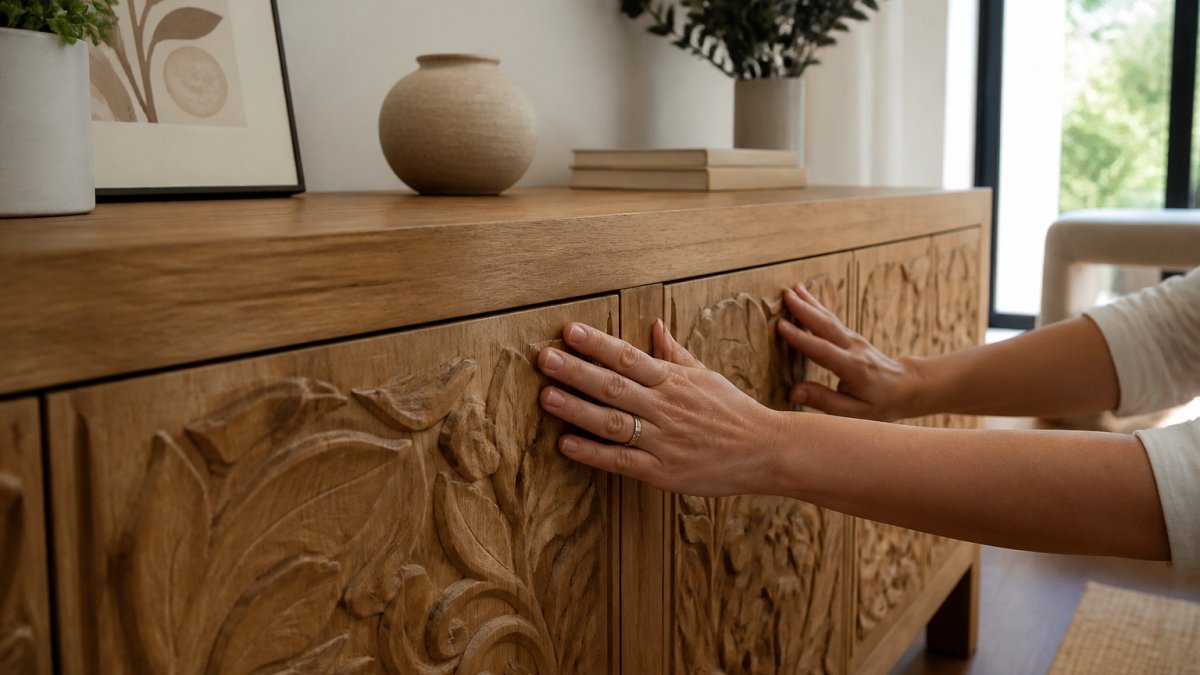
Wood, Fiber, and Fabric That Hold Up
Acacia wood and sheesham wood are two of the toughest choices for furniture. Both resist scratches and stand up to heavy use. Our hand-carved sideboard is built from reclaimed acacia wood, so it brings warmth and history to a room. The natural grain shifts in color, and no two pieces match exactly.

For soft goods, look at organic cotton, linen, and wool. Portugal-woven bedding is a strong example. If you have sensitive skin, hypoallergenic options matter. OEKO-Tex certified textiles are tested for harmful substances, so they are safer for you and your family.
Boucle furniture brings soft texture and holds its shape well. Bone inlay furniture adds intricate detail that machine production cannot match.
How to Identify Ethically Made Furniture Without Getting Fooled
To identify ethically made furniture, ask three questions. Who made it? What is it made of? Can the seller prove it? If a brand cannot answer clearly, treat that as a warning sign.
Most guides skip the hard part. They tell you to "buy sustainable" and stop there. That advice is useless without a way to check. So here is a system you can use in the store or online.
A Practical Verification Checklist for Shoppers
Run every potential purchase through this list:
- The maker or workshop is named, not hidden behind vague terms
- Materials are listed specifically, such as reclaimed acacia wood or organic cotton
- Certifications are named and can be verified on the certifier's own site
- The brand explains fair wages and safe working conditions
- Care and repair instructions are provided
- Return and damage policies are clear before you buy
- The price reflects real materials, not just a trendy label
If a piece passes most of these, you are on solid ground. If it fails several, keep looking.
Eco-Certifications and How to Read Them
Eco-certifications are third-party checks that verify a product meets a specific standard. They matter because a brand cannot certify itself. The Federal Trade Commission's Green Guides set the rules for how companies may describe environmental claims in marketing.
Here is how to read the common ones:
- OEKO-Tex: tests textiles for harmful substances, useful for bedding and fabric
- FSC: confirms wood comes from responsibly managed forests
- Fair Trade: focuses on fair pay and safe conditions for workers
- GOTS: covers organic fiber from farm to finished product
The key is to check what each one actually covers. A wood certification says nothing about labor. A labor certification says nothing about chemicals. Read the scope, not just the logo.
Greenwashing and the Limits of Certification
Greenwashing is when a company exaggerates or fakes its environmental claims. It is common, and it is getting harder to spot. A leaf icon and the word "natural" mean nothing on their own.
Certifications help, but they have limits. Small workshops often cannot afford the fees, so their honest work goes unlabeled. Meanwhile, big brands can pay for badges while changing little. That is the frustrating part. Direct relationships with artisans bypass these systemic shortcomings, making choosing small brands a more reliable path toward genuine accountability.
So do not rely on logos alone. Look for specifics. A brand that names its makers, lists its materials, and explains its process is usually telling the truth. Vagueness is the tell.
Worker Welfare, Fair Wages, and Safe Working Conditions
Most guides talk about trees and oceans. They skip the hands that make your furniture. That is a huge blind spot. Worker welfare is the piece that separates real ethical sourcing from green marketing.
Here is what fair wages actually mean. A maker earns enough to cover food, housing, healthcare, and school for their kids. Not just survival. Enough to build a life. Safe conditions mean no toxic fumes, no dangerous machines, and no forced overtime.
How do you check? Start with the brand's website. Look for named workshops or cooperatives. Look for statements about pay and safety. If a brand says "we care about our makers" but never names them, that is a red flag.
Ask these questions before you buy:
- Does the brand name the workshop or cooperative?
- Does it explain how wages are set?
- Does it mention safety training or protective gear?
- Does it publish any third-party labor audits?
A common pattern is the word "artisan" with no name attached. That label does marketing work, not honest work. Real ethical brands name their partners.
We work with women-owned businesses and global makers because of this. It is not a slogan. It is the difference between a supply chain that helps people and one that uses them. When you buy from brands that commit to fair pay and safe conditions, your money does more than decorate a room. It supports a family.
Lifecycle Trade-Offs and End-of-Life Options
Every product has a lifecycle. From raw material to disposal. The trade-offs are real. Honest brands talk about them. Most guides skip this part because it is messy. But you deserve the full picture.
Think about a piece of furniture. Extraction takes energy. Production uses water and chemicals. Transport burns fuel. Use phase depends on how long you keep it. End of life decides whether it becomes waste or a resource.
Distance is not the whole story. A piece shipped from far away carries more transport emissions than a local one. But a well-made piece that lasts thirty years beats a cheap one replaced every three. The total impact over time is far lower. Durability is the quiet hero of sustainability.
Here is how to compare trade-offs:
- Extraction: Reclaimed acacia wood avoids new logging. Organic cotton uses less water than conventional.
- Production: OEKO-Tex certified textiles limit harmful chemicals.
- Transport: Local sourcing cuts emissions. But durable goods shipped once beat disposable goods shipped often.
- Use: Hypoallergenic materials improve indoor air quality. Built to last furniture resists daily wear.
- End of life: Solid wood can be refinished or repaired. Natural fibers can be composted in some cases.
When a piece finally wears out, think about its end. Furniture built to last rarely ends up in a landfill. Someone else wants it. Resale, donation, or repair keeps it alive. That is the circular economy in action.
A common mistake is assuming "eco" means expensive and fragile. Often the opposite is true. A well-made piece costs more upfront but saves money over decades. You replace it less often. That cuts waste and saves cash.
A Category-by-Category Buying Guide
Different rooms need different thinking. Here is how to shop each category with ethics in mind.
Furniture, Bedding, and Decor
For furniture, prioritize solid wood and joinery over particleboard. Acacia, sheesham, and reclaimed wood are strong picks. Boucle and bone inlay pieces add texture and detail when you want something distinctive.
For bedding, look for organic cotton and Portugal-woven options. Check for OEKO-Tex certification if you have sensitive skin.
For decor, small handcrafted pieces carry big impact. A hand-thrown ceramic vase or a terracotta planter made by artisans supports real people. These are the details that make a room feel collected, not bought in one trip.

Conclusion
The challenge is simple. Most stores make it hard to know what you are really buying. Labels mislead, and claims go unchecked. You deserve better than guesswork.
At Fluent Trends, we built our Artisan Collection to solve that. Every piece is ethically made and sustainably sourced. We support women-owned businesses and global makers through fair practices. Our handcrafted goods use eco-friendly materials like organic cotton, wool, jute, and linen.
If you want furniture and decor that last and tell a real story, start with our durable furniture for daily use. Shop now and build a home you can feel good about.
Frequently Asked Questions
What are the primary benefits of buying ethically sourced home goods?
You get pieces made with real materials like acacia wood or organic cotton that hold up for years. You also support fair wages and safe conditions for makers. Many items use low-waste techniques, so your home looks good while your purchase supports better practices. It is a practical way to align your space with your values.
How do I identify truly ethical home brands?
Look for specifics, not slogans. A brand should name its makers, materials, and certifications like OEKO-Tex. Check if they explain where wood comes from or how fabrics are woven. If a company cannot answer basic questions about its supply chain, that is a red flag. Transparency matters more than a fancy label.
What materials should I look for in sustainable home decor?
Start with durable options like acacia wood, sheesham wood, or reclaimed wood. For textiles, choose organic cotton, linen, or Portugal-woven bedding with OEKO-Tex certification. These materials last longer and often use less water and energy to produce. Avoid pieces that feel flimsy or have strong chemical smells.
Does choosing ethical products support fair labor practices?
Yes, when you buy from brands that verify their supply chain. Ethical sourcing means makers earn fair wages and work in safe conditions. Many artisan groups, like those in Honduras or Portugal, rely on these sales to sustain their craft. Your purchase helps keep those traditions alive and supports communities.