

Why Handcrafted Goods Cost More: The Real Economics
Yuatinia LeakTable of Contents
- The True Cost Breakdown of Handcrafted Goods
- The Benefits of Buying Handcrafted Products
- Small-Batch vs. Mass Production: Why Scale Changes Everything
- The Value of Artisan Craftsmanship in a Mass-Produced World
- How to Identify Authentic Handmade Goods
- The Psychology of Value: Why Handcrafted Goods Feel Worth It
- Maintenance, Repairability, and the Long-Term Investment
- Supply Chain Transparency and Ethical Production
- Frequently Asked Questions
Last Updated: September 12, 2026
The True Cost Breakdown of Handcrafted Goods
Every handcrafted piece carries a price that reflects far more than materials. Understanding why handcrafted goods cost more starts with the actual economics behind each creation. A single artisan vessel might require hours of shaping, firing, and finishing.

Most guides speak in generalities. They say labor is expensive and materials cost more. A transparent cost breakdown shows exactly where each dollar lands and why the artisan cannot simply lower the number.
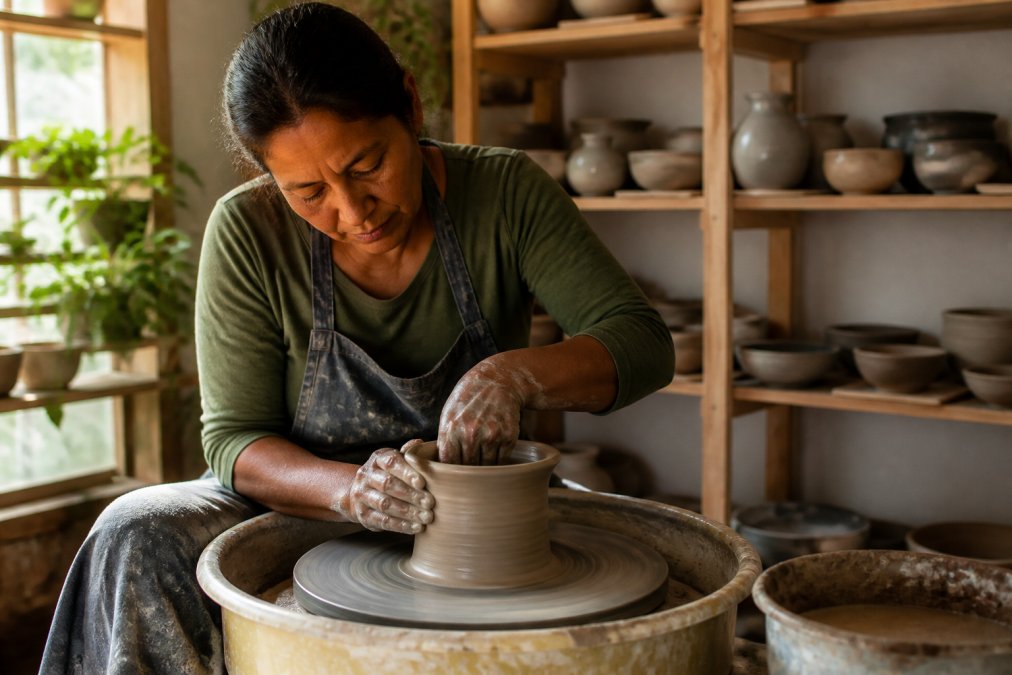
Where the Money Actually Goes
A handcrafted item's price splits into four main buckets. Materials, direct labor, studio overhead, and the maker's margin.
Materials typically run fifteen to thirty percent of the final price for small-batch goods. That range climbs when the maker uses organic fiber, natural dyes, or traceable stone. A factory buying synthetic substitutes in bulk can push material cost below ten percent.
Direct labor is the largest line item. Most artisans find that hands-on time accounts for forty to sixty percent of the price. A potter throwing, trimming, and glazing a single bowl may spend three to five hours on it. At a sustainable hourly rate, that time alone sets a floor.
Studio overhead covers rent, utilities, kiln firings, tool replacement, and insurance. For a small studio producing limited volume, overhead can add another fifteen to twenty-five percent. A factory spreads the same categories across thousands of units per day.
The remaining slice is the maker's margin. It funds future materials, slow seasons, and the ability to keep working.
Why the Invisible Labor Matters
What most buyers never see is the labor that produces nothing sellable. Sourcing trips, glaze testing, tool maintenance, and rejected pieces all consume hours. A common pattern among ceramicists is that one in five pieces fails to meet the maker's standard.
That failure rate is built into the price of the pieces that do sell. A factory discards defects at scale and absorbs the loss across millions of units.
The Setup and Prototyping Tax
Before a single sellable item exists, the maker prototypes. A furniture artisan might build three versions of a chair before one meets their standard. A textile artist may dye dozens of test swatches to lock a color.
Factories amortize prototyping across production runs of thousands. An artisan amortizes it across a run of ten or twenty. The math is unforgiving. It is the reason small-batch pricing rarely drops with volume.
Why Scale Cannot Fix This
Economies of scale reward repetition. Artisans cannot access those savings. The moment a maker automates to cut cost, the qualities buyers pay for start to disappear. That trade-off is why handcrafted goods cost more.
The Benefits of Buying Handcrafted Products
The benefits of buying handcrafted products extend well beyond aesthetics. Each purchase supports fair wages, reduces environmental impact, and delivers durability that mass manufacturing rarely matches.
Consider what you actually receive. A handcrafted piece carries unique design details that no two items share. The maker's intentionality shows in every seam, glaze, and joint. You are not buying a product. You are acquiring a small piece of someone's disciplined practice.

Traditional low-waste techniques mean less scrap, fewer chemicals, and a smaller carbon footprint. Many artisans work with natural materials that biodegrade rather than persist in landfills.
Factor |
Handcrafted Goods |
Mass-Produced Goods |
|---|---|---|
Production time |
Hours to weeks per piece |
Minutes per unit |
Labor type |
Skilled artisan |
Automated machinery |
Materials |
Organic, natural, traced |
Synthetic, untraced |
Durability |
Decades with care |
Limited lifespan |
Uniqueness |
One-of-a-kind |
Identical units |
Small-Batch vs. Mass Production: Why Scale Changes Everything
Small-batch production operates on an entirely different economic model than mass manufacturing. Economies of scale reward volume, which means factories lower unit costs by producing thousands of identical items.
Artisans cannot access those savings. A small-batch maker buying clay in modest quantities pays more per pound than a factory ordering by the ton. Overhead costs, from studio rent to kiln electricity, spread across far fewer units.
Profit margin works differently too. A mass manufacturer might accept a thin margin per unit because volume compensates. An artisan needs a healthier margin per piece simply to sustain the practice. This is not greed. It is survival.
The cost of goods sold for handmade items includes setup time, prototyping, and quality control that factories automate away. Every piece is inspected by hand.
The Value of Artisan Craftsmanship in a Mass-Produced World
Artisan craftsmanship preserves knowledge that industrial production has largely abandoned. When you buy from a skilled maker, you fund the continuation of cultural techniques that might otherwise disappear within a generation.
This value is difficult to quantify. This is precisely why it gets overlooked. A machine can replicate a shape, but it cannot replicate the judgment behind it. The artisan adjusts, corrects, and refines in real time.
Bespoke work commands the highest premiums because it cannot be replicated. Customization requires consultation, measurement, and a relationship between maker and buyer.
How to Identify Authentic Handmade Goods
Authentic handmade goods share recognizable markers that factory imitations struggle to fake. Learning these signals protects you from paying artisan prices for mass-produced items.
Start with the surface. Handcrafted pieces show subtle variations: uneven glazes, slight asymmetries, and tool marks. Perfect uniformity usually indicates a mold or a machine.
Signs of Genuine Craft vs. Factory Imitation
- Visible tool marks or hand-finishing details
- Slight variations between supposedly identical items
- A maker's signature, stamp, or studio mark
- Documentation of materials and origin
- A named artisan or workshop you can research
- Weight and heft consistent with solid natural materials
Factory imitations often fail on weight first. Synthetic substitutes feel hollow or unnaturally light. Genuine stoneware, solid wood, and natural fiber carry a density you can feel immediately.
The Psychology of Value: Why Handcrafted Goods Feel Worth It
Consumer behavior research consistently shows that people assign higher value to objects they believe carry human effort. It is a measurable bias that shapes what buyers will pay.
Behavioral economists call one version of this the IKEA effect. People place disproportionate value on things they helped create, even when the result is objectively inferior to a professional version. The same principle extends to objects they believe a human made with care.
The Effort Heuristic
When buyers evaluate a product, they unconsciously weigh the effort behind it. A piece that clearly took hours of skilled work reads as more valuable than an identical piece that appears machine-made. Researchers describe this as the effort heuristic. It holds even when the two objects are physically indistinguishable.
This explains a strange pattern. Two vases can look the same on a shelf. The one with a maker's story attached commands a higher price. Buyers report greater satisfaction with it.
Why Story Changes the Calculation
A handcrafted piece arrives with a narrative. You know who made it, where the materials came from, and what technique shaped it. That story transforms an object into a possession with meaning.
Narrative does something specific to the brain. Buyers are not comparing the vase to other vases. They are comparing it to the experience of owning something with a known origin.
The Uniqueness Premium
The aesthetic value compounds over time. Mass-produced items fade into the background because they are everywhere. A unique piece continues to draw the eye because nothing else in your home looks quite like it.
Scarcity amplifies this. When a buyer knows the maker produces only a limited number of pieces each year, the item feels more valuable.
What This Means for Buyers
The psychological premium explains why handcrafted goods cost more and why buyers willingly pay it. You are purchasing emotional connection alongside physical form.
Maintenance, Repairability, and the Long-Term Investment
Durability is where handcrafted goods quietly outperform their cheaper counterparts. A well-made piece can last decades. Many can be repaired rather than replaced.
Mass-produced items are often designed for disposal. Glued joints, synthetic finishes, and proprietary parts make repair impractical.
Artisans build differently. Traditional joinery, natural finishes, and replaceable components mean a damaged piece can be restored. That repairability turns a higher upfront cost into a lower lifetime cost.
Consider a handcrafted stoneware lamp built with a replaceable socket and a fabric cord. When a component wears out, you swap it.
Supply Chain Transparency and Ethical Production
Supply chain transparency is the practice of documenting and disclosing every step between raw material and finished product. It is expensive. It is the clearest signal of ethical production.
Transparent makers publish their sourcing, name their partners, and welcome questions. This openness costs money because verification requires time and relationships. Factories that hide their supply chains do so because disclosure would expose exploitation.
Sustainability claims deserve scrutiny. Look for specific, verifiable practices rather than vague green language. A maker who names their wool cooperative and explains their dye process is far more credible than one who simply prints "eco-friendly" on a tag.
According to Federal Trade Commission guidance on environmental marketing claims, brands must substantiate green claims with competent and reliable evidence. That standard exists precisely because greenwashing is common.
The Environmental Protection Agency's sustainable materials management resources outline how material choices affect waste and energy use across a product's life. Artisans working with natural, low-waste techniques align closely with those principles.
For broader context on how labor conditions shape global supply chains, the International Labour Organization's reports on artisan and craft work document the economic realities facing makers worldwide.
The challenge is simple: most cheap decor sacrifices durability, ethics, and meaning for a lower sticker price. Fluent Trends answers that trade-off with a curated Artisan Collection built on ethically made, sustainably sourced pieces that support women-owned businesses and global makers. Every item carries unique handcrafted details, from organic cotton and natural wool to jute and linen, while promoting fair wages and the preservation of craft heritage. Get started with Fluent Trends and furnish your home with pieces that hold their value for decades. Consider the Agadir Decorative Vessel for a touch of timeless elegance, or the Corduroy Handcrafted Stoneware Table Lamp for artisan quality. The Wrap Planter offers a modern ceramic accent, and the Panda Small Woven Crossbody Bag provides sustainable style. Shop Now.

Frequently Asked Questions
What are the benefits of buying handcrafted products?
Handcrafted goods offer durability, unique design, and ethical production that mass-produced items rarely match. Each piece supports skilled labor and fair wages for artisans. You also get cultural techniques preserved through generations, plus materials like organic cotton or stoneware that age well. The environmental impact is lower because small-batch production wastes less. For homeowners, these pieces add aesthetic value and a story that factory furniture cannot replicate.
How do you distinguish between genuine handcrafted quality and factory-made imitations?
Look for slight variations in shape, texture, or finish. Genuine handmade goods show the maker's hand: uneven glazes, visible tool marks, or subtle asymmetries. Check for transparency about production time and raw materials. Ask where the piece was made and by whom. Factory imitations often have perfect uniformity and vague sourcing claims. A maker who shares their process, studio location, or artisan partners is usually the real thing.
Does the durability of handcrafted furniture justify the higher initial investment?
Often, yes. Handcrafted furniture uses joinery and materials chosen for longevity, not just speed. A solid wood chair or stoneware lamp can last decades with basic care. Mass-produced alternatives may need replacing every few years. When you divide cost by years of use, the handcrafted piece frequently costs less per year. Repairability also matters: artisan makers often offer repairs, while disposable furniture goes to landfill.
Why is supporting small-scale makers considered an investment in cultural heritage?
Many handcrafted goods rely on cultural techniques passed down through generations. When you buy from small-scale makers, you fund the preservation of those skills. Fair wages keep artisans in their communities rather than leaving for factory work. This sustains local economies and keeps traditional designs alive. Choosing handcrafted goods cost more upfront, but that premium helps protect heritage that would otherwise disappear.