

Best Ethical Home Decor Brands: 2026 Buyer's Guide
Yuatinia LeakTable of Contents
- What Actually Makes Home Decor Ethical
- Sustainable Home Decor Materials That Hold Up
- Durable Furniture for Daily Use: Why Solid Wood Wins
-
Best Ethical Home Decor Brands: Six Pieces Worth the Investment
- Edessa Bone Inlay Coffee Table: The Statement Piece
- Hand Carved Sideboard Cabinet : Storage That Lasts Decades
- Blackwash Wall Mirror: A Focal Point That Ages Well
- Wavy Wall Mirror: Full-Length Function With Sculptural Form
- Milan White Sculptural Vase: Portugal Ceramics With Real Depth
- Adu Plant Stand: Small Piece, Direct Artisan Impact
- How to Judge Any Ethical Decor Brand, Not Just These Six
- How to Spot Greenwashing Before You Buy
- Budget-Conscious Ethical Shopping: Small Pieces, Big Impact
- End-of-Life Disposal and Circularity in Home Decor
- Shipping Footprints and Geographic Sourcing
- Conclusion: Building a Home That Tells Your Story
- Frequently Asked Questions
Last Updated: September 29, 2026
What Actually Makes Home Decor Ethical
Ethical home decor is furniture and accessories made with verified responsible sourcing, fair labor practices, and materials that do not harm people or the planet. It is not a marketing label. It is a paper trail.
This guide from Fluent Trends cuts through the noise. We will show you what separates real ethical home decor from clever branding.
Here is the uncomfortable truth. Most "sustainable" collections are regular products with a green sticker. The real thing looks different.
Real ethical decor has three markers. First, you can trace the material back to a source. Second, the maker earns a living wage. Third, the piece is built to last, not replaced every two years.
That last point matters most. A chair that survives twenty years has a lower carbon footprint than three cheap chairs that fall apart. Durability is sustainability.
Keep reading. We will show you exactly which materials hold up and how to spot greenwashing before you spend a dollar.
Sustainable Home Decor Materials That Hold Up
The best sustainable home decor materials are natural fibers, solid wood, and low-waste finishes that age gracefully instead of degrading. Material choice decides whether a piece lasts decades or disappoints you in a year.
Look for linen, wool, jute, and organic cotton. These fibers come from renewable resources. They breathe well and get softer with time.
Solid wood beats veneer and engineered substitutes every time. Mango wood, reclaimed wood, and other hardwoods carry natural grain variation. They also hold their structure through daily use.
Avoid pieces where the frame is particleboard wrapped in a thin wood-look film. That film peels. The particleboard swells. You replace the whole thing.
Natural Fibers, Organic Cotton, and OEKO-Tex Certification
OEKO-Tex certification means a textile has been tested for harmful substances at every stage of production. It is one of the few labels that actually verifies what it claims.
Organic cotton skips the pesticides used in conventional cotton farming. Hypoallergenic fabrics matter if anyone in your home has sensitive skin.
Natural fibers also fit a zero-waste approach. Wool, linen, and jute biodegrade at the end of their life. Synthetic blends do not.
Durable Furniture for Daily Use: Why Solid Wood Wins
Solid wood furniture outlasts veneer and composite pieces by decades, which makes it the most sustainable choice for daily use. You buy once instead of three times.
Think about what "daily use" really means. A coffee table takes coffee cups, remote controls, and feet. A sideboard holds your entryway clutter every single day.

Veneer cannot handle that. The top layer chips. Moisture gets into the core. The piece is done.
Solid mango wood handles it. It resists warping. It takes scratches and keeps going. A scratch on solid wood is a mark of character. A scratch on veneer is a death sentence.
Furniture built for constant use has thicker frames and real joinery. You need the construction.
Bone Inlay, Boucle, and Built-to-Last Construction
Bone inlay furniture uses ethically sourced bone from naturally deceased animals. Each piece is applied by hand. No two patterns are identical.
Boucle furniture brings texture and warmth. The nubby weave feels substantial, not thin.
Both work well on pieces built to last. Look for frames that use real joinery instead of staples and glue. Look for hardware that is solid metal, not plated plastic.
Sustainably sourced wood matters here too. Responsible makers replant what they harvest. Ask where the wood came from. A real answer takes them seconds.
Best Ethical Home Decor Brands: Six Pieces Worth the Investment
The best ethical home decor brands earn that title through traceable sourcing, fair maker partnerships, and pieces built to last. Fluent Trends curates exactly this kind of work.
Below are six pieces from the Fluent Trends Artisan Collection. Each one is handcrafted, sustainably sourced, and made for daily use.
Here is how they compare at a glance.
Piece |
Price |
Material |
Best For |
|---|---|---|---|
$1,239.98 |
Solid mango wood, bone inlay |
Living room statement |
|
$1,209.99 |
Reclaimed acacia wood |
Entryway, Living Room, and Dining Room storage |
|
$400.98 |
Mango wood, 4mm glass |
Entryway focal point |
|
$546.22 |
Mango wood, full-length glass |
Dressing areas |
|
$400.00 |
Ceramic, Portugal-made |
Shelf styling |
|
$195.00 |
Sese wood, Ghana-made |
Plant display |
Edessa Bone Inlay Coffee Table: The Statement Piece
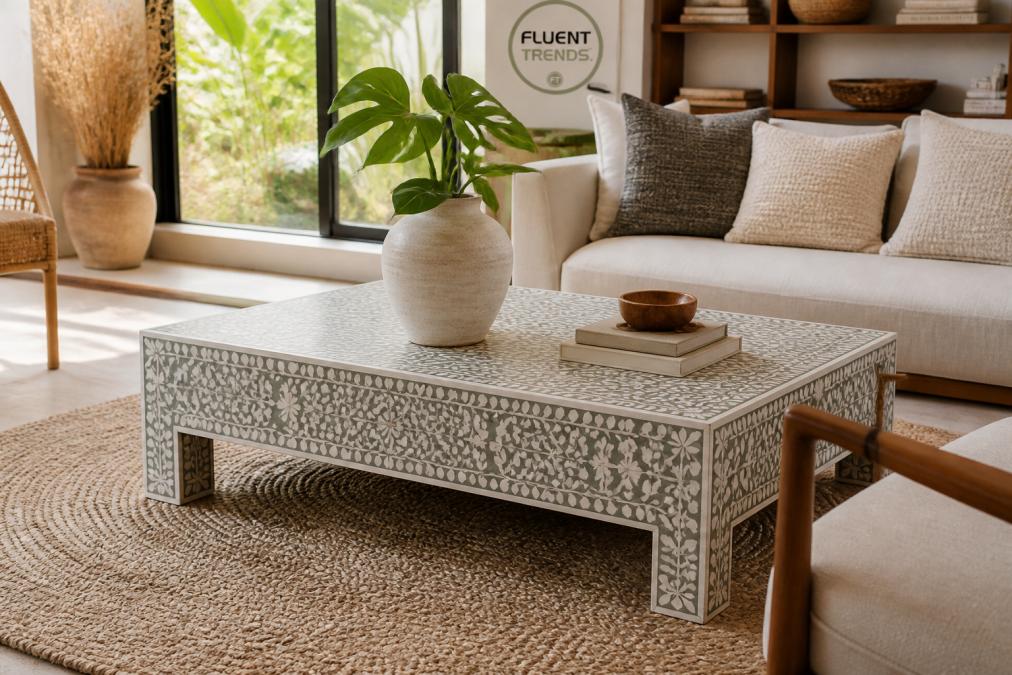
This bone inlay coffee table is crafted from 100% solid mango wood with a natural oak-tone finish. The drawer features ethically sourced bone inlay from naturally deceased animals, including camels, goats, and buffaloes.
The Nordic-style legs give it modern stability. The round form pairs with both minimalist and layered rooms. The inlay pattern wraps the drawer front and back, so it looks finished from every angle.
What most listings will not tell you: this piece is crafted in small batches. Restocking is not guaranteed. If it speaks to you, waiting is a gamble.
The natural variation in wood grain and inlay pattern means your table is genuinely one of a kind. That is the point of handcrafted work.
Hand Carved Sideboard Cabinet : Storage That Lasts Decades
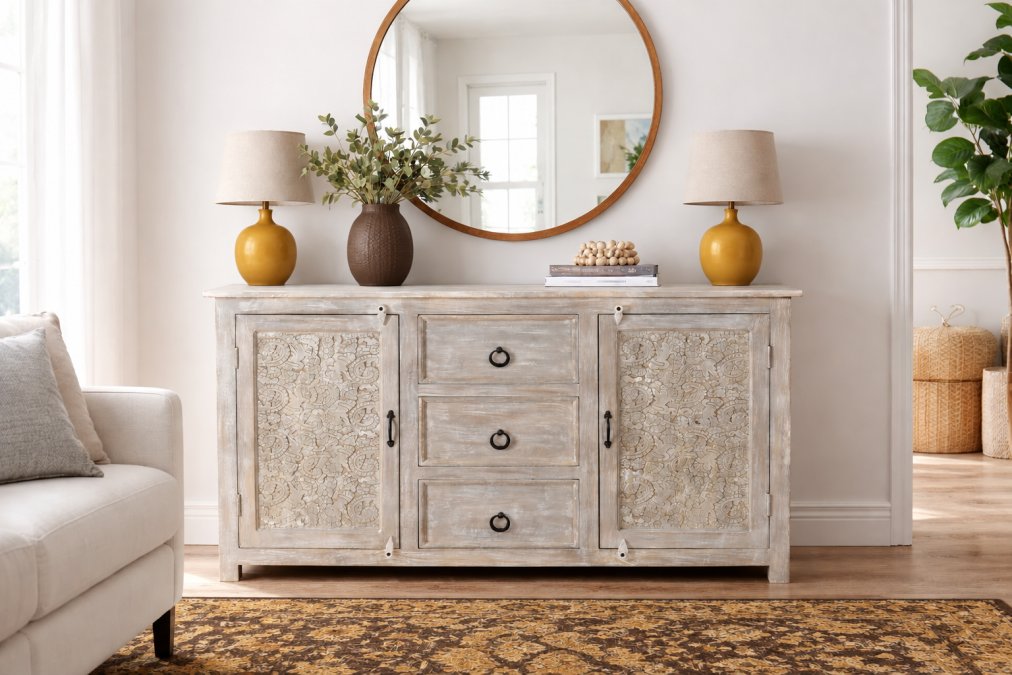
Skilled artisans hand carve every floral detail, piece by piece. No two are alike, as the reclaimed acacia wood carries natural grain and color shifts giving each one its own personality.
Behind the two carved cabinet doors sit three central drawers, sized to keep everyday clutter out of sight. It works equally well in entryways, dining rooms, or living rooms.
This is solid wood construction, built to hold up in busy, high-traffic spaces. You feel it in the weight. You see it in the natural grain variation.
Iron hardware adds a rustic edge to the antique white finish. The piece pairs easily with neutral tones, natural wood accents, and vintage or modern décor alike.
Blackwash Wall Mirror: A Focal Point That Ages Well
The Blackwash Wall Mirror is framed in solid mango wood with a deep blackwashed finish. The 4mm glass gives a clean, distortion-free reflection.
Mango wood is a fast-growing hardwood. It regenerates quickly, which makes it a smarter choice than slow-growth species under pressure.
The blackwash finish hides fingerprints and dust better than glossy frames. That matters in an entryway where hands and bags brush past daily.
Hang it at eye level across from a window. The reflection doubles your natural light without adding a lamp.
Wavy Wall Mirror: Full-Length Function With Sculptural Form
The Wavy Wall Mirror uses the same solid mango wood frame in a full-length format. The undulating edge turns a practical mirror into a wall sculpture.
Full-length glass in a solid wood frame is rare at this level. Most mirrors in this range use MDF frames wrapped in foil. Those warp near bathrooms and humid spaces.
Solid wood holds its shape. The frame will not bow after a year of steam and temperature swings.
Place it in a dressing area or at the end of a hallway. It earns its wall space twice over.
Milan White Sculptural Vase: Portugal Ceramics With Real Depth
The Milan White Sculptural Vase is made in Portugal, a country with centuries of ceramic tradition. The sculptural form works as a standalone object, even without flowers.
Style it on a shelf with one dried stem. Or leave it empty and let the silhouette do the work.
Adu Plant Stand: Small Piece, Direct Artisan Impact
The Adu Plant Stand is hand carved by artisans in Ghana from Sese wood. The finish uses traditional soot staining, a technique passed down through generations.
Sese wood is a sustainably sourced hardwood native to West Africa. It takes carving detail well and holds up to indoor humidity.
This is the entry point if you want fair trade decor without a big commitment. It supports craft heritage directly and looks intentional in any corner.
Pair it with a trailing plant. The stand lifts the pot off the floor and adds vertical interest to a plain wall.
How to Judge Any Ethical Decor Brand, Not Just These Six
Six pieces are a starting point. The real skill is knowing how to vet any brand you find.
Ask three questions before you buy. Where was it made? What is it made of? Can it be repaired?
A brand that answers all three in one sentence is doing the work. A brand that deflects is not.
Chayana Moon Phase Mother of Pearl Wind →
Look for solid wood over veneer. Look for natural fibers over synthetic blends. Look for real joinery over staples and glue.
These signals separate built to last furniture from fast furniture wearing a green label. They apply to any brand, at any price point.
For a deeper look at construction details that survive daily use, see our Built To Last collection, where you will find resilient furnishings ranging from mirrors to foundational pieces.
How to Spot Greenwashing Before You Buy
Greenwashing is when a brand markets a product as eco-friendly without verifiable proof behind the claim. You can catch it with a few sharp questions and a little digging.
Most guides tell you to look for a logo. That is not enough. Logos get faked, borrowed, and stretched. Here is how to verify claims yourself.
Start With the FTC Green Guides
The Federal Trade Commission publishes Green Guides that set the rules for environmental marketing claims. These guides say a claim must be specific, not vague.
A brand cannot say "eco-friendly" without qualifying what that means. Broad, unqualified claims are a red flag under these guidelines.
If a brand claims "recycled content," it must state the percentage. If it claims "non-toxic," it must back that up. Vague words are a tell.
You do not need to be a lawyer. You just need to notice when a claim has no number, no standard, and no proof behind it.
Check Whether the Certification Is Real
GOTS-certified organic textiles and OEKO-Tex labels are third-party verified.
OEKO-Tex Standard 100 tests for harmful substances at every stage of production. It covers the finished product, not just the raw fiber.
GOTS covers organic fiber content, chemical restrictions, and labor conditions.
A leaf icon on a hangtag is not a certification. A certification has a number you can look up. If you cannot verify it, treat it as decoration.
Ask What Percentage Is Actually Sustainable
"Made with recycled materials" tells you nothing if that is 2% of the item. Ask for the number.
A common pattern is a small sustainable component wrapped in a mostly conventional product. The marketing leads with the green part. The rest stays hidden.
Hypoallergenic claims work the same way. Ask what the fabric is made of. Organic cotton and milk or casein fiber are genuinely gentle on sensitive skin.
Trace the Supply Chain
Ask where it was made and by whom. Vague answers like "responsibly sourced abroad" are a red flag. Real makers name their partners.
Look for supply chain transparency. Brands doing the work are proud to show it. Brands hiding something stay fuzzy on details.
Sustainably sourced wood is a good test. Responsible makers can tell you the species, the region, and how they replant. A real answer takes them seconds.
Watch for These Specific Red Flags
A brand that leads with one green word and nothing else. A certification logo with no number. A price that is too low for the material claimed. A product described as "biodegradable" with no timeline or conditions.
Another tell is a sudden green collection from a brand known for fast furniture. Real change shows up in the whole supply chain, not one capsule line.
The One-Sentence Test
If a brand cannot answer "where was this made and what is it made of" in one sentence, treat the sustainability claim as unverified.
That single test filters out most greenwashing before you spend a dollar. It works on any product, at any price point.
FTC Green Guides on environmental marketing claims
Budget-Conscious Ethical Shopping: Small Pieces, Big Impact
You do not need a full renovation budget to shop ethically. Small, well-made pieces deliver real impact per dollar.
Start with accessories. The Adu Plant Stand is hand carved by artisans in Ghana from Sese wood and stained with traditional soot. It costs $195.00 and supports craft heritage directly.
The REVOLVE Eco-Friendly Watering Can is another smart entry point at $29.00. It is made from 60% bioplastic derived from corn and 40% recycled wood fibers. It is manufactured locally in Texas, which cuts transportation emissions.
The Chayana Moon Phase Wind Chime brings fair trade decor into your home for $51.00. Artisans shape and tune each bell by hand using age-old techniques.
One strategy works better than spreading your budget thin. Buy one meaningful piece per season instead of five forgettable ones. Your home looks more curated, and your money supports real makers.
End-of-Life Disposal and Circularity in Home Decor
Most decor guides stop at the purchase. The real sustainability question is what happens when you are done with a piece.
This is where solid wood and natural fibers win again. A mango wood table can be refinished, repaired, or passed to someone else. A particleboard unit goes to a landfill.
The circular economy in home decor works on three paths. Resell pieces that still have life. Repair what can be fixed. Recycle or compost natural materials at the end.
Bone inlay and solid wood pieces hold resale value. Fast furniture does not. That resale value is part of your real cost of ownership.
Before you buy anything, ask one question. Can this piece be repaired? If the answer is no, you are renting it, not owning it.
Shipping Footprints and Geographic Sourcing
Where a piece ships from changes its environmental impact. This is the angle almost no buying guide covers.
A locally made product travels fewer miles. The REVOLVE watering can is manufactured in Texas, which keeps its shipping footprint small for domestic buyers.

Handcrafted pieces from Ghana, India, or Portugal travel farther. That is real. But those same pieces often replace three disposable items over their lifetime. The math still works in their favor.
Ask brands how they ship. Consolidated shipments and sea freight beat air freight every time on emissions.
Conclusion: Building a Home That Tells Your Story
The hardest part of ethical decorating is not finding pieces. It is resisting the urge to fill space fast with things that will not last.
Buy fewer pieces. Buy better ones. Let your home build slowly around objects with real stories behind them.
At Fluent Trends, every piece in our Artisan Collection is ethically made, sustainably sourced, and crafted by hand. We support women-owned businesses and global makers through fair wages and traditional techniques. Our furniture is built to last, from solid mango wood sideboards to hand-carved accents.
Get started with Fluent Trends and build a home where every piece earns its place.
FTC Green Guides on environmental marketing claims
OEKO-Tex Standard 100 certification details
Frequently Asked Questions
What criteria define an ethical home decor brand?
Look for four things: supply chain transparency, fair trade certification, sustainable home decor materials, and durability. A brand that publishes its maker list, pays living wages, and uses organic cotton or reclaimed wood is on the right track. Ask if they disclose factory locations and third-party audits. If they dodge those questions, that tells you something.
How can I verify if a home decor brand is truly sustainable?
Check for GOTS certification on textiles and OEKO-Tex labels on bedding. Look for Fair Trade stamps on artisan goods. Visit the brand's website and search for a sustainability page that names specific suppliers. If the only proof is a leaf icon and vague words like 'eco-friendly,' that is a red flag. Real brands show receipts.
Are there affordable options for ethically made home goods?
Yes. Start with smaller pieces like a $51 fair trade wind chime or a $29 eco-friendly watering can. These entry-level items let you support ethical makers without a huge spend. You can also save by buying one durable piece instead of replacing cheap decor every year. Quality costs more upfront but less over time.
What materials should I look for in sustainable furniture?
Solid mango wood, reclaimed wood, and FSC-certified timber are your best bets. Avoid particleboard and veneer, which fall apart fast. For textiles, choose organic cotton, linen, wool, or jute. Bone inlay from naturally deceased animals is another ethical option. These sustainable home decor materials last longer and carry lower environmental impact.
Why is artisan-made decor better for the environment?
Artisan-made decor typically uses traditional, low-waste techniques passed down through generations. Small-batch production means less overstock and fewer discarded goods. Many artisans also use natural dyes and locally sourced wood that is replanted after harvest. This slow approach cuts carbon footprint and keeps craft heritage alive while supporting women-owned businesses worldwide.