

Difference between sofa and sectional: How to choose the perfect seating
Yuatinia LeakThe simplest way to think about it is this: a sofa is a single, standalone piece of furniture, usually designed for two or three people. A sectional, on the other hand, is a multi-piece, modular unit you can configure into different shapes, like an L or a U. The real question is whether you need the compact, often more formal structure of a sofa or the sprawling, casual comfort of a sectional.
Architectural Precision vs. Modular Versatility
Selecting the primary seating for your living space is a significant design milestone. It does more than fill a room; it dictates the spatial flow, daily function, and the overall "vibe" of your sanctuary. A classic sofa offers architectural symmetry, making it a masterclass in placement for more compact or formal rooms. It creates a defined, elegant focal point that anchors a room without overwhelming its footprint.
Sectionals, conversely, are engineered for expansive comfort and social connection. They excel at maximizing seating capacity and encouraging a more relaxed, "serious lounging" environment. In open-concept living areas, a sectional acts as a visual anchor, defining the lounge zone within a larger floor plan.
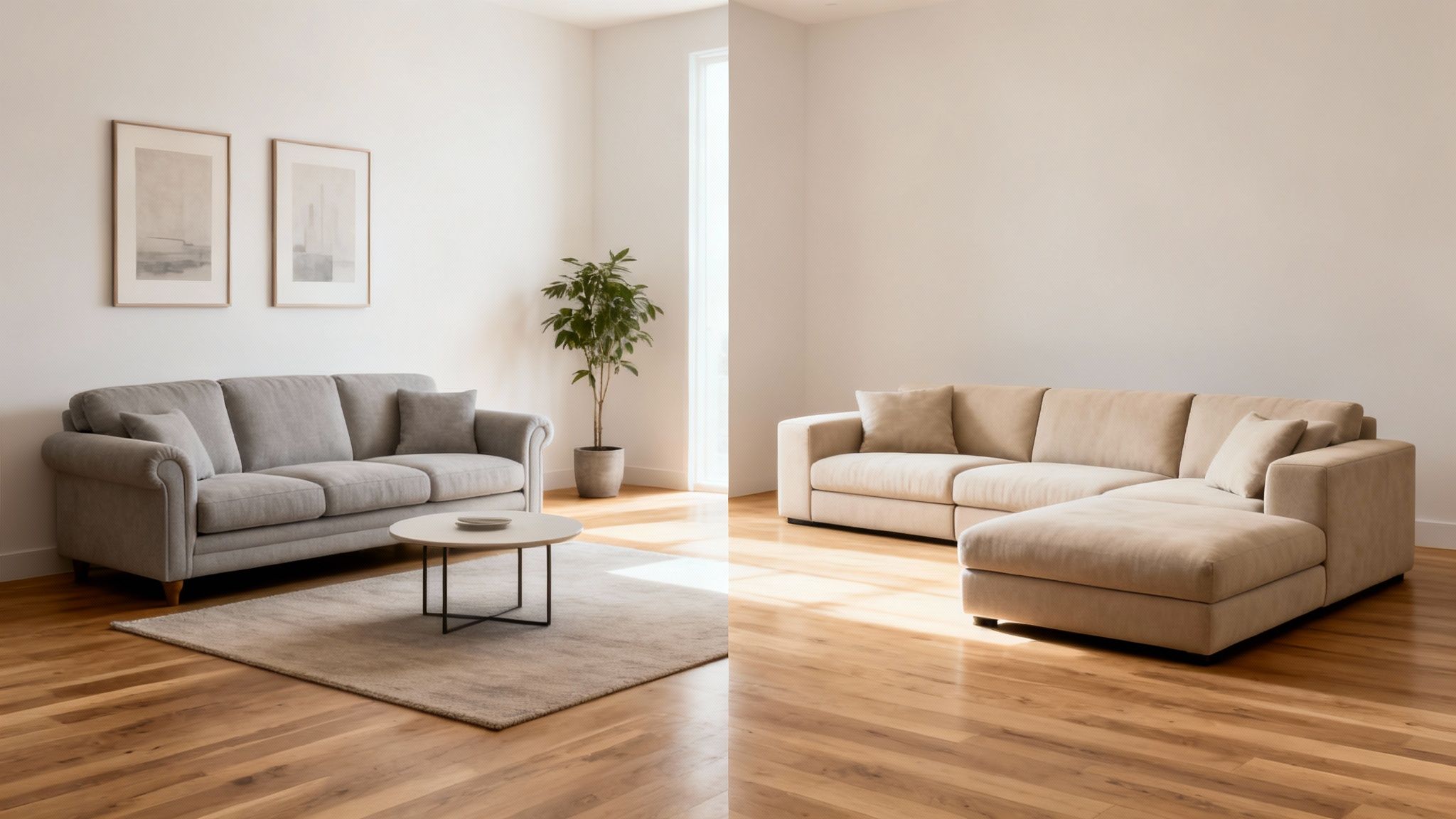
Whether you prefer the structured poise of a sofa or the inviting scale of a sectional, the right choice ultimately reflects your unique lifestyle and home architecture. To provide further clarity, let’s compare the two side-by-side.
The Sofa vs. Sectional Design Matrix
For a streamlined perspective, here is a snapshot of how the classic sofa and the modular sectional compare across the essential pillars of home design.
| Feature | Sofa | Sectional |
|---|---|---|
| Structure | Single, Self-Contained Anchor vs. Integrated Modular Silhouette | Multiple pieces combined. |
| Seating Capacity | Intimate (2–4 Guests) vs. Expansive (5+ Guests) | Typically seats 4+ people. |
| Versatility | Fixed Structural Form vs. Dynamic Modular Configurations | Highly flexible and modular. |
| Best For | Formal Parlors & Compact Nooks vs. Great Rooms & Family Anchors | Large rooms, family lounging. |
| Placement | Effortless Mobility vs. Architectural Planning Required | Requires careful room planning. |
While this matrix provides the foundational logistics, the ultimate selection depends on the daily rhythms of your household—whether you value structured poise or communal comfort
Defined Structure vs. Adaptive Modular Forms
Beyond basic definitions, the difference between a sofa and a sectional is defined by the atmosphere they cultivate and the spatial logic they provide. A sofa is a singular, curated anchor—the symmetrical star of the room. From the timeless silhouette of a Chesterfield to the clean, tailored lines of a Lawson, a sofa’s fixed shape introduces a sense of architectural order. This inherent poise makes the sofa the premier choice for formal entertaining or for maintaining an airy, open feel in more intimate floor plans.
In contrast, the sectional is a masterclass in flexibility. Composed of modular components—chaises, corner units, and armless elements—it allows you to sculpt your seating to the exact contours of your life. This adaptive nature is ideal for creating expansive L-shaped or U-shaped configurations that transform a living area into a communal sanctuary, perfect for large-scale hosting or deep relaxation.
The Shift Toward Expansive Comfort
Current design movements signal a clear preference for scale and versatility. While the global sofa market remains a substantial anchor at $30.25 billion, the modular sectional market has surged to nearly $39 billion. This isn’t merely a trend; it reflects a fundamental shift in how we inhabit our homes.
In the era of "Cocooning"—a design philosophy centered on creating a restorative, sanctuary-like environment—the sectional has become the premier choice for modern, open-concept living. This growth highlights a collective desire for seating that adapts to the fluid rhythms of family life rather than sticking to rigid, traditional layouts.
This evolution in seating boils down to a core lifestyle distinction:
A sofa anchors a room with a singular, defined statement, fostering architectural symmetry and formal connection. A sectional defines an entire zone, creating a casual, lounge-led atmosphere that prioritizes communal comfort.
Consider the architectural impact: an L-shaped sectional can nestle into a corner, reclaiming underutilized space and opening up the room's center. Alternatively, a grand U-shaped sectional can act as a sophisticated divider, elegantly demarcating the lounge from the dining area in an open floor plan. Ultimately, the choice hinges on your social rhythm—are you curating a space for structured, formal gatherings, or a sanctuary for relaxed, everyday family life?
Curating Your Space: How to Choose Between a Sofa and a Sectional
Choosing between these two icons is more than a measurement of floor space—it is a decision on how you intend to experience your home. The ideal selection requires an honest appraisal of your architectural layout, your current lifestyle, and how you envision your space evolving over the coming years.
Spatial Logic and Room Flow The first consideration is the dialogue between your furniture and your floor plan. A traditional sofa offers a high degree of versatility; it can be tucked against a perimeter wall or "floated" in the center of a room to maintain an airy, unobstructed sightline. It provides comfort without sacrificing the room's perceived volume.
A sectional, conversely—particularly expansive L-shaped or U-shaped silhouettes—is a significant architectural commitment. While it maximizes seating density, it demands substantial "floor real estate" and can easily overwhelm an intimate room if not scaled with precision. In smaller footprints, an improperly sized sectional can disrupt the natural flow, making the space feel crowded rather than cozy.
Aligning Form with Your Daily Social Rhythms
When selecting your primary seating, consider the daily choreography of your household. A traditional sofa is the definitive choice for formal architectural settings or more intimate households. It establishes a structured, symmetrical environment that fosters focused conversation, providing each guest with a clearly defined sense of personal space.
Conversely, if your lifestyle prioritizes communal relaxation and large-scale hosting, the modular sectional is an unparalleled ally. Engineered for expansive comfort, it transforms a living area into a sprawling sanctuary—perfect for family movie nights or inviting a crowd to "kick back" in a continuous, unified lounging zone.
A sofa creates distinct, curated seating zones ideal for formal entertaining; a sectional establishes a singular, large-scale lounging hub designed for casual, family-centric living.
This shift in preference is reflected in global design trends. The modular sectional market has surged to $39.2 billion, notably outpacing the $30.25 billion traditional sofa market. This gap highlights a modern evolution: with over 63% of homeowners now seeking adaptable furniture, the sectional has become the standard for open-concept layouts and multi-functional spaces.
The Decision Logic: Mapping Your Space This curated decision tree illustrates the most logical path for your home based on architectural scale and your need for modular flexibility.
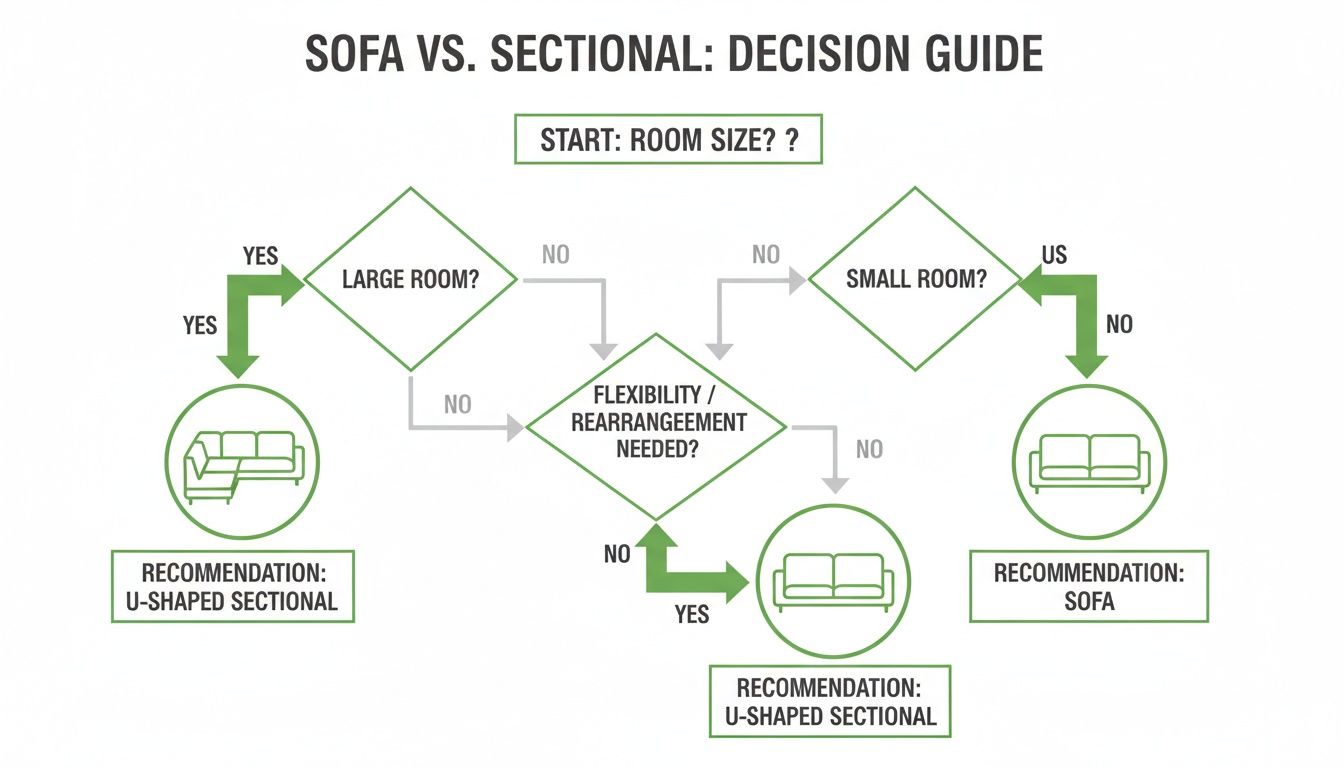
The Professional Perspective: The primary takeaway is foundational: prioritize precise measurements before considering the social function of the room. If you are leaning toward a more structured aesthetic, explore our comprehensive guide on How to Choose a Sofa: A Practical Guide for deeper insights into tailoring the perfect fit for your home.
The Editorial Verdict: Sofas and Sectionals in Situ
Beyond technical specifications, the true distinction between a sofa and a sectional is revealed through their practical application within a home. To visualize how these pieces perform "in situ," let’s explore four common living scenarios where one silhouette clearly outperforms the other.
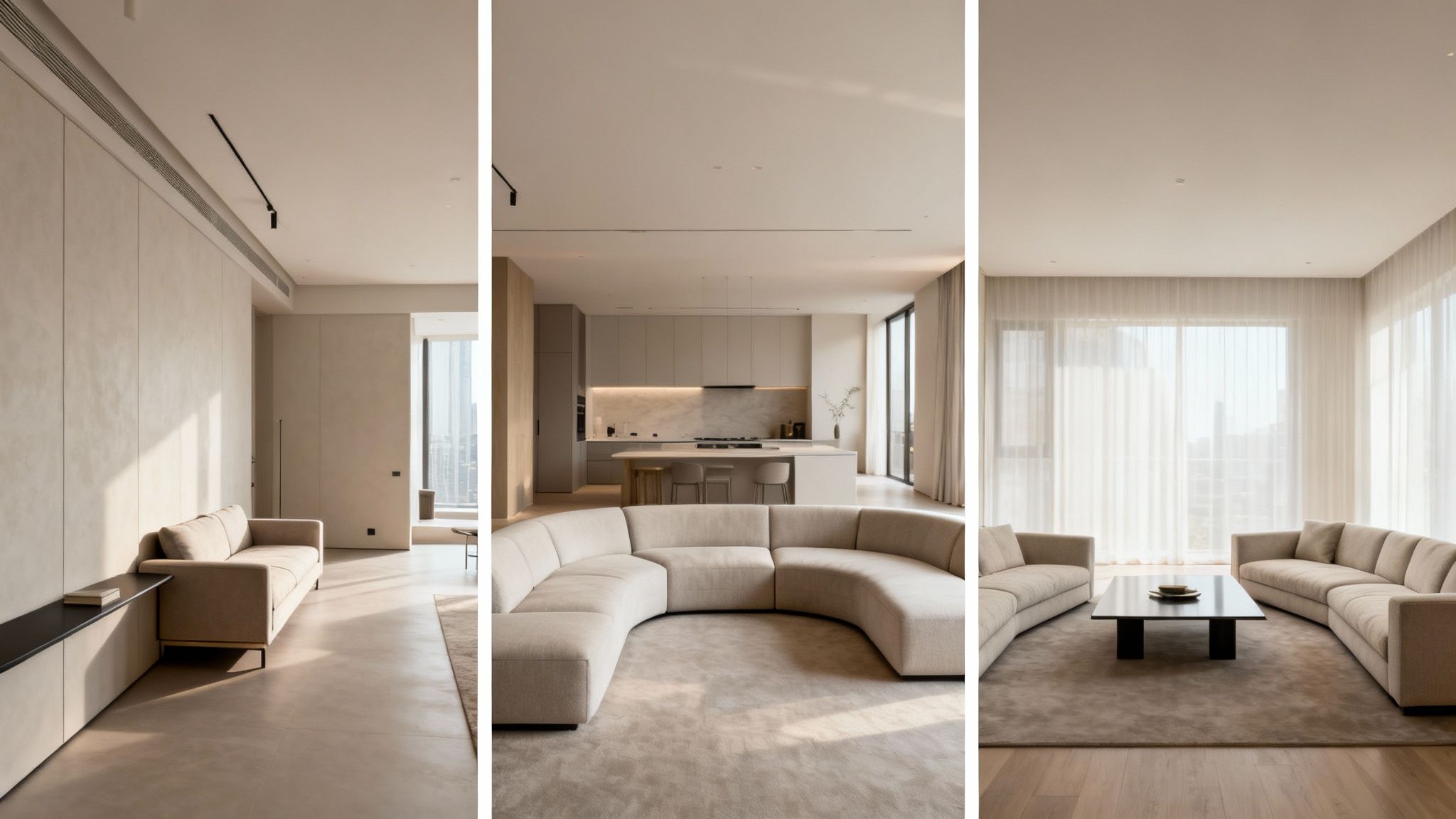
The Compact Urban Sanctuary
In a curated city residence, spatial economy is paramount. A sleek two- or three-seater sofa is the undisputed victor in this setting, providing sophisticated comfort without infringing on precious floor real estate. Attempting to integrate a sectional into a restricted footprint often results in a "claustrophobic" aesthetic—a common design misstep. A tailored sofa preserves the room’s proportions and maintains an airy, open flow. For those navigating more intimate floor plans, explore our curated guide on the Best Furniture for Small Living Rooms to Maximize Space for additional professional insights.
The Open-Concept Family Anchor
For expansive, open-concept residences, a grand U-shaped or L-shaped sectional acts as a vital architectural anchor. It does more than offer seating; it demarcates a dedicated "zone" for connection, elegantly separating the lounge from the culinary or dining areas. A singular sofa often lacks the visual weight required to unify a large-scale room, whereas a sectional invites the entire household into one cohesive, communal hub.
A sectional excels at defining and unifying expansive, open floor plans, while a traditional sofa preserves the architectural integrity of smaller, more defined rooms.
The Formal Entertaining Parlor
Envision a room dedicated exclusively to the art of hosting. Here, a pair of matching sofas positioned in parallel creates a masterclass in symmetry. This classic arrangement fosters direct face-to-face interaction and sophisticated dialogue in a way a singular sectional cannot. It establishes an intentional, balanced aesthetic perfect for formal salons or traditional living spaces.
The Bespoke Media Retreat
When the objective is uncompromising relaxation—such as in a dedicated media room—the modular sectional is the reigning champion. With integrated chaises and expansive depth, it offers a theater-like experience, allowing multiple guests to stretch out in a way a standard sofa simply cannot accommodate.
Once you have identified the "social rhythm" and the scenario that best fits your lifestyle, the final step is ensuring your vision aligns with the physical reality of your home.
The Art of Precision: A Practical Guide to Measuring Your Space
One of the most common—and costly—design errors is selecting a silhouette that is physically incompatible with its intended environment. Before committing to a specific piece, technical precision is essential. A tape measure is your most valuable tool in ensuring your selection can navigate the thresholds of your home and sit comfortably within its designated footprint.
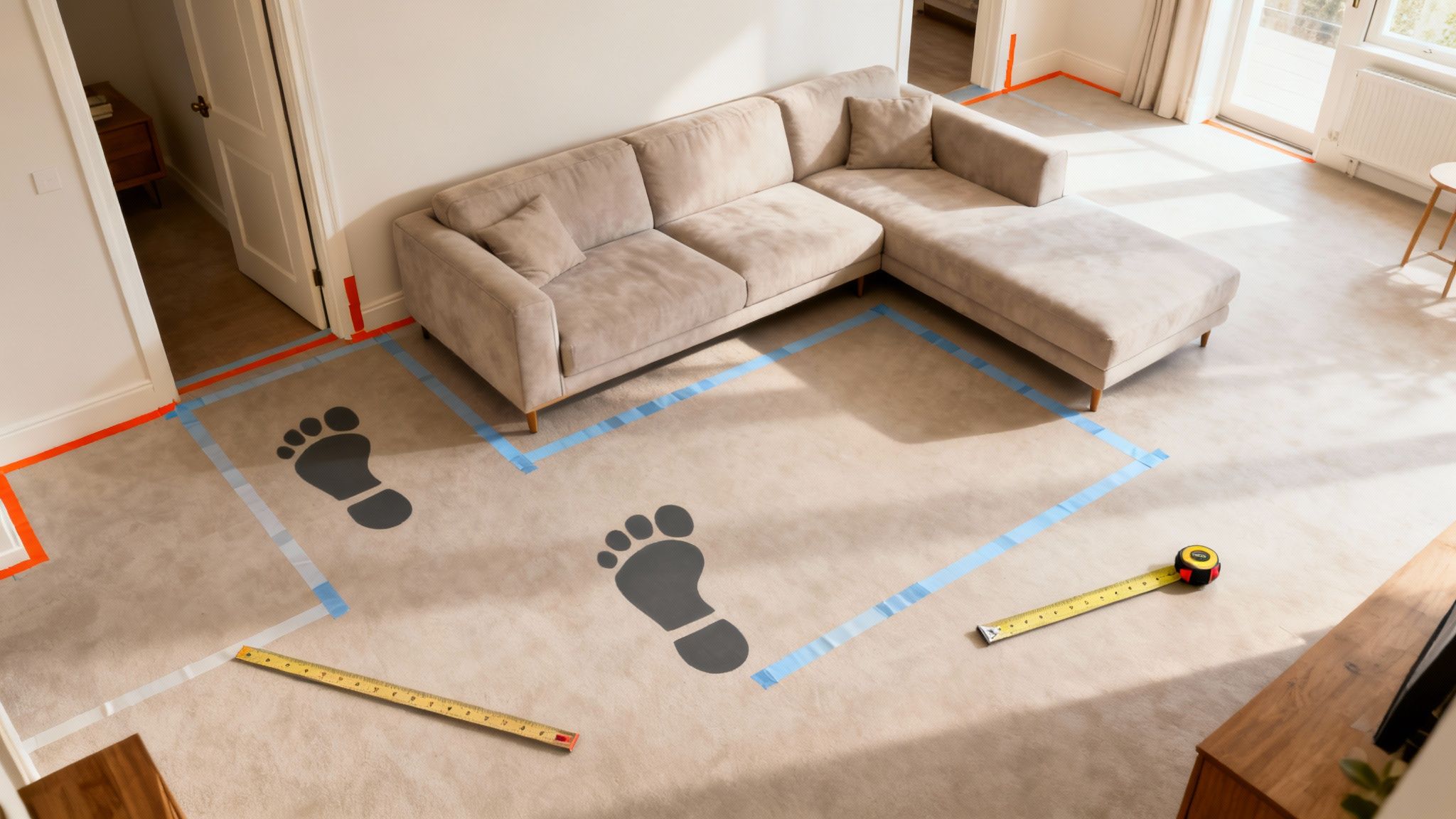
The Professional’s Footprint Strategy: Begin by documenting the total width and depth of your intended layout. A proven "pro tip" is to use painter's tape to replicate the footprint of the sofa or sectional directly onto your flooring. This allows you to visualize the volumetric impact on the room and assess the "traffic flow" before the piece arrives. Ensure you test all clearances: can cabinet doors swing freely? Is the primary pathway to the kitchen unobstructed?
A silhouette that appears appropriately scaled in a vast, open-plan showroom can easily overwhelm a residential living room. Never rely on visual estimation alone—architectural success is always measured in inches.
Mapping the Delivery Path
This is the stage where precision is non-negotiable. Beyond the final placement, you must audit the entire journey your furniture will take from the delivery truck to your living room. Ensure you have documented every potential "pinch point":
-
Doorways: Record the precise height and width of every frame, accounting for hinges and decorative molding.
-
Hallways: Document the minimum width, being mindful of protrusions like sconces, radiators, or built-in cabinetry.
-
Stairwells: Measure the clearance between the stairs and the ceiling, and pay close attention to the turning radius on landings.
Sectional-Specific Measurements
Navigating Sectional Orientation
If you have selected a sectional, there is one final architectural detail: Orientation. Sectionals are typically described using industry shorthand—Right-Arm Facing (RAF) or Left-Arm Facing (LAF).
-
RAF (Right-Arm Facing): The arm is on your right side when you are standing and facing the piece.
-
LAF (Left-Arm Facing): The arm is on your left side when you are standing and facing the piece.
Miscalculating the orientation can entirely disrupt your room’s flow, potentially blocking primary thoroughfares or architectural features. Re-examine your painter's tape footprint one last time to confirm which configuration aligns with your room's natural movement before finalizing your investment.
The Final Verdict: Your Lifestyle Checklist
Choosing between a sofa and a sectional is a decision that shapes how you inhabit your home. Before you commit, perform a final audit of these four pillars:
-
The Primary Function: Is this piece destined for formal hosting or restorative relaxation? A sofa provides a structured, poised environment; a sectional is a lifestyle-led choice that prioritizes communal comfort.
-
Spatial Volume: Does the room require an open, airy silhouette (Sofa) or an architectural anchor to define a large, open-concept zone (Sectional)?
-
Seating Density: Are you curating a space for intimate, one-on-one conversation, or do you need to accommodate the entire household plus guests?
-
Future Mobility: Consider your long-term plans. A sofa offers effortless portability for future moves, while a modular sectional provides the flexibility to reconfigure your layout as your environment evolves.
The definitive choice is deeply personal. A sofa is a timeless, self-contained anchor that centers a room with classic poise. A sectional is a versatile investment that adapts to the fluid rhythms of your daily life. Trust your design intuition, and you will find the centerpiece your home has been waiting for.
Expert Perspectives: Answering Your Final Questions
You have measured, visualized, and weighed the logistics. However, we find that many clients still have a few remaining nuances to consider. Here, we address the most common inquiries from our design community to ensure your final decision is made with absolute confidence.
FAQ: The Design Advisory
Can I Expand My Sectional Configuration in the Future?
The adaptability of your seating depends largely on its construction. If you have invested in a true modular sectional, the answer is a definitive yes. These systems are engineered for evolution, allowing you to integrate additional armless components or chaises as your living requirements change. However, brand continuity is essential; because connection mechanisms and frame depths are rarely universal, you must source additions from the same manufacturer and collection to ensure a seamless architectural fit.
How Do I Navigate Durability and Long-Term Maintenance?
In high-traffic households—particularly those with children or pets—fabric selection is just as vital as the frame itself. We recommend prioritizing high-performance textiles such as tightly woven polyesters, microfibers, or solution-dyed acrylics. These materials are engineered to repel moisture and resist both stains and UV fading without sacrificing the tactile softness expected of luxury furniture.
Inevitably, life happens. Understanding the nuances of professional upholstery care—from decoding care tags to utilizing the correct cleaning solvents—is the key to preserving the integrity and aesthetic of your investment for a decade or more.
A well-kept industry secret: while a sectional appears more imposing, its modular nature often makes it significantly easier to navigate through tight corridors and stairwells than a singular, rigid three-seater sofa.
Is a Sectional More Difficult to Relocate Than a Sofa?
This is a frequent misconception. While a fully assembled sectional occupies more volume, its modularity is a distinct logistical advantage. It is far simpler to maneuver several independent, lighter components around a challenging corner or up a narrow flight of stairs than it is to balance the weight of one awkward, oversized sofa. The priority during a move is simply to secure all modular connectors and hardware in a dedicated container to ensure a smooth reassembly in your new space.
Ready to find the perfect centerpiece for your living space? Explore the curated collections at Fluent Trends where you’ll discover designer-approved sofas and sectionals designed to elevate your home. Find your ideal fit today.
The Bio: Yuatinia Leak, owner and creative director of Fluent Trends, is a luxury home and lifestyle brand dedicated to elevating everyday living through thoughtful design. With a refined eye for balance, texture, and timeless style, she blends classic influences with modern sensibilities to create interiors that feel both sophisticated and deeply livable. Her work is rooted in quality, clarity, and intentionality — values that guide every product, editorial, and design insight she shares.