

Handmade vs Machine Made Throws: 2026 Comparison
Yuatinia LeakTable of Contents
- Quick Comparison: Handmade vs Machine Made Throws
- Craftsmanship and Quality: Artisan vs Automated Production
- Durability and Longevity: A Long-Term Investment
- The Benefits of Organic Cotton Throws for Your Home
- Why Handmade Goods Support Cultural Heritage
- OEKO-Tex Certified Home Decor Benefits Explained
- Material Sourcing and Sustainability: Natural vs Synthetic
- Maintenance and Care: Preserving Your Throw's Integrity
- Frequently Asked Questions
Last Updated: September 21, 2026
Quick Comparison: Handmade vs Machine Made Throws
Handmade throws are textiles woven or knitted by individual artisans, while machine made throws are produced on automated industrial looms. The benefits of handmade throws vs machine made options come down to four factors: craftsmanship, durability, material integrity, and cultural value. This guide from Fluent Trends breaks down each one.
Here is the short answer. Handmade throws cost more because a single weaver may spend days on one piece. Machine made throws cost less because automated production spreads labor across thousands of units. That price gap reflects real differences in how each throw ages, how it feels, and what it supports.
The comparison below covers what matters most when you choose.
| Factor | Handmade Throws | Machine Made Throws |
|---|---|---|
| Production method | Handloom, hand-spun yarn | Automated industrial looms |
| Typical materials | Organic cotton, wool, linen | Synthetic fibers, blended yarns |
| Construction time | Days to weeks per piece | Minutes per piece |
| Durability | Repairable, ages well | Consistent, shorter lifespan |
| Design character | Unique variations, intricate patterns | Uniform, repeatable |
| Sustainability | Low-waste, natural materials | Higher energy and waste output |
| Price point | Higher per piece | Lower per piece |
Machine made throws win on price and speed. Handmade throws win on longevity, material quality, and the story behind them.

OEKO-TEX certification standards for textiles
Craftsmanship and Quality: Artisan vs Automated Production
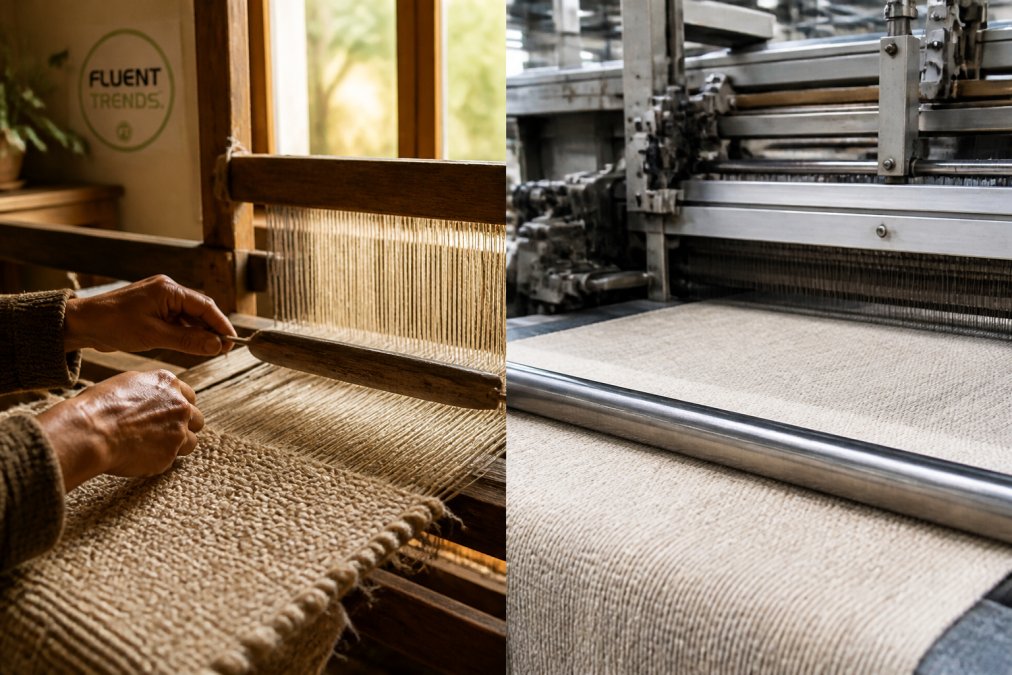
Craftsmanship is the single clearest difference between these two categories. A handmade throw passes through human hands at every stage: spinning, dyeing, weaving, and finishing. A machine made throw passes through calibrated equipment that repeats the same motion thousands of times per shift.
That distinction shapes quality in ways you can feel. Hand-spun yarn carries slight variations in thickness, which gives the finished weave depth and texture. Automated looms produce perfectly uniform yarn, which reads as flat and even.
Artisan production also allows for meticulous detailing that machines cannot replicate. Hand-stitched hems, short fringes, and reversible designs all require a maker's judgment at the loom. These are the details that separate a throw you keep for twenty years from one you replace in three.
Mass-produced throws are not poorly made. They are made to a different brief: speed, consistency, and low cost per unit. Quality control on an automated line is excellent at catching defects. It simply cannot add the personal touch that comes from a single artisan working a single piece.
Durability and Longevity: A Long-Term Investment
Durability favors handmade construction over time. A handwoven throw uses longer staple fibers and a more deliberate interlacing pattern. That structure resists pilling and holds its shape through repeated use and washing.
The mechanism is simple. Longer fibers create more contact points within the yarn. More contact points mean the yarn holds together under friction. Short-staple fibers slip free and migrate to the surface, which is what you see as pilling.
Repairability is where handmade throws separate from the pack. When a handwoven throw snags, a skilled textile repairer can reweave the affected section. The original weave structure stays visible, so the repair blends in. When a machine made throw develops a pulled thread, the damage usually spreads. Shorter fibers and a denser weave leave no room to rework the yarn.
Think of it as a long-term investment rather than a purchase. A well-made throw that lasts fifteen years costs less per year of use than three cheaper throws replaced every five years. The math favors quality when you run it out far enough. True durability stems from the inherent quality of handmade goods, which you can evaluate by examining the specific construction techniques detailed in our guide to identifying superior craftsmanship.
Wear and tear affects every textile. The question is whether the piece degrades gracefully or fails suddenly. Natural materials like wool, organic cotton, and linen age with character. Synthetic fibers tend to pill, shed, and lose loft.
Consider how durability plays out across a home. A commercial-grade furniture piece in a hotel lobby survives decades of daily use because the frame and upholstery are built to a higher standard. The same principle applies to textiles. A handwoven throw built with long-staple fiber and tight interlacing is the textile equivalent of commercial-grade construction.
The Benefits of Organic Cotton Throws for Your Home
Organic cotton throws offer three practical advantages: they feel softer against skin, they contain no synthetic pesticide residue, and they biodegrade at end of life. For anyone with sensitive skin, that first point matters most.
Conventional cotton farming relies heavily on synthetic inputs. Organic certification requires natural growing methods instead, which keeps chemical residue out of the finished fiber. The USDA organic certification program sets the standards growers must meet.
The comfort difference is real. Organic cotton fibers are typically longer and less processed, so they stay soft after washing. Blended synthetic throws often feel plush in the store and rougher after a few laundry cycles.
Hypoallergenic bedding matters for households with allergies or eczema. Natural fibers breathe better than synthetic ones and trap less dust. A wool or organic cotton throw is a sensible choice for a bedroom or a reading chair.
Sustainably sourced cotton also supports better farming practices. Lower chemical use means healthier soil and cleaner water near the farms that grow it.
Why Handmade Goods Support Cultural Heritage
Handmade goods support cultural heritage because they keep traditional skills alive. Weaving techniques pass from one generation to the next only when there is demand for the finished work. Every purchase is a vote for that craft to continue.
Consider what disappears when a weaving tradition ends. The patterns go first. Then the dye recipes. Then the knowledge of how to set up a loom for a specific weave. None of that lives in a manual. It lives in people.
Many artisan workshops are women-owned businesses that provide steady income in regions with few formal employment options. Fair wages and direct trade relationships keep those workshops running. Removing middlemen means more of the retail price reaches the maker.
Fluent Trends builds its Artisan Collection around this model. Each piece supports global makers through sustainable practices and preserves craft heritage for the next generation.
Ink Black White Ombre Textured Throw →
OEKO-Tex Certified Home Decor Benefits Explained
OEKO-TEX certification means a textile has been tested for harmful substances and meets published safety limits. It covers the finished product, not just the raw fiber. That distinction matters because dyes and finishes can introduce chemicals that raw material testing would miss.
The OEKO-TEX Standard 100 explanation outlines what the testing covers. Independent laboratories screen for substances banned or regulated in textiles, including certain dyes and formaldehyde.
For home decor, this certification answers a question buyers should always ask: what is touching my skin for hours at a time? A throw sits against your face and hands. It is worth knowing what is in it.
Several throws in the Fluent Trends range carry OEKO-TEX certification. The Checkerboard Throw, the Snug Throw, the Cloud Silque Throw, and the Braided Pom Pom Throw all meet the standard. Each is machine washable and built for everyday use.

Certification is not a marketing badge. It is a test result you can verify, which is exactly what a skeptical buyer should want.
Material Sourcing and Sustainability: Natural vs Synthetic
Material sourcing determines almost everything about how a throw performs and how it ends up. Natural materials like wool, organic cotton, linen, and jute come from renewable sources and return to the soil at end of life. Synthetic fibers come from petrochemicals and persist in landfills for decades.
Production efficiency is where synthetics win. An automated line can turn out synthetic throws quickly and cheaply. That efficiency comes with a cost: higher energy use and more waste per unit.
Natural fibers carry their own advantages. Wool regulates temperature and resists odor. Linen gets softer with every wash. Organic cotton breathes. None of these properties can be engineered into polyester.
Sourcing transparency is the harder question, and most guides skip it. Ask where the fiber was grown, how it was processed, and who did the work. Brands that can answer those questions are usually the ones worth buying from.
Traceability matters for a reason. A throw labeled organic cotton may blend fibers from several regions. Without documentation, the organic claim is hard to verify. Sustainably sourced materials come with a chain of custody that names the farm, the mill, and the finisher.
Milk and casein fiber adds another dimension. It is a regenerated protein fiber derived from dairy byproducts. Production recovers a waste stream rather than creating a new one.
Certifications help close the gap. OEKO-TEX testing covers the finished textile, including dyes and finishes. Organic certification covers growing methods. Together they answer two separate questions: what is in the fiber, and what was done to it.
Hypoallergenic bedding depends on this transparency. Natural fibers breathe better than synthetic ones and trap less dust. A wool, organic cotton, or milk fiber throw is a sensible choice.
| Material | Source | Durability | Care Level |
|---|---|---|---|
| Merino wool | Renewable, sheep | High, ages well | Hand wash or dry clean |
| Organic cotton | Renewable, plant | High, softens over time | Machine washable |
| Linen | Renewable, flax plant | Very high | Machine washable |
| Milk and casein fiber | Regenerated dairy protein | High, blends well | Gentle cycle |
| TENCEL Lyocell | Wood pulp, closed loop | High | Machine washable |
| Polyester | Petrochemical | Moderate, pills | Machine washable |
Fluent Trends sources natural materials for its artisan pieces and favors traditional, low-waste production methods. That approach reduces environmental impact while producing a better textile.
OEKO-TEX certification standards for textiles
Maintenance and Care: Preserving Your Throw's Integrity
Care determines how long any throw lasts, handmade or not. The good news is that most quality throws need less attention than people assume. The rules are simple and consistent.
- Wash less often than you think. Spot clean when possible and air the throw between uses.
- Follow the care label exactly. Wool usually needs cold water and a gentle cycle, or dry cleaning.
- Skip fabric softener. It coats natural fibers and reduces their breathability over time.
- Store folded, not hung. Hanging stretches the weave and distorts the shape.
- Rotate throws between rooms to even out wear and sun exposure.
For handmade wool pieces, hand washing in cool water with a mild detergent preserves the fiber best. Lay flat to dry. Never wring or twist a handwoven throw.
Repair small snags early. A loose thread caught in the first week is a five-minute fix. Left alone, it becomes a hole. This is where handmade throws have a real edge: a repairer can match the weave because the original structure is visible and intact.
Never put a handwoven wool throw in a hot dryer. The heat causes shrinkage and felting that cannot be reversed. Air dry it flat instead, even if the label says tumble dry low.
Frequently Asked Questions
What are the primary differences between handmade and machine-made textiles?
Handmade throws are woven by artisans, often on traditional looms, allowing for intricate patterns and meticulous detailing. Machine-made throws are produced rapidly on automated lines, prioritizing consistency and production efficiency. Handmade pieces offer uniqueness and a personal touch, while machine-made options provide accessibility at a lower price point. The choice depends on whether you value design character or economies of scale.
How does the durability of handmade throws compare to mass-produced options?
Handmade throws often use natural materials like wool or organic cotton, which can withstand wear and tear better than some synthetic fibers. Artisans inspect each piece for quality control, ensuring material integrity. Machine-made throws may degrade faster due to lower-grade materials and automated production. A handmade throw is a long-term investment that ages gracefully with proper care.
Are handmade throws more sustainable than machine-made alternatives?
Handmade throws typically involve low-waste techniques and sustainably sourced natural materials. Artisans often use traditional weaving techniques that minimize energy consumption. Machine-made production relies on economies of scale, which can increase resource use and synthetic fiber output. Choosing handmade supports environmental impact reduction and preserves craft heritage.
What materials are commonly used in high-end artisan throws?
High-end artisan throws often feature organic cotton, merino wool, linen, and jute. These natural materials offer breathability, softness, and durability. Some makers use OEKO-Tex certified dyes to ensure safety. Look for throws with hand-stitched hems or reversible designs for added versatility. The material integrity of natural fibers contributes to the throw's aesthetic appeal and longevity.
How do you identify authentic handcrafted home decor?
Authentic handcrafted decor often shows slight variations in weave, color, and texture, reflecting the artisan's hand. Check for details like hand-stitched hems or intricate patterns that machines cannot replicate. Ask about the maker's story and sourcing transparency. Certifications like OEKO-Tex can verify material safety. A genuine piece carries a narrative of craftsmanship and cultural heritage.