

How to Choose the Right Rug a Comprehensive Guide
Donna MaloneWhen you're picking out a new rug, it comes down to three things: getting the size right for the room, choosing a material that actually works for your life, and finding a color and pattern that creates the vibe you're after.
Believe it or not, the biggest mistake people make isn't picking the wrong color—it's buying a rug that’s way too small. A tiny rug can throw off the entire room, making it feel disconnected and incomplete.
Getting the Rug Size Right
This is the one thing you have to get right. It’s less about the exact square footage of your room and more about how your furniture sits in it. I've seen it a hundred times: a small "postage stamp" rug floating in the middle of a room, making everything look smaller and a bit awkward. The goal here is to lay a foundation that anchors your furniture and defines the whole area.
A simple rule I always follow is to make sure at least the front legs of your main furniture pieces are sitting on the rug. It’s a small detail that visually pulls everything together, creating a cohesive and welcoming space.
Before you even think about browsing online, grab a roll of painter's tape. Seriously. Mark out the dimensions of the rug you're considering right there on your floor. This is a classic designer trick that helps you see the actual footprint and can save you from a very expensive mistake.
Sizing Up Your Living Room
The living room is where rug sizing is most crucial. Ideally, your rug should be at least 6-8 inches wider than your sofa on both sides. This little bit of extra width keeps the sofa from looking like it's swallowing the rug and frames your seating area perfectly.
There are three common ways to arrange a rug with your furniture:
-
All Legs On: If you have a larger room, go for this. Placing all your furniture entirely on the rug creates a very intentional, luxurious feel. Just be sure to leave about 8 inches of rug showing around the edges so it doesn't look cramped.
-
Front Legs On: This is my go-to recommendation and the most versatile option. You just rest the front legs of the sofa and chairs on the rug. It connects everything without needing a giant, room-sized rug, keeping the space feeling open yet grounded.
-
The Float (But Be Careful): With smaller or statement rugs, you can "float" them under the coffee table so they don't touch the seating. This can work, but the key is to keep the gap between the rug and the sofa to 5 inches or less. Any more than that, and it starts to look disconnected.
This quick visual breaks down how to measure your space and choose a size based on your furniture setup.
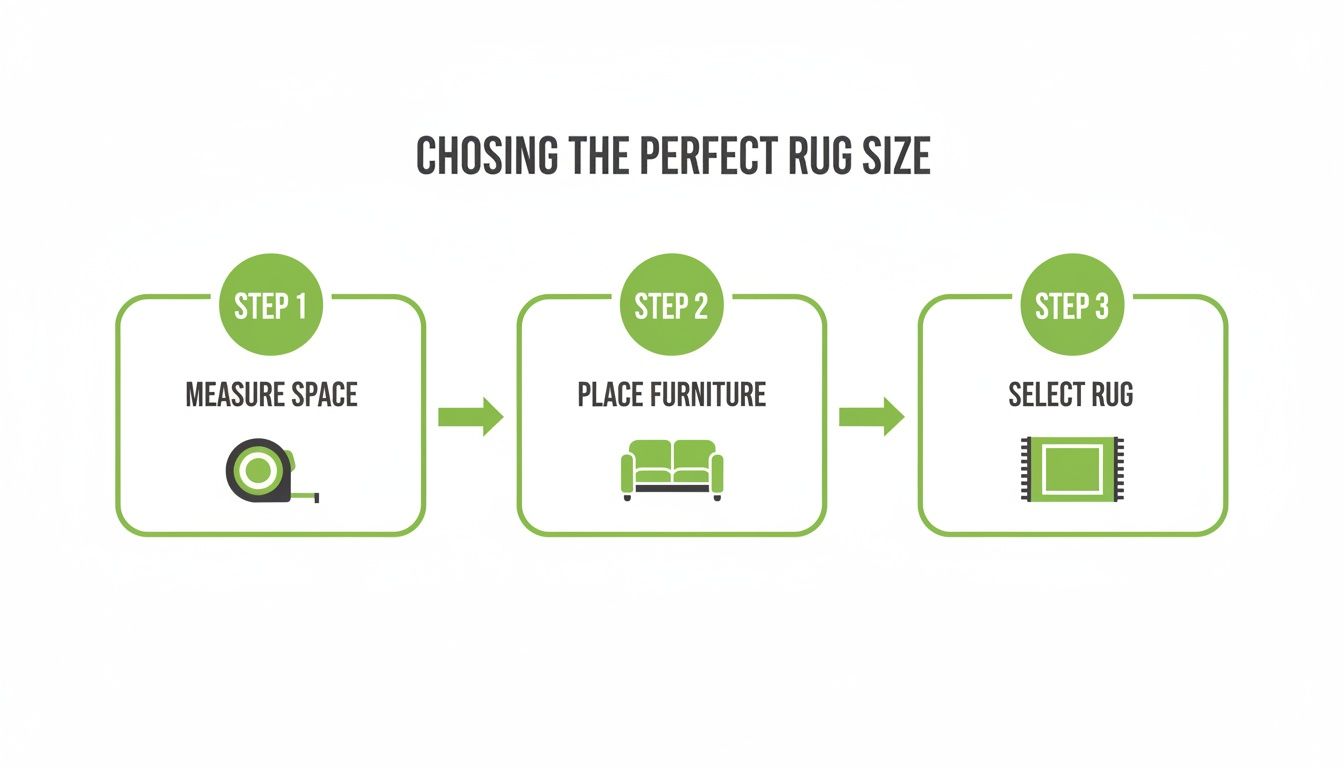
The big idea here is simple: let your furniture layout decide the rug size, not the other way around.
Perfect Proportions for the Bedroom and Dining Room
In the bedroom, a rug is all about creating a soft, warm place to land your feet in the morning. A good rule is to have the rug extend at least 18-24 inches from the sides of the bed. For a deep dive into getting this just right, check out this ultimate rug under bed guide.
For the dining room, it’s all about function. You need a rug that’s big enough for the chairs to stay on it, even when they’re pulled out. A good measurement is to add 24-30 inches to each side of your dining table—that's your minimum rug size.
Here's a quick cheat sheet for the most common spaces in your home.
Rug Size and Placement Rules by Room
This table gives you a quick reference for standard sizes and placement tips to get you started.
| Room | Common Rug Sizes (ft) | Key Placement Guideline |
|---|---|---|
| Living Room | 8×10, 9×12, 10×14 | Ensure at least the front legs of the sofa and chairs are on the rug. |
| Dining Room | 8×10, 9×12 | Allow 24-30 inches of rug beyond the table edge on all sides. |
| Bedroom (Queen) | 8×10 | Place horizontally under the bed, extending 18+ inches on the sides. |
| Bedroom (King) | 9×12 | Place horizontally under the bed, extending 18+ inches on the sides. |
| Hallway/Entry | 2×8, 3×5, 4×6 | Leave 4-6 inches of bare floor on all sides of the runner or rug. |
Remember, these are just starting points. Every room is different, so always measure your own space first.
Key Takeaway: A properly sized rug should unify a furniture grouping, define the space, and feel generous. When in doubt, always choose the larger size—it’s a fix that almost always works. For even more detailed guidance, check out our guide on how to choose the right rug size.
As a general design principle, an area rug should cover about 60–70% of a room’s floor to create the right visual balance. Market trends back this up, with correctly proportioned 8×10 ft and 9×12 ft rugs making up an estimated 45% of premium rug sales. It shows that more and more people are realizing just how important proper scale really is.
Choosing Materials That Fit Your Lifestyle

A rug's material is the heart of its performance. It dictates not just the feel underfoot, but how it will hold up to real life—the muddy paws, the spilled juice, the daily foot traffic. Thinking about the material first helps you pick a rug that solves problems instead of creating them.
Before you fall in love with a pattern, get real about your home. Is this for a busy hallway or a quiet guest room? Do you have kids and pets who see the floor as their personal playground? Your honest answers will point you toward a material that truly works for you.
Natural Fibers: The Timeless Choice
When it comes to a premium feel and lasting durability, it's hard to beat natural fibers. They bring an organic, grounded texture to a room that synthetic materials just can't mimic.
Wool is the undisputed champion here. It’s incredibly resilient, naturally stain-resistant (thanks to its lanolin coating), and even flame-retardant. A good wool rug can bounce back from heavy furniture and foot traffic for years, making it a brilliant long-term investment for a living room or family den.
Other popular natural options include:
-
Cotton: Often used for flatweaves like dhurries and kilims, cotton rugs are lightweight, easy to clean (many are even machine-washable), and generally more affordable than wool. They’re a fantastic choice for casual spaces like kitchens or kids' rooms but won't hold up as well in high-traffic zones.
-
Jute and Sisal: These plant-based fibers deliver incredible texture and a laid-back, earthy vibe. Jute is the softer of the two, while sisal is tougher and more durable. Both are great for layering or adding a natural element to a living room, but be warned—they are notoriously difficult to clean once they get wet.
Expert Insight: Wool is a natural air filter. Its fibers trap dust, pollen, and other allergens, helping to improve your room's air quality. This makes it an especially smart choice for bedrooms and family rooms.
Synthetic Materials: The Practical Powerhouses
On the other side of the coin, we have synthetic, or man-made, fibers. These materials are engineered for performance, often delivering amazing stain resistance and durability at a much more accessible price point. If your home is a hub of constant activity, a synthetic rug is your best friend.
Polypropylene (also called olefin) is the workhorse of the rug world. It’s highly resistant to stains, moisture, and fading, making it perfect for dining rooms, playrooms, and even outdoor patios. It may not feel as luxurious as wool, but its easy-care nature is a massive win for busy households.
Another major player is Nylon. It’s one of the most durable synthetic fibers out there, known for its excellent resiliency—which means it won’t crush easily under furniture. This makes nylon a top contender for hallways, entryways, and any area that sees constant foot traffic.
Comparing Popular Rug Materials
To make it a little easier, here’s a quick breakdown of the most common materials you'll run into.
| Material | Durability | Best For | Care Level |
|---|---|---|---|
| Wool | High | Living rooms, bedrooms, high-traffic areas. A great all-around investment. | Medium |
| Cotton | Low-Medium | Kitchens, bathrooms, kids' rooms. Casual, low-traffic spaces. | Low (often machine-washable) |
| Jute & Sisal | Medium | Low-traffic living rooms, bedrooms, sunrooms. Great for layering. | Low (but stains easily) |
| Polypropylene | High | Dining rooms, hallways, outdoor spaces, homes with kids and pets. | Low |
| Nylon | Very High | Hallways, entryways, stairs, and the busiest parts of your home. | Low |
Ultimately, the trade-off often comes down to budget versus longevity. You can expect a synthetic rug to cost 30–70% less than a natural-fiber one, which is why they account for 55–65% of global sales, according to market data from Grandview Research. A high-quality wool rug, however, can last 10–20 years with proper care, far outliving the typical 3–7 year lifespan of a synthetic in a busy spot.
Pile Height Explained
Beyond the fiber itself, you need to think about the pile height—that’s just a fancy term for how long the rug’s fibers are. It has a huge impact on the look, feel, and practicality of a rug.
A low-pile rug has short, dense fibers that create a smooth, flat surface. This is a must-have for dining rooms, where you need chairs to slide in and out easily. Low-pile rugs are also easier to vacuum and a smart choice for entryways because they don’t trap as much dirt.
A high-pile rug, like a shag or flokati, has long, loose fibers. This gives you that luxuriously soft and cozy feel underfoot, making it perfect for bedrooms or low-traffic living areas where you want to dial up the warmth and texture. The downside? Those long fibers can be a magnet for dirt and debris, making them a less practical choice for spill-prone or high-traffic zones.
Alright, you've handled the technical stuff—size and material are sorted. Now comes the part where you really get to put your stamp on the room: color and pattern.
Think of your rug as the emotional core of your space. It can make a room feel calm and airy, or it can inject a dose of vibrant energy. The choice is entirely yours.
So, the first question to ask yourself is this: do you want the rug to be the main event or play a supporting role? There's no right or wrong answer here, but it's a decision that will steer everything else.

A bold rug with a commanding pattern can serve as the room’s centerpiece, almost like a piece of art for your floor. On the flip side, a neutral rug with a subtle texture creates a quiet foundation that lets your furniture and other decor shine.
Building Your Color Palette
If you’re lucky enough to be decorating from scratch, starting with the rug is a designer’s secret. Its colors can become the roadmap for everything else, from your wall paint to the smallest decorative accessories.
But most of us are adding a rug to a room that’s already lived-in. In that case, look around for clues. A fantastic trick is to pull two or three accent colors already in the room—maybe from your curtains, a painting, or even a favorite vase—and find a rug that picks up on those same tones. It’s a simple move that makes the whole space feel thoughtfully pulled together.
Color also has a huge impact on the vibe of a room. Knowing a little color psychology can help you nail the mood you're after.
-
Warm Tones: Think reds, oranges, and yellows. These colors bring energy and can make a large, cavernous room feel much cozier and more inviting. They’re perfect for social spaces like a living room.
-
Cool Tones: Blues, greens, and grays tend to create a sense of calm and serenity. These are great choices for bedrooms or a home office where you need a tranquil atmosphere to unwind or focus.
As a general rule, a lighter-colored rug will make a room feel bigger and brighter. A darker rug, on the other hand, can ground the space and give it a more intimate, dramatic feel.
Mixing Patterns Like a Pro
The idea of mixing patterns can seem tricky, but it’s the key to creating a room with real depth and character. The secret? Vary the scale.
If your heart is set on a rug with a big, bold geometric print, pair it with pillows or drapes that feature a much smaller, quieter pattern—like a thin stripe or a delicate floral. This contrast lets each element have its moment without clashing.
Essentially, one pattern needs to be the star, and the others are the backup singers.
A Practical Tip from Experience: For a high-traffic family room or under a dining table, a multi-colored, patterned rug is an absolute lifesaver. It’s incredibly forgiving and a master at camouflaging the inevitable spills and stains, which means less stress for you.
Ultimately, choosing your rug's color and pattern is a personal decision. Don't be afraid to pick something that you genuinely love looking at. A rug is a major investment in your home’s comfort and style, so it should make you happy every time you walk into the room.
How to Set a Realistic Rug Budget
Let's talk money. It's just as crucial as figuring out the right size or material, and being upfront about your budget from the get-go will save you a world of frustration. It helps you focus your search and shop with confidence, avoiding that sinking feeling when you fall in love with something way out of reach.
Rug prices are all over the map, so knowing what drives the cost is your first step toward a smart buy. It really boils down to three things: material, construction (how it's made), and size. A small, machine-made synthetic rug will always be on the lower end, while a massive, hand-knotted wool masterpiece is a true investment.
Breaking Down the Price Tiers
To give you a clearer picture, let’s look at what you can expect to spend. Entry-level area rugs in standard sizes (think 5x7 or 8x10 feet) usually run from $50–$300. These are typically made from synthetics like polypropylene.
If you step up to a mid-range wool or a high-quality performance rug, you’re looking at the $300–$1,200 bracket. For intricate, hand-knotted pieces, prices can easily start at $1,500 and climb from there.
Interestingly, consumer data shows that 35–42% of shoppers set a budget beforehand, with the median spend for a living room rug hovering around $400. This just goes to show how planning ahead can anchor your entire shopping process.
Having this financial clarity helps you decide where to splurge and where to save. A high-traffic living room absolutely benefits from a more durable, higher-quality rug. But for a low-traffic guest room? You can probably get away with a more budget-friendly option.
Thinking About Long-Term Value
Sometimes, a higher upfront cost actually means better value down the line.
Consider this: a $1,000 wool rug that lasts 15 years is a much smarter purchase than a $250 synthetic one you have to replace every three years. The wool rug works out to about $67 per year, while the synthetic option costs over $83 per year—not to mention the hassle of shopping for a new one again and again.
Key Takeaway: Your rug budget should account for more than just the initial price tag. Think about the rug’s expected lifespan and future maintenance needs. A durable material might cost more now but will save you money by sidestepping premature wear and tear.
When you're crunching the numbers, don't forget to factor in the total cost of ownership. This includes professional cleanings down the road. By understanding professional rug cleaning cost, you ensure your beautiful new rug stays that way. This kind of forward-thinking is the real secret to being happy with your purchase for years to come.
You’ve done the hard work—you’ve navigated the world of sizes, materials, and patterns to find the perfect rug. But don't roll it out just yet. A couple of final details are absolutely crucial for protecting your new centerpiece and making sure it looks incredible for years to come.
It all starts with the right foundation.
Think of a rug without a pad like a painting without a frame. It’s just not finished. A rug pad is a non-negotiable accessory, and it does so much more than just stop your rug from sliding across the floor. It’s the unsung hero, acting as a shock absorber against the daily grind of footsteps and furniture, which dramatically reduces wear and tear on your rug's delicate fibers.
This simple addition can literally extend the life of your rug by years. Plus, it adds a noticeable layer of cushioning underfoot, making the whole room feel more luxurious and comfortable.
Choosing the Right Rug Pad
Not all rug pads are created equal. The right one for you depends entirely on what kind of floor you have.
-
For Hard Surfaces (Wood, Tile, Laminate): You need grip. Look for pads made from natural rubber or a felt-and-rubber combo. They provide fantastic non-slip traction while still offering that plush cushioning.
-
For Carpeting: Skip the grip. A simple felt pad is your best bet here. Its job isn't to stick, but to anchor the rug to the carpet fibers below, preventing that annoying bunching and wrinkling that happens when you layer rugs.
A quality rug pad also protects your floors. I’ve seen cheap vinyl pads react with certain floor finishes over time, leaving behind discoloration. Investing a little more in a quality felt or natural rubber pad is a small price to pay for peace of mind.
Essential Rug Maintenance and Cleaning
The real secret to a long-lasting rug? Regular care. For most rugs, consistent vacuuming—once or twice a week—is your best defense against the dirt and grit that grinds down fibers over time.
But how you vacuum matters. You’ll want to adjust your technique based on the pile.
-
Low-Pile and Flatweave Rugs: You can use a vacuum with the beater bar (the spinning brush) on. It’s great for agitating and lifting out that deeply embedded dirt.
-
High-Pile and Shag Rugs: Turn off the beater bar. Seriously. Use the suction-only setting to avoid snagging, pulling, and destroying those beautiful long fibers.
-
Delicate Rugs (Silk, Viscose, or Vintage): Suction only, always. It’s also a good idea to vacuum in the direction of the pile to keep it looking smooth and uniform.
Spills are going to happen. It's just a fact of life. But they don’t have to be a disaster if you act fast. The golden rule is to blot, never rub. Rubbing a stain only grinds it deeper into the fibers and can cause them to fray. For a more detailed game plan, especially for those super-versatile indoor-outdoor materials, our guide on how to clean indoor outdoor rugs has you covered.
A Quick Spill Response Plan: Gently blot the spill with a clean, dry white cloth. Work from the outside of the spill inward to keep it from spreading. For tougher stains on a wool rug, a simple solution of mild dish soap and water often does the trick. Just be sure to test any cleaner on a hidden spot first!
Smart Tips for Buying Rugs Online
More of us are buying rugs online than ever before. The selection is amazing, but you also face the challenge of buying something sight-unseen. A few strategies will help you click "add to cart" with total confidence.
First, always order a sample if the retailer offers one. There’s no way around it: computer monitors just can't replicate color and texture perfectly. A physical sample is the only way to truly see how the rug's texture and exact shades will look in your room's unique light.
Next, become a review detective. Look past the star rating and dig into what people are actually saying. Are there consistent comments about the color being different in person? Does it shed more than people expected? These little tidbits from real customers are pure gold.
Finally—and this is the big one—read the return policy before you buy. Get clear on the return window, who pays for return shipping (it can be expensive!), and whether there are any restocking fees. Knowing this upfront can save you from a massive headache if the rug just doesn't work out. By taking these few extra steps, you’re not just buying a rug; you’re making a smart investment that will look beautiful for a long, long time.
Still Have Questions? Let's Unpack Them
Even with all the rules and guidelines, choosing a rug can still feel a bit daunting. It's totally normal to get stuck on a few final details.
Let’s tackle some of the most common dilemmas I see homeowners run into. Getting these last few things sorted out will help you make that final decision with total confidence.
Can I Put a Rug on Top of Carpet?
Yes, you absolutely can! In fact, layering a rug over wall-to-wall carpet is a go-to designer trick for adding dimension and defining a space. Think of it as creating a "room within a room"—it’s perfect for carving out a cozy seating arrangement in a large living room or breaking up the monotony of a carpeted bedroom.
The secret to pulling this off is contrast. You want the area rug to feel distinct from the carpet underneath. A low-pile or flatweave rug, like a jute or a thin wool kilim, looks incredible over a plusher carpet. Just be sure to grab a special rug pad designed for carpet-on-carpet use. It’s a non-negotiable for keeping the top rug from bunching up and becoming a tripping hazard.
What's the Best Rug for an Entryway?
Your entryway sets the tone for your whole home, but let's be honest—it’s also a magnet for dirt, mud, and whatever else gets tracked in. So, when it comes to an entryway rug, durability is everything.
You need something that can take a beating. Here’s what I recommend:
-
Wool: It's naturally tough, cleans up beautifully, and is surprisingly resilient against stains. A real workhorse.
-
Polypropylene: This synthetic is practically bulletproof. It laughs at stains, moisture, and fading, making it ideal for the busiest of households.
-
Jute/Sisal: While I love the natural look, they can be tricky to clean once they get wet or muddy. They're better suited for entry points that don't see as much action.
Stick with a low-pile or flatweave rug. It will trap less grime and make vacuuming a breeze. And a little practical advice? A darker color or a busy pattern is your best friend here. It'll do a masterful job of hiding footprints until you get a chance to clean.
Pro Tip: A rug with a darker base and a vibrant, multi-colored pattern is the ultimate camouflage for a busy entryway. It adds a splash of personality while being incredibly forgiving.
Should the Rug Be Lighter or Darker Than the Sofa?
This is a question I get all the time, and the truth is, there's no single right answer. It all comes down to the vibe you’re trying to create. Each choice has a completely different impact on the feel of the room.
Choosing a rug that’s lighter than your sofa will instantly make the space feel bigger and more open. It bounces light around the room, which is a great trick for making smaller living rooms feel more expansive.
On the other hand, a rug that's darker than your sofa will create a cozier, more grounded atmosphere. It really anchors the furniture, giving the room a more intimate and sometimes dramatic feel.
If you’re stuck, my favorite solution is to find a patterned rug that pulls in the color of your sofa along with a few other complementary tones. It’s the easiest way to create a layered, cohesive look that feels like it was put together by a professional.
Ready to find the perfect piece to tie your room together? Explore the curated collection of designer-approved indoor and outdoor rugs at Fluent Trends.