

How to Spot Authentic Handcrafted Items: A 2026 Guide
Yuatinia LeakTable of Contents
- Start With the Small Clues Nobody Fakes
- How to Tell If Furniture Is Handmade Before You Buy
- Signs of Quality Craftsmanship in Furniture You Can Feel
- How to Check Furniture Construction Quality in Five Minutes
- Legitimate Variation Versus Poor Workmanship
- Questions to Ask Before Buying Handmade Furniture
- Verify the Maker, Not Just the Label
- Why Authentic Handcrafted Pieces Cost What They Cost
- Conclusion: Buy Less, Choose Better
- Frequently Asked Questions
Last Updated: October 12, 2026
Start With the Small Clues Nobody Fakes
Learning how to spot authentic handcrafted items starts with one simple habit. Turn the piece over. Machines are fast and consistent. Human hands leave small, uneven marks that are almost impossible to copy.
At Fluent Trends, we handle pieces from real workshops every week. We look for tiny clues first. A wobbly line. A brush stroke that stops short. A stitch that runs a little long.
These marks are not flaws. They are proof of a person behind the work.
Mass-produced goods come out identical. Every unit looks the same because a mold or a machine made it. Handcrafted items carry small differences, batch after batch.
That gap is your best clue. Below, we will show you exactly how to use it.
Look for Tool Marks and Human Rhythm
A maker's tools leave evidence. Look closely and you can usually see it.
- Slight hammer marks on metal or wood
- Brush strokes that fade or thicken
- Throwing rings on pottery, like on the Lhasa Mug
- Stitches that vary in length by a hair
- Carvings with a tiny slip, then a recovery
Machines do not slip. They repeat. When you see a small correction, a human made it.
The Back of the Piece Tells the Truth
Sellers photograph the front. Makers finish the back.
Flip the piece over. Check the underside, the inner seams, the hidden edges. On a hand-carved frame, the inlay continues around the back. On a hand-woven rug, the reverse shows the same density as the front.

Sloppy hidden work often means the whole piece is rushed. Careful hidden work means the maker cared the whole way through.
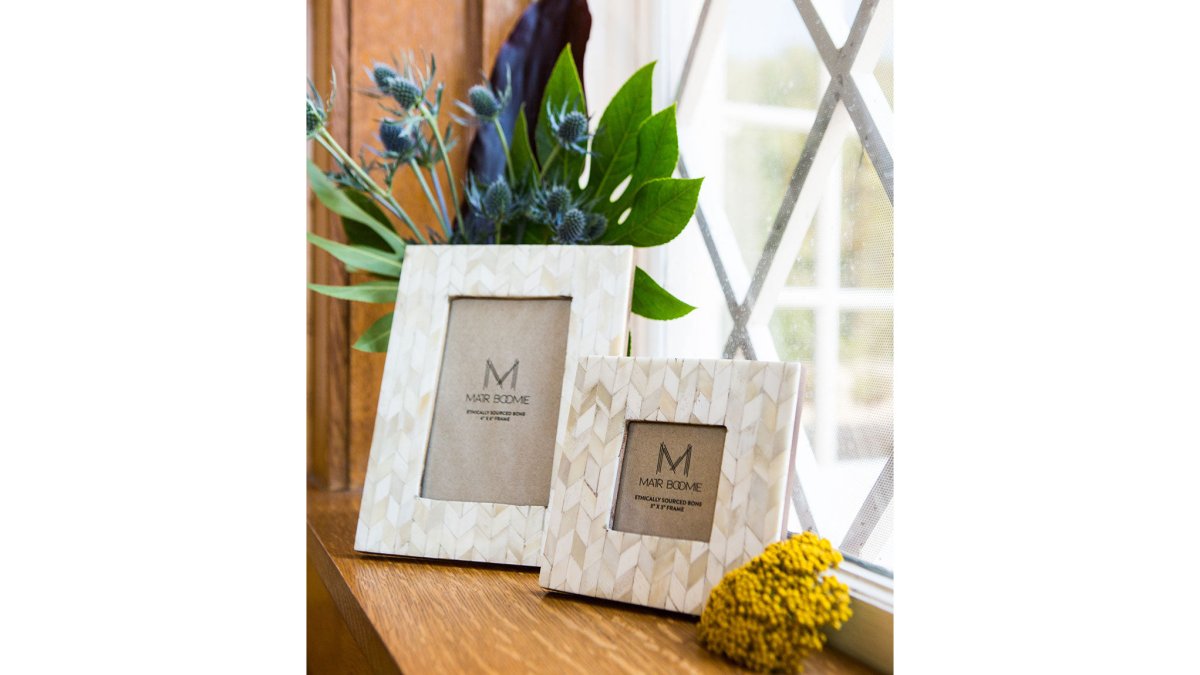
How to Tell If Furniture Is Handmade Before You Buy
You can tell if furniture is handmade by checking three things. Look at the joints, study the grain, and lift the piece. Real wood feels heavier than particle board, and hand-cut joints fit tighter than factory staples.
Here is what to do in order:
- Check the joints first. Dovetails and mortise-and-tenon joints are hand-fit.
- Study the grain. Real wood grain flows and changes. Printed veneer repeats.
- Lift one end. Solid wood weighs more than it looks like it should.
- Look for screws and staples. Heavy stapling is a factory sign.
- Smell the piece. Real wood smells like wood, not glue.
Joints, Grain, and the Weight Test
Joints are the strongest signal. A hand-cut dovetail has slightly uneven pins. A machine-cut one is perfectly uniform.
Grain tells you a lot too. On real wood, the pattern shifts from board to board. On a print or veneer, the same pattern repeats across the surface.
The weight test is the fastest check. Pick up a chair or a small table. Solid wood like acacia or sheesham feels dense and solid. Particle board feels light and hollow.
Sheesham earns its weight. On the Janka hardness scale, which measures dent resistance, sheesham scores around 1,410 lbf. Teak sits near 1,000 lbf. That density means sheesham resists scratches and daily knocks without chipping.
Signs of Quality Craftsmanship in Furniture You Can Feel
Signs of quality craftsmanship in furniture show up in how the piece feels, not just how it looks. Run your hand along the edges. A well-finished edge is smooth and slightly rounded, never sharp or rough.
Then check these details:
- Drawers that slide without wobbling
- Doors that close flush without a gap
- Legs that sit flat on the floor, no rocking
- Upholstery with tight, even seams
- Cushions that hold their shape when you press them
Materials matter here too. Boucle furniture feels dense and springy under your hand. Bone inlay furniture shows tiny variations in each cut piece. Sustainably sourced wood keeps its color and structure for years.
Durability is the point. A piece built for daily use should handle spills, sunlight, and constant movement. That is what separates real furniture from decor that only looks good in photos.
How to Check Furniture Construction Quality in Five Minutes
You can check furniture construction quality in about five minutes. Do it in the same order every time. That way nothing gets missed.
The routine changes slightly depending on where you are. In person, you can touch and tilt. Online, you have to read photos and ask sharper questions. Here is how to run both.
In-Person Checks at a Market or Showroom
- Open every drawer and door. Check the slides and hinges.
- Press down on one corner. Listen for creaks or rattles.
- Look under the piece. Check for corner blocks and bracing.
- Feel the edges. Sharp edges mean rushed finishing.
- Check the hardware. Solid metal outlasts thin, plated parts.
- Tilt the piece slightly. A stable frame will not flex.
- Ask for the wood species. Vague answers are a warning sign.
A solid frame will not twist when you tilt it. Cheap frames flex and creak. That one test tells you more than any label.
Online Checks Before You Click Buy
You cannot tilt a photo. So you verify with evidence instead.
- Ask for a short video of the drawer sliding open and closed.
- Request a close-up of the underside and the back panel.
- Ask for the wood species and where it was milled.
- Look for work-in-progress photos of that exact piece.
- Run a reverse image search on the product photo.
- Check whether the same photo appears on other shops.
That last step matters. If one photo shows up across five storefronts, it is a stock image. A real maker photographs their own work.
What the Wood Itself Tells You
Species matters more than finish. Acacia wood is dense and shows strong grain movement. Sheesham earns its weight too.
On the Janka hardness scale, which measures dent resistance, sheesham scores around 1,410 lbf. Teak sits near 1,000 lbf. That means sheesham is physically harder and more scratch-resistant than teak. It absorbs the knocks of daily life without chipping or splitting.
Density also brings dimensional stability. Once sheesham is properly seasoned by the manufacturer, it strongly resists warping, twisting, or splitting. The joints in a sheesham bed or dining table stay tight and secure for decades.
There is a pest angle too. The heartwood of the tree produces natural compounds that are highly toxic to dry-wood termites and fungi. It protects itself from the inside out without harsh chemical treatments.
The Five-Minute Rule in Practice
Spend your first minute on joints. Spend the second on grain and weight. Use the third for hardware and edges. The last two minutes go to questions and photo checks.
If a seller dodges even one of those steps, slow down. A confident maker will walk you through all of it. That confidence is its own kind of proof.
Legitimate Variation Versus Poor Workmanship
Natural variation is not the same as poor workmanship. This is where most buyers get confused. A wavy glaze line on a handmade mug is normal. A cracked handle is not.
Use this table to tell the difference:
| What You See | Legitimate Variation | Poor Workmanship |
|---|---|---|
| Color | Slight glaze or dye shifts | Patchy, uneven coverage |
| Shape | Small asymmetry | Lopsided, unstable form |
| Surface | Brush or tool marks | Deep gouges or cracks |
| Joints | Hand-fit, slightly uneven | Loose, gapped, or glued shut |
| Texture | Natural grain shifts | Bubbling or peeling finish |
Handmade goods vary because a person made them one at a time. That is the whole appeal. But variation should never mean weak. A piece should still sit flat, hold weight, and last.
If the seller calls a defect "rustic," walk away. Real artisans fix structural problems before shipping.
Questions to Ask Before Buying Handmade Furniture
The right questions to ask before buying handmade furniture save you money and regret. Ask them early, before you fall in love with a piece.
Start with these:
- Who made this, and where is their workshop?
- What wood or material is this, exactly?
- How long does a piece like this take to make?
- Do you have work-in-progress photos?
- What is your return policy if it arrives damaged?
- How is the piece packed and shipped?
Good sellers answer all of these without flinching. They share maker stories, process photos, and real timelines.
Ask about production capacity too. A single artisan cannot make hundreds of identical pieces a week. If the volume seems impossible for one workshop, the goods are likely mass-produced.
Verify the Maker, Not Just the Label
Verifying the maker matters more than trusting a label. Anyone can print the word "handmade." Fewer sellers can show you the hands behind it.
Look for these proof points:
- A named maker or family workshop
- Process documentation and work-in-progress photos
- A clear origin story for the craft
- Fair pay and ethical sourcing details
- Consistent materials across the catalog
Seller transparency is the real test. A maker with nothing to hide shows the messy middle: the workshop, the tools, the drying racks.
This is where cultural context counts. A hand-woven rug from a family workshop carries techniques passed down for generations. That story is part of the value, and it should come with proof.

The Federal Trade Commission's guidance on "Made in USA" claims sets clear rules for origin claims. Sellers who respect those rules tend to respect the rest of their claims too.
Why Authentic Handcrafted Pieces Cost What They Cost
Price plausibility is a real signal. But price alone proves nothing. You have to read it alongside volume and turnaround time.
Think about what goes into a single piece:
- Hours of skilled labor, often days
- Materials sourced and prepared by hand
- Traditional techniques that take years to learn
- Small-batch production, not factory volume
- Fair pay for the maker
A hand-carved frame with bone inlay takes far longer than a molded plastic one. A hand-woven wool rug takes weeks on a foot loom. That time is the price.
The Three-Number Test
Ask three questions and write down the answers.
- How many of this item can you make in a month?
- How long from order to shipping?
- How many people work in the workshop?
Now do the math. One artisan making a complex piece by hand cannot produce hundreds per week. If the shop lists 400 units in stock and promises two-day shipping, the numbers do not fit a hand process.
A common pattern is a small workshop with a waitlist. That waitlist is often a good sign. It means demand outruns what two hands can make.
Where the Money Actually Goes
When a piece is truly handmade, the cost splits across a few places.
- Skilled labor, paid by the hour or by the piece
- Raw materials, often bought in small batches
- Tools, finishing supplies, and drying time
- Packaging that protects a fragile or heavy item
- Fair compensation for the maker
Cut any one of those and the price drops. Cut labor and you get underpaid artisans. Cut materials and you get veneer over particle board. Cut packaging and you get a cracked bowl in a box.
When a Low Price Is a Warning
If a "handmade" item costs less than a factory version, something is off. Either the maker is underpaid, or the item is not handmade at all. Neither is a good deal.
That does not mean every expensive piece is real. High prices get attached to machine goods too. Price is one clue, not a verdict.
Durability Is Part of the Math
Cost per year matters more than cost at checkout. A sheesham dining table resists warping, twisting, and splitting for decades. Its heartwood even fights off termites and fungi on its own, with no harsh chemical treatment. You buy it once.
The same logic applies across materials. Portugal-woven bedding and organic cotton textiles hold up through repeated washing. Milk and casein fibre blends feel soft and stay hypoallergenic over time. OEKO-Tex certified fabrics skip the harsh finishes that break down after a few cycles.
A boucle chair that keeps its shape for years beats a cheap lookalike replaced every season. That is the real price comparison. Not what you pay today, but what you pay across the life of the piece.
Conclusion: Buy Less, Choose Better
The real challenge is not finding handmade goods. It is finding sellers who prove what they sell. Check the marks, ask hard questions, and verify the maker before you spend.
That is exactly why we built Fluent Trends. Our Artisan Collection features ethically made pieces from women-owned workshops and global makers. Every item is sustainably sourced and built to last.
You can browse our durable furniture for daily use collection, handcrafted ceramics like the Lhasa Mug, and organic cotton textiles woven for everyday life. Each piece tells a real story, and we can show you the hands behind it.

Get started with Fluent Trends and fill your home with pieces made to last, not replaced.
Frequently Asked Questions
Are small variations a sign that an item is handmade?
Yes, usually. Slight differences in glaze pooling, stitch spacing, or wood grain are normal in handcrafted items. A hand-thrown Limoges porcelain mug, for example, will show subtle shifts in its blue glaze from piece to piece. What matters is whether the variation looks intentional and controlled or sloppy and rushed. Uneven glaze that still feels smooth and food-safe is a hallmark of artisan work. Chipped edges, wobbly bases, or loose joints are not charming variation. They are defects, and you should treat them differently.
How can I verify a seller's ethical and women-owned claims?
Ask for specifics, not slogans. A trustworthy seller can name the workshop, the region, and the relationship. Look for third-party certifications like Fair Trade or OEKO-TEX where textiles are involved. Check whether the seller publishes maker stories, process photos, or production capacity details. If a shop claims to support women-owned businesses, ask which ones and how long they have worked together. Vague answers or recycled marketing language are red flags. Real transparency sounds like names, places, and dates, not hashtags.
Is it worth paying more for authentic handcrafted furniture?
It depends on how you measure value. A well-made sheesham wood dining table scores around 1,410 lbf on the Janka hardness scale, which means it resists dents better than teak at roughly 1,000 lbf. That density translates to decades of daily use without warping or splitting. Compare that to a particleboard piece that sags within three years, and the math shifts. You are not just buying a look. You are buying fewer replacements, tighter joints, and natural pest resistance that does not rely on chemical treatments.
What should a maker disclose about materials and production?
A serious maker will tell you the species of wood, where it was sourced, and how it was seasoned. They will explain whether a piece is solid, veneered, or mixed. For textiles, they should name the fiber, like organic cotton, wool, or milk casein fiber, and mention certifications such as OEKO-TEX. They should also describe their production method: hand tools, small-batch workshop, or a mix of hand and machine work. If a listing skips all of this, ask directly. The answer, or the silence, tells you plenty.