

Is OEKO-TEX Certified Worth It for Your Home?
Yuatinia LeakLast Updated: October 31, 2026
Quick Summary
OEKO-TEX certified means an independent institute tested the finished textile for harmful substances like formaldehyde, heavy metals and azo dyes. It is worth it for bedding that touches your skin for hours, but it does not cover durability, comfort or ethical labor. Always verify the label number yourself.
- Certification applies to a specific product, not to a whole company or brand.
- STANDARD 100 splits items into four product classes, and baby items sit in the strictest class.
- A label check takes about two minutes and costs nothing using the official verification tool.
- OEKO-TEX and organic cotton answer different questions, so the strongest products carry both.
- The label does not certify a product as hypoallergenic or guarantee fair factory wages.
Table of Contents
- What OEKO-TEX Certified Actually Means
- STANDARD 100 and the Harmful Substances It Screens For
- How to Run an OEKO-TEX Label Check in Two Minutes
- OEKO-TEX Certified Bedding: What the Label Covers on a Comforter
- OEKO-TEX vs. Organic Cotton: Two Different Promises
- Is OEKO-TEX Hypoallergenic? What It Can and Cannot Claim
- What Certification Does Not Guarantee
- How Certification Works for Makers: Costs, Timelines, and Renewal
- Shop the Certified Pieces at Fluent Trends
- Frequently Asked Questions
What OEKO-TEX Certified Actually Means
OEKO-TEX Certified means a textile has been tested for harmful substances by an independent institute. It is not a brand promise. It is a third-party check on what touches your skin.
That distinction matters when you are spending real money on bedding. A label you can verify beats a claim you cannot. We look for that difference every time we source a piece for Fluent Trends.
The system is run by an independent body that sets the testing criteria. Independent labs do the testing. A certificate follows a passing result.
Here is the part most shoppers miss. Certification applies to a specific product, not to a whole company. A maker can hold a valid certificate on one comforter and none on the next.
So the label is a starting point. It tells you what was tested, and it tells you what was not.
STANDARD 100 and the Harmful Substances It Screens For
STANDARD 100 is the best-known OEKO-TEX label. It targets harmful substances in the finished article, not just the outer fabric. Testing covers every component that touches the product.
Think of it as a chemical screen with a long checklist. The list includes formaldehyde, heavy metals, and certain azo dyes. It also covers pesticide residues, chlorinated phenols, and other regulated compounds.
Every test has a limit value. A product passes only when results sit under that line. Labs test against published criteria, so results are comparable across makers.
Product classes do a lot of work here. OEKO-TEX splits items into four classes based on skin contact. Baby items sit in the strictest class. Items with little or no skin contact sit in the loosest. A baby bodysuit and a curtain are not judged the same way.
Here is the part most shoppers miss. STANDARD 100 is not the only OEKO-TEX label. Other OEKO-TEX labels cover different scopes, so each label answers a different question.
Traceability runs through the chain too. Yarn, fabric, and component parts can all fall inside the certification scope. That is how a finished product earns a label that means something.
OEKO-TEX official STANDARD 100 overview
If you are comparing a milk fibre duvet cover to a Portugal-woven bedding set, this matters. Both can carry the label. But the test criteria follow the product class, not the fiber name. Ask which class applies before you assume one is safer.
One honest limit: STANDARD 100 tests for harmful substances. It does not test for durability, comfort, or ethical labor. Those are separate questions. Use the label as one filter, then ask the harder questions about construction and sourcing.
How to Run an OEKO-TEX Label Check in Two Minutes
Running an OEKO-TEX label check takes about two minutes and costs nothing. You need the label number and a browser. That is the whole toolkit.
Here is the process we use before we list any certified piece:
- Find the label number on the sewn-in tag or the product page.
- Go to the official OEKO-TEX label verification tool.
- Enter the certificate number exactly as printed.
- Confirm the product type matches what you are buying.
- Check the certificate validity date.
- Confirm the company name matches the seller.
Watch out: a certificate number proves a product passed. It does not prove the specific item in your cart is covered. Always match the product description, not just the number.
If a seller cannot give you a number, treat the claim as unverified. That is not an accusation. It is just how verification works.
OEKO-TEX Certified Bedding: What the Label Covers on a Comforter
OEKO-TEX certified bedding means the comforter itself passed harmful-substance testing. That includes the shell fabric, the filling, and the trims. All of it counts as the finished product.
This is where certification earns its keep. A comforter sits against your skin for eight hours a night. You want to know what is in the filling, not just the cover.
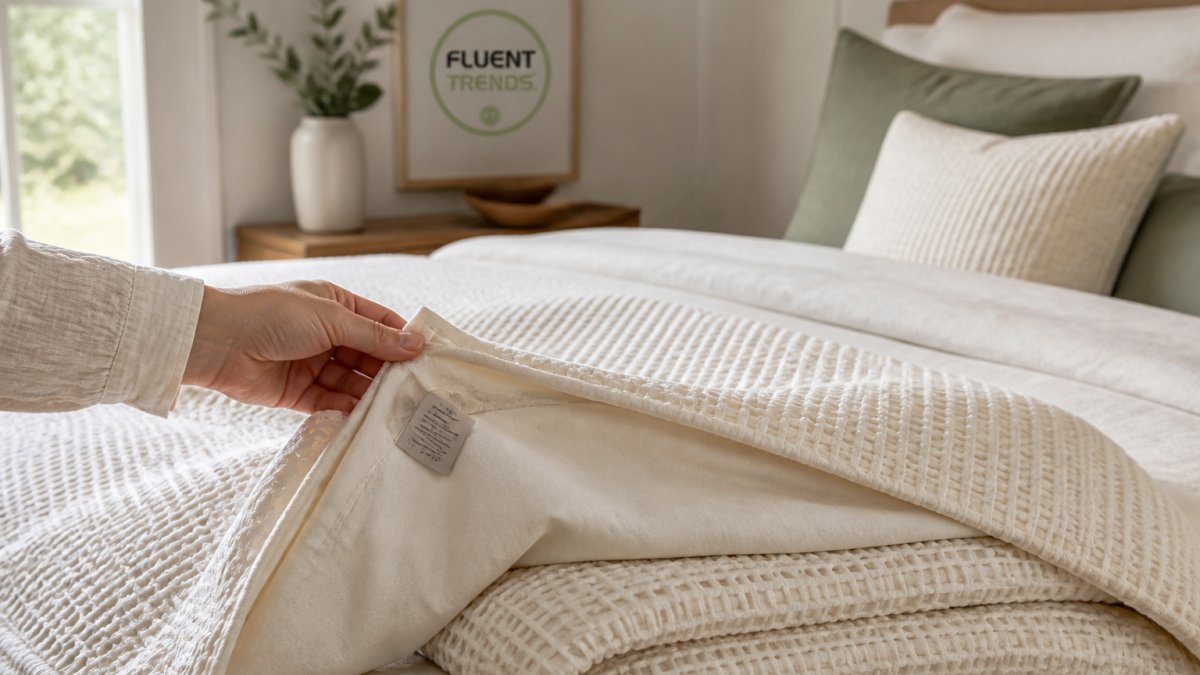
We stock certified bedding for exactly this reason. Our Snug Waffle Comforter carries OEKO-TEX certification and uses a filling made from recycled plastic. The reverse side is viscose from bamboo.
You can browse the full range of bed sheets and bedding essentials if you want to see how certified options compare across materials.
One honest limitation: certification does not tell you how the comforter feels or how long it lasts. Those are separate questions. Test the label, then judge the product.
OEKO-TEX vs. Organic Cotton: Two Different Promises
OEKO-TEX and organic cotton answer different questions. Certification asks whether a finished textile contains harmful residues. Organic asks how the fiber was grown.
You can have one without the other. An organic cotton towel can fail chemical testing. A conventional cotton sheet can pass with flying colors.
That surprises people. It should not. Farming standards and chemical safety standards are separate systems.
Organic cotton focuses on the field: no synthetic pesticides, no genetically modified seed, and documented growing practices. OEKO-TEX focuses on the factory floor and the finished good.
The strongest products carry both. When we source, we look for pieces that clear the chemical test and use responsibly grown fiber. That combination tells a fuller story.
USDA organic standards for fiber and textile labeling
If you are weighing a milk fibre duvet cover against a conventional one, this distinction helps. The Signature Milk Fibre Duvet Cover sits in that conversation about alternative fibers and how they are tested.
Snug Waffle Comforter Bundle →
Is OEKO-TEX Hypoallergenic? What It Can and Cannot Claim
No, OEKO-TEX does not certify a product as hypoallergenic. The label confirms harmful-substance testing, not allergy safety. Those are different claims with different evidence behind them.
This is a common misunderstanding. Shoppers see a certification mark and assume it means allergy-friendly. It does not work that way.
What certification does is reduce exposure to known chemical irritants. It cannot promise that a fabric will not trigger your specific allergy.
Dust mites, pollen, and pet dander are not chemicals. Certification does not address them. Neither does it test for every possible allergen.
If allergies drive your purchase, look for a product that is both certified and easy to wash. You can browse a cooling comforter set with temperature-regulating eucalyptus silk that addresses this concern directly. Frequent hot washing does more for dust mite control than any label.
What Certification Does Not Guarantee
Certification does not guarantee durability, comfort, or ethical labor. It is a chemical safety standard. Nothing more, nothing less.
Here is what the label leaves out:
- How long the product will last
- Whether the factory pays fair wages
- Whether the fiber is organic
- Whether the item is truly hypoallergenic
- Whether the product will hold its color after washing
That list matters. Plenty of shoppers treat a certification mark as a full ethical scorecard. To see how ethical sourcing compares across brands, read our luxury home decor brand comparison. It is one line on that scorecard.
We think transparency beats a single badge. That is why we research reputable purveyors and source from them. We ask about materials and construction.
Use certification as one filter. Then ask the harder questions about longevity and labor.
How Certification Works for Makers: Costs, Timelines, and Renewal
Certification is a business process, not a one-time sticker. Makers apply, submit samples, and pay for testing. Then they renew.
The general flow looks like this:
- The manufacturer applies to an approved institute.
- Samples go to a laboratory for testing.
- The lab tests against the criteria for the product class.
- A certificate is issued for the specific product.
- The maker renews annually to keep the label valid.
Costs and timelines vary by product complexity and how many components are in scope. A simple item moves faster than a multi-part one. We will not quote numbers we cannot verify, so ask your supplier for their certificate date.
Here is the gap most guides miss. The certificate scope is narrow by design. It covers the specific product and the specific components listed. It does not cover a whole factory or a whole brand.
That is why a maker can hold a valid certificate on one comforter and none on the next. It is also why a brand can show a certificate that covers one product line and imply it covers everything. That is a scope problem, not a testing problem.
Certificate validity is the detail buyers forget. An expired certificate is not a current claim. Check the date every time.
Makers who let it lapse tend to bury the label in a footer. That tells you something about how seriously they treat the claim.
If you are sourcing furniture or bedding, ask for the certificate number and the product class. Then check both against the label lookup tool. That two-step check is the fastest way to separate a real claim from a marketing line.
We research reputable purveyors and source from them. We ask about materials, construction, and certificate scope before we list a piece. That is how we keep the label honest.
Shop the Certified Pieces at Fluent Trends
You do not need to become a certification expert to buy well. You need a short checklist and a seller who will answer questions. That is the whole game.
Here is our quick reference:
| What You Want to Know | Where to Check | What Good Looks Like |
|---|---|---|
| Is the product tested? | Label number lookup | Valid certificate, matching product |
| What was tested? | Certificate scope | Full finished product, not one part |
| Is it current? | Validity date | Active, not expired |
| Is it organic too? | Fiber claim | Separate organic documentation |
| Will it last? | Construction details | Dense weave, reinforced seams |
We built our bedding collection around that checklist. Every certified piece we carry has a label number you can look up yourself.
The Snug Waffle Comforter Bundle is our most popular certified option. It pairs the waffle comforter with a matching sham set. Both carry OEKO-TEX certification. Both are machine washable.

That combination, certified and washable, is what most people actually need. Certification handles the chemical question. Washing handles the everyday reality.
Certification is a filter, not a finish line. The real test is whether a piece still looks and feels right after years of daily use. That is where construction and sourcing show up.
At Fluent Trends, we source from reputable purveyors and ask the questions that badges do not answer. We look at materials, joinery, and who stands behind the work. Our certified bedding, handcrafted furniture, and artisan decor are chosen for that longer view.
Get started with Fluent Trends and build a home around pieces you can verify and keep.
Frequently Asked Questions
What does an OEKO-TEX certification mean?
It means a finished textile was tested for harmful substances by an independent lab and passed the limits set for its product class. The label covers the fabric, the thread, and trims like zippers and buttons. It is a safety check, not a farming or labor standard. So an OEKO-TEX certified pillow tells you what is not in the fabric, not how the cotton was grown or who sewed it.
Is OEKO-TEX the same as 100% cotton?
No. OEKO-TEX is a testing and certification system, not a fiber. A product can be OEKO-TEX certified and still be polyester, viscose, or a blend. The label says nothing about fiber content. Check the materials tag for that. For example, a certified sham set can be smooth polyester microfiber and still carry the label, because the certification is about chemical safety, not what the fabric is made of.
How can I verify an OEKO-TEX certificate?
Look for the label number on the product tag or the product page. Then enter that number on the official OEKO-TEX label check tool online. It returns the certificate holder, the product scope, and whether the certificate is still valid. If a brand shows a logo with no number, or the number does not match, treat the claim as unverified until the seller provides proof.
Does OEKO-TEX certification mean a product is organic?
No. Organic refers to how fibers are grown, and OEKO-TEX tests for harmful substances in the finished item. A product can be certified and not organic, or organic and not certified. Some items carry both, and that is the strongest combination. If organic matters to you, look for a separate organic fiber standard alongside the OEKO-TEX label.
Does OEKO-TEX certification guarantee a product is hypoallergenic?
Not exactly. The certification limits chemical residues that can irritate skin, and products in the baby class face the strictest limits. That supports gentler skin contact for many people. But hypoallergenic is not a regulated claim, and no certificate can promise a reaction-free experience. If you have a diagnosed allergy, check the fiber and dye details with the seller before buying.
