

Styling a Sculptural Sideboard in a Luxury Living Room
Yuatinia LeakQuick Summary
Style a sculptural sideboard by letting its form lead. Keep the surface partly open, place your largest object off-center, and balance it with one medium piece and a low bowl. Test the arrangement under warm evening light before settling on the final look.
- Pick the silhouette first, since a geometric cabinet and a wavefront front call for different styling.
- Leave at least one-third of the surface open so the carving stays visible.
- Hang art about 8 to 12 inches above the sideboard so the two read as one unit.
- Mix tall and low objects in odd numbers for a styled, relaxed look.
- Test the arrangement at night with a lamp on, and remove one object if shadows look muddy.
Table of Contents
- Why a Sculptural Sideboard Needs a Different Approach
- Choosing the Right Sideboard Silhouette for Your Room
- How to Style a Sideboard Without Hiding Its Form
- Sideboard Decor Ideas: Balancing Tall and Low Objects
- Sideboard Styling With Art: Placing Wall Pieces Above the Surface
- Sideboard Styling With Lamps and Evening Lighting
- Scale, Clearance, and Proportion for Luxury Rooms
- Matching Materials and Finishes Around Your Sideboard
- Booking Your Sculptural Sideboard Into Your Room Plan
- Frequently Asked Questions
Styling a Sculptural Sideboard in a Luxury Living Room
Last Updated: November 6, 2026
Why a Sculptural Sideboard Needs a Different Approach
A sculptural sideboard is not just storage. It is the piece people notice first, and it asks for a different styling plan than a plain cabinet. One carved piece can anchor an entire room when it is styled with care. The trick is to let the piece do the talking. Let the carved silhouette remain the focal point, while a restrained touch of bone china shows how styling sculptural objects can bring quiet refinement to a luxury room.
Most people treat a sideboard like a blank shelf. They fill it edge to edge with frames, vases, and books. The result looks busy, and the carving disappears. A sculptural sideboard needs breathing room so its form can be seen.
So think of the surface as a stage. The piece is the lead. Everything else is a supporting actor.
Choosing the Right Sideboard Silhouette for Your Room
The silhouette sets the tone before you add a single object. A geometric four-door cabinet reads as bold and architectural. A wavefront front reads as soft and flowing. Pick the shape first, then style around it.
The 71" Solid Wood Geometric Sideboard Cabinet is a good example. Its deep rectangular frame gives you room to ground large mirrors or gallery canvases above it. If you want to see how wide and deep it sits in a room, the dimensions tell you most of what you need.

Before you buy, measure your wall. Leave a comfortable gap between the top of the sideboard and any art above it.
Here is a quick look at how the two main silhouettes compare for a luxury room.
| Silhouette | Best for | Key difference |
|---|---|---|
| Geometric four-door cabinet | Bold, architectural rooms | Deep rectangular frame |
| Wavefront front | Soft, flowing rooms | Curve guides the eye |
How to Style a Sideboard Without Hiding Its Form
A sculptural sideboard has a visual center of gravity. Find it before you place a single object. On a wavefront piece, the eye travels along the curve. You can browse this sculptural solid wood piece to see how the grain follows the form. On a geometric cabinet, the eye locks onto the frame edges and door seams.

Start by standing at the doorway guests will use. Note where your eye lands first. That spot stays clear. Everything else supports it.
Here is a working sequence that most stylists follow:
- Clear the surface completely and look at the piece for a full minute
- Place your largest object off-center, never dead middle
- Add one medium piece on the opposite third for counterweight
- Leave at least one-third of the surface open
- Step back to the doorway and check the silhouette again
Scale matters more than count. Keep a bowl to a modest share of the sideboard's width so it does not dominate the surface.
Watch out: a common mistake is stacking books under a vase to add height. On a carved or curved top, that stack hides the very detail you paid for. Use a single low object instead.
Material choice protects the form too. A matte ceramic bowl recedes, while a polished brass tray can compete with the carving, so softer tones usually suit a textured piece best.
If you want a single object to carry the surface, a low, clean-glazed bowl works well under a sculptural silhouette.
Test the arrangement at night with a lamp on. Carved detail reads differently under warm light. If the shadows look muddy, remove one object and try again.
Sideboard Decor Ideas: Balancing Tall and Low Objects
Mixing heights is the fastest way to make a sideboard look styled rather than stored. A tall object near one end pulls the eye up. A low bowl near the other end keeps the composition grounded.
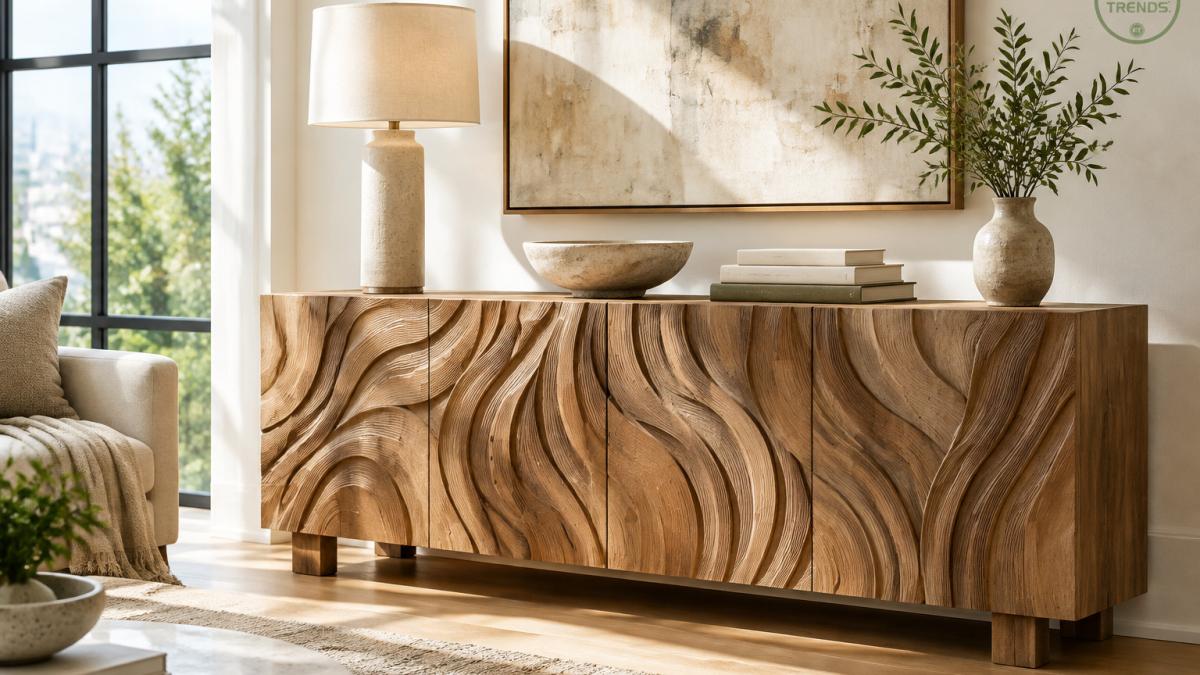
A helpful approach is to pair one tall sculptural vase with two lower objects, such as a stack of books and a shallow ceramic dish. The Faceted Gold Aluminum Vase can work well for the tall role because it adds height and catches light from every angle.

Try grouping in odd numbers. Three objects of different heights almost always look more natural than two. Keep the grouping asymmetrical so the arrangement feels relaxed.
Sideboard Styling With Art: Placing Wall Pieces Above the Surface
Art above a sideboard frames the whole display. The most common mistake is hanging art too high. Center the piece about 8 to 12 inches above the sideboard top so the two read as one unit.
Choose art with a tonal palette if your sideboard already has strong grain or carving. A bold canvas can compete with a sculptural piece, while a quieter work lets the wood lead. For inspiration on hanging and placing wall pieces, see How to Style Cultural Wall Art for Beginners.
Keep one rule in mind: the art and the objects below should share a color or material thread. A gold vase under a gold-framed mirror ties the room together without matching it exactly.
Sideboard Styling With Lamps and Evening Lighting
Lighting changes everything at night. A sculptural sideboard can glow in the evening if you plan for it. A lamp placed near the tallest object gives you height and warmth, and a second, smaller light on the opposite end balances the glow.
Warm bulbs tend to suit this kind of piece better than cool light, which can flatten wood grain and carved detail. If your room has a ceiling fixture, use a dimmer so you can soften the light after dark.
Lamps also double as a styling anchor. One tall lamp on the left and a low accent light on the right creates the same odd-number balance as your decor.
Scale, Clearance, and Proportion for Luxury Rooms
Proportion decides whether a sideboard feels grand or cramped. A long sideboard needs a wide wall, and a deep piece needs enough floor space to pull out from the wall without blocking a path.
As a working guide, a statement sideboard should feel substantial against the wall it sits on, with clear floor space for walkways. For a sideboard with a deep frame, check that the doors open fully without hitting a sofa or chair.
Measure the room before you order. Tape the footprint on the floor and live with it for a day. This simple test catches most sizing mistakes.
Matching Materials and Finishes Around Your Sideboard
Luxury rooms read as one composition, not a collection of nice objects. The sideboard sets the material key. Everything else either echoes it or answers it.
Start with the wood. Acacia wood brings warm honey tones and a lively grain. For a reclaimed alternative, see the mango wood finish up close. Sheesham wood runs darker and denser, and its hardness matters here. On the Janka scale, sheesham scores around 1,410 lbf, which makes it harder and more scratch-resistant than teak at roughly 1,000 lbf. That density also means properly seasoned sheesham resists warping and splitting, and its heartwood naturally repels dry-wood termites and fungi without harsh chemical treatments. In a living room, that translates to a surface that absorbs daily life and stays tight for decades.
Once the wood tone is set, pick two supporting materials and stop. A common luxury pairing is wood plus stone plus one soft textile. A brass or aged metal accent counts as a third only if it appears twice in the room.
Textiles soften a hard sculptural piece. Boucle furniture nearby adds a nubby, matte counterpoint to polished wood. A Cloud Silque Throw draped over a chair arm brings a soft touch. An Avenida in Bosque 18" x 18" Pillow adds a botanical note to the room.
For a softer, more tactile room, Portugal-woven bedding and hypoallergenic milk or casein fibre textiles can extend beyond the bedroom. Look for OEKO-Tex certification on any textile you bring into the room, since it signals the fabric has been tested for harmful substances.
Organic cotton covers and slipcovers keep a neutral look that lets the sideboard lead.
Watch out: more than four materials in one sightline starts to look like a showroom. Count wood, metal, stone, glass, and textile. If you hit five, remove one.
Finish sheen is the quiet variable. Match sheen levels across the room. A high-gloss lacquer sideboard wants satin or matte accessories. A hand-rubbed oil finish wants soft waxed wood and brushed metal. Mismatched sheen is the fastest way to make expensive pieces look accidental.
Finally, think about sourcing. We research reputable purveyors and source from them, so you can plan around the pieces you receive.
Booking Your Sculptural Sideboard Into Your Room Plan
Before you buy, sketch your room with the sideboard, the art, and the lighting in place. Note the measurements, the clearances, and the material palette. This plan saves time and prevents costly returns.
Once the plan is set, you can browse our sideboards and decor pieces and check each one against your sketch. Look at dimensions, finish, and how each piece fits the room you have in mind.
With a clear plan, a sculptural sideboard becomes the calm center of your living room. Start small, step back often, and let the carving speak for itself.
Interior design guidance on sideboard placement
Frequently Asked Questions
How do you style a sculptural sideboard in a living room?
Start with the piece itself. Let its carved or geometric form do most of the work, then add only a few objects. Pick one tall element, one low element, and one textural accent. Group them in odd numbers and leave open space around the sculpted front so the silhouette stays visible. Step back from the doorway to check that the display reads clearly from the room's main seating area.
What should you put on top of a sideboard?
Choose three to five objects that work at different heights. A tall lamp or vase, a sculptural bowl, and a stack of books or a small object make a balanced group. Pick colors and materials from the room's palette so nothing competes with the sideboard's finish. Leave some surface empty. Empty space makes the furniture look deliberate rather than crowded.
How tall should art be above a sideboard?
Hang art so its lower edge sits roughly 8 to 12 inches above the top of the sideboard. This keeps the two pieces connected without crowding the surface. For a sculptural piece, choose artwork with tonal colors and simple lines so the two elements do not fight for attention. A single large piece often works better than several small frames.
