

How to Style Cultural Wall Art for Beginners
Yuatinia LeakLast Updated: October 30, 2026
Quick Summary
To style cultural wall art for beginners, start with a piece whose story you can name, then measure your wall and furniture before buying. Art should fill roughly two-thirds to three-quarters of the wall width above furniture, hung at eye level 57 to 60 inches from the floor.
- Start with a memory, not a color, and confirm the culture and maker behind the piece.
- Cut paper templates to size and tape them to the wall before committing to a nail.
- Hang your most meaningful piece as the focal point, keeping frame gaps around 2 to 3 inches.
- Choose natural frames like hand-carved bone or marble that echo the artwork's origins.
- Buy from sellers who name makers and can verify material claims like OEKO-Tex certification.
Table of Contents
- Start With a Story: Choosing Cultural Wall Art That Means Something
- Cultural Wall Art Ideas That Fit Your Room's Style
- Your Wall Art Size Guide: Getting Scale and Proportion Right
- How to Arrange Wall Art Around a Focal Point
- How to Create a Gallery Wall Without the Guesswork
- Frames That Let Cultural Artwork Breathe
- Hanging Height, Hardware, and Renovation-Safe Tricks
- Buy Ethically and Display With Respect
- Shop the Fluent Trends Pieces That Bring It All Together
- Frequently Asked Questions
Start With a Story: Choosing Cultural Wall Art That Means Something
Cultural wall art is artwork rooted in a specific heritage, made with traditional techniques or motifs. It carries a story you can point to. Fluent Trends sources pieces from reputable purveyors who work with women-owned studios and global makers. That matters here. A piece with a real story is easier to style, because you already know what it is saying.
Most beginners start with color. That is the wrong first step.
Start with a memory instead. A trip, a grandmother's kitchen, a textile you saw once and never forgot. Write it down in one sentence.
Then ask three questions:
- Does this piece come from a culture I can name?
- Do I know who made it or where it came from?
- Would I still love it in five years?
If you answer yes to two of three, you have a keeper. Below, we will show you exactly how to hang it, frame it, and build a wall around it.
Cultural Wall Art Ideas That Fit Your Room's Style
Matching cultural wall art to a room comes down to one idea: match the mood, not the catalog. A modern minimalist room can hold a carved bone frame beautifully. It just needs space around it.
Here is how we would pair pieces by room style:
- Contemporary rooms: one large print, thin black frame, lots of white wall
- Traditional rooms: warm woods, brass accents, layered frames
- Global style rooms: mixed textures, woven baskets, bone inlay, bouclé seating
- Afrocentric decor: bold earth tones, textured photography, natural fibers
The trick is contrast. A minimalist room needs one warm, textured piece to feel alive. For more help, see this guide to styling global decor in modern homes. A busy room needs one calm piece to breathe.
Your Wall Art Size Guide: Getting Scale and Proportion Right
Getting scale right is the single biggest difference between art that looks intentional and art that looks like an afterthought. Most beginners buy too small. A tiny frame floating on a big wall reads as a mistake, not a style choice.
Here is the rule that solves most problems before you spend a dollar. Art should fill roughly two-thirds to three-quarters of the wall width above a piece of furniture. That is your starting point, not your final answer.
Measure the wall, then measure the furniture
Grab a tape measure and write down three numbers. The width of the wall. The width of the furniture below it. The distance from the furniture top to the ceiling.
Those three numbers tell you almost everything. If your sofa is 84 inches wide, your art should span about 56 to 63 inches. That could be one large piece or a grouping of three smaller ones.
A common pattern among interior stylists is to treat the furniture as the anchor. The art lives in relationship to the sofa, bed, or console, not to the wall alone.
A simple size guide to work from
| Wall Type | Art Width | Best For |
|---|---|---|
| Above a sofa | 60-75% of sofa width | One large statement piece or a triptych |
| Narrow hallway | 40-50% of wall width | Vertical prints, stacked in a column |
| Above a bed | 50-60% of bed width | One wide piece or a matched pair |
| Small accent wall | 30-40% of wall width | Single framed print |
| Above a console table | 50-70% of console width | Layered frames or a leaning arrangement |
Measure first. Buy second. We cannot stress this enough.
The empty-wall test
Here is a trick that costs nothing. Cut a piece of paper or cardboard to the exact size of the art you are considering. Tape it to the wall. Live with it for a day.
If the paper looks too small, the art will look too small. If it feels overwhelming, size down. This test catches mistakes before they become returns.
When to go bigger than feels comfortable
A good rule for beginners is to go one size larger than your first instinct. Most people underestimate scale because they are picturing the art alone, not the art on a wall.
A 16x20 inch print above a queen bed will look lost. A 24x36 inch piece or a pair of 16x20 frames will feel balanced. The math does not lie.
Scale is about relationship, not just inches
A large piece in a small room can work beautifully if it has breathing room. A small piece in a large room can work if it is grouped with others. The goal is visual weight, not a specific number.
If you are styling cultural wall art, give it space. A hand-carved bone frame or a textured textile needs room to be seen. Crowding it with clutter defeats the purpose.
Pairing size with the rest of the room
A large piece above a sofa pairs well with a low-profile bouclé chair nearby. The soft texture balances the visual weight of the art. A woven basket or a Cloud Silque Throw on the sofa adds warmth without competing.
If your room already has heavy furniture, like a solid sheesham wood console, keep the art lighter in visual weight. Thin frames and open mats help. If the furniture is light, the art can carry more presence.
For more on building a room that holds up to daily life, this collection of durable furniture for daily use is worth a look.
One last check before you buy
Ask yourself three questions. Does the art fill the right proportion of the wall? Does it relate to the furniture below it? Does it have room to breathe?
If you answer yes to all three, you are ready to hang. If not, size up or regroup. The wall will wait.
How to Arrange Wall Art Around a Focal Point
Every wall needs one hero. A focal point is the piece your eye lands on first. Build everything else around it.
Here is the arrangement we recommend for beginners:
- Pick your largest or most meaningful piece as the hero.
- Hang it at eye level, roughly 57 to 60 inches from the floor to the center.
- Place smaller pieces around it in pairs or threes.
- Keep gaps between frames consistent, around 2 to 3 inches.
- Step back and check the visual balance from across the room.
Symmetry feels calm. Asymmetry feels collected and lived-in. Neither is wrong.
What most guides miss is this: the focal point should be the piece with the most personal connection. Not the biggest. The one you would rescue in a fire.
How to Create a Gallery Wall Without the Guesswork
A gallery wall is a group of framed pieces arranged as one unit. The easiest method uses paper templates. Trace each frame onto paper, tape the paper to the wall, and move things around before you commit to a single nail.
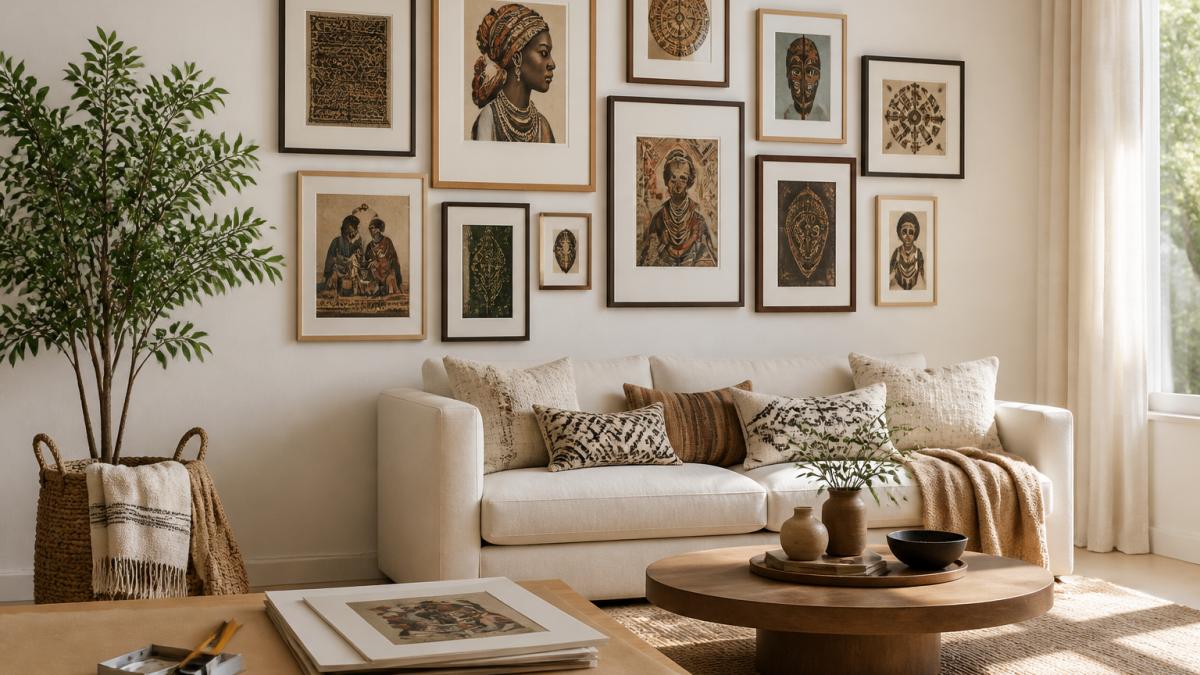
Follow these steps:
- Lay all frames on the floor first and photograph the layout.
- Cut paper templates the same size as each frame.
- Tape templates to the wall and live with them for a day.
- Start with the center piece, then work outward.
- Keep the outer edges aligned to an invisible rectangle.
One honest limitation: gallery walls take patience. Rushing the layout is the number one reason they look messy.
Frames That Let Cultural Artwork Breathe
The right frame protects the art and lets it speak. For cultural wall art, we lean toward natural materials that echo the piece itself. Bone, brass, and marble all work beautifully.
Two pieces we keep coming back to:
- The Mukhendu 5x7 cream frame, hand-carved bone with brass bar accents, made using traditional Old Delhi art forms
- The Sammita 4x6 black and white frame, hand-carved marble with brass accents
Both are ethically handmade. Both hold a 5x7 or 4x6 print. Both include a tabletop easel or a wall-hanging d-ring.


Black frames feel modern and graphic. Natural frames feel warm and grounded. Match the frame to the mood you want, not to the trend.
Hanging Height, Hardware, and Renovation-Safe Tricks
Hang art so the center sits at eye level, about 57 to 60 inches from the floor. That is the standard most designers use, and it works in almost every room.
For hardware, you have options:
- Nails and hooks: best for drywall with a stud nearby
- D-ring hangers: already built into many frames, including ours
- Adhesive strips: renter-friendly, damage-free, and rated by weight
- Picture rail hooks: good for plaster walls you cannot drill
Renters, listen up. Adhesive strips hold well when you follow the weight rating on the package. Clean the wall first. Press firmly for 30 seconds. Wait an hour before hanging.
Watch out: adhesive strips fail on textured, dusty, or freshly painted walls. Give new paint a week to cure before hanging anything.
Buy Ethically and Display With Respect
This is the section most guides skip. It is also the one that matters most when you are styling cultural wall art. Buying ethically and displaying with respect are not afterthoughts. They are the foundation.
Start with provenance, not price
Provenance means the origin story of a piece. Who made it. Where. Using what materials and techniques. A piece with clear provenance is easier to style because you know what it is saying. You can explore authentic cultural heritage decor pieces to find items with clear origins.
Ask sellers three questions before you buy. Who made this? Where was it made? How was the maker paid? If a seller cannot answer, that is your answer.
We source from reputable purveyors who work with women-owned studios and global makers. We research purveyors and source from them because that is what we do. That distinction matters.
How to research a piece before you commit
You do not need a degree in art history to buy responsibly. You need twenty minutes and a search engine.
- Search the motif or technique. If the piece uses bone inlay, look up how bone inlay is traditionally made. You will learn quickly whether a seller is describing it accurately.
- Look for the maker's name. A piece attributed to a specific studio or region is a good sign. A piece labeled only as ethnic or global is a red flag.
- Check the material claims. Sustainably sourced wood, organic cotton, and OEKO-Tex certified textiles are verifiable standards. Ask for the certification if it is not listed.
- Read the return policy. A seller who stands behind their sourcing will stand behind their returns.
The difference between inspiration and appropriation
Inspiration honors a culture. Appropriation takes from it without credit or context. The line is not always obvious, but a few questions help.
Does the piece credit the culture and the maker? Is the price fair for the labor involved? Would the maker recognize the piece as their own tradition? If the answer to any of these is no, pause.
Sacred objects are not decor. A mask used in ceremony, a religious textile, or a ritual object belongs in a museum or a cultural institution, not above your sofa. Skip those and choose pieces made for display.
Display with context
When guests ask about a piece, tell them what you know. Name the culture. Name the maker if you can. Share the technique. That small act turns decor into a conversation and gives credit where it is due.
A small card or label near a gallery wall is a simple way to add context. It does not have to be formal. A handwritten note works.
Buying on a budget without compromising ethics
You do not need a large budget to buy ethically. Small prints from artists you can name are often more affordable than mass-produced decor. Textiles, ceramics, and small carved pieces are good entry points.
A Large Porcelain Nesting Bowl or a Lhasa Mug in Limoges porcelain can anchor a shelf or console. A pair of Peridot and Emerald Textured Coin Earrings can be framed as a small textile study.
When you buy prints, ask about the paper and the printing method. A giclée print on heavy, sustainably sourced paper is built to last. That matters if you want the piece to stay with you.
Supporting artists directly
Buying from sellers who name their makers is a direct way to support the people behind the work. Look for artist attribution on product pages. Look for fair trade claims that are specific, not vague.
If a seller says fair trade but cannot tell you what that means for their makers, ask. A reputable purveyor will have an answer.
A simple checklist for beginners
Before you buy, run through this list. Can I name the culture this piece comes from? Do I know who made it or where it came from? Is the price fair for the labor? Is the material claim verifiable? Would I still love this in five years?
If you answer yes to most of these, you are buying well. If not, keep looking. The right piece will wait for you.
Shop the Fluent Trends Pieces That Bring It All Together
You have the framework. Now for the pieces that make it real. You can shop the Fluent Trends trends pieces that bring it all together.
Start with a print that anchors the wall. Our Giclée fine art print, Carrying the Day, brings warm earth tones and real texture. It is printed on heavy, sustainable paper stock. It pairs naturally with a hand-carved bone frame and a woven basket nearby.

Add softness with organic cotton and linen textiles. Add durability with solid wood pieces built for daily life. Sheesham wood, for example, scores around 1,410 lbf on the Janka hardness scale. That makes it harder and more scratch-resistant than teak. It resists warping when properly seasoned.
Frequently Asked Questions
What is the 3-5-7 rule for decorating?
The 3-5-7 rule is a simple styling trick for grouping objects. You use odd numbers, like three, five, or seven items, because odd numbers feel more natural to the eye. For cultural wall art, this could mean hanging three framed prints in a row or grouping five small frames around one larger piece. It also works on shelves and tables. Pair a framed print with a woven basket and a ceramic bowl. Odd groupings create visual balance without feeling stiff or overly matched.
How do you mix cultural wall art with modern decor?
Start with one or two cultural pieces and let them stand out against clean, simple surroundings. Keep the rest of the room calm with neutral walls and modern furniture lines. Use frames that match your existing finishes, like black or brass, so the art feels intentional. Repeat one color from the artwork in a pillow or throw to tie things together. A giclée fine art print with warm earth tones, for example, pairs well with a linen sofa and a simple wood table.
How high should cultural wall art be hung?
Hang the center of your artwork at eye level, which is usually around 57 to 60 inches from the floor. If you are hanging art above a sofa, leave about 6 to 8 inches of space between the top of the sofa and the bottom of the frame. For a gallery wall, treat the whole group as one unit and center that group at the same height. These measurements keep the art connected to your furniture instead of floating too high on the wall.
How do you arrange cultural wall art in a living room?
Pick one wall as your focal point and build around it. Place your largest or most meaningful piece at eye level, then add smaller pieces around it in a balanced layout. Keep spacing between frames at about 2 to 3 inches so the group reads as one display. Pull colors from the artwork into pillows, rugs, or throws. If you rent, use adhesive strips for lighter frames and keep heavier pieces on a console or shelf to avoid wall damage.
Styling a wall should feel like telling a story, not solving a puzzle. Start with one meaningful piece, measure before you hang, and let the rest grow around it. Fluent Trends can help you get there with ethically sourced, handcrafted decor, from Giclée fine art prints to hand-carved bone and marble frames. Every piece is chosen with care and built to last. Get started with Fluent Trends and build a wall that means something.
