

Toy Storage Ideas For Playroom: Smart, Clutter-Free Space
Donna MaloneWhen you're trying to figure out the best toy storage ideas for a playroom, it’s easy to get lost in a sea of cubby shelves, woven baskets, and wall-mounted units. The real goal, though, isn't just to hide the mess. It's to create a system that makes cleanup genuinely intuitive for kids while actually looking good in the room.
From Chaos To Calm: A New Approach To Playroom Design
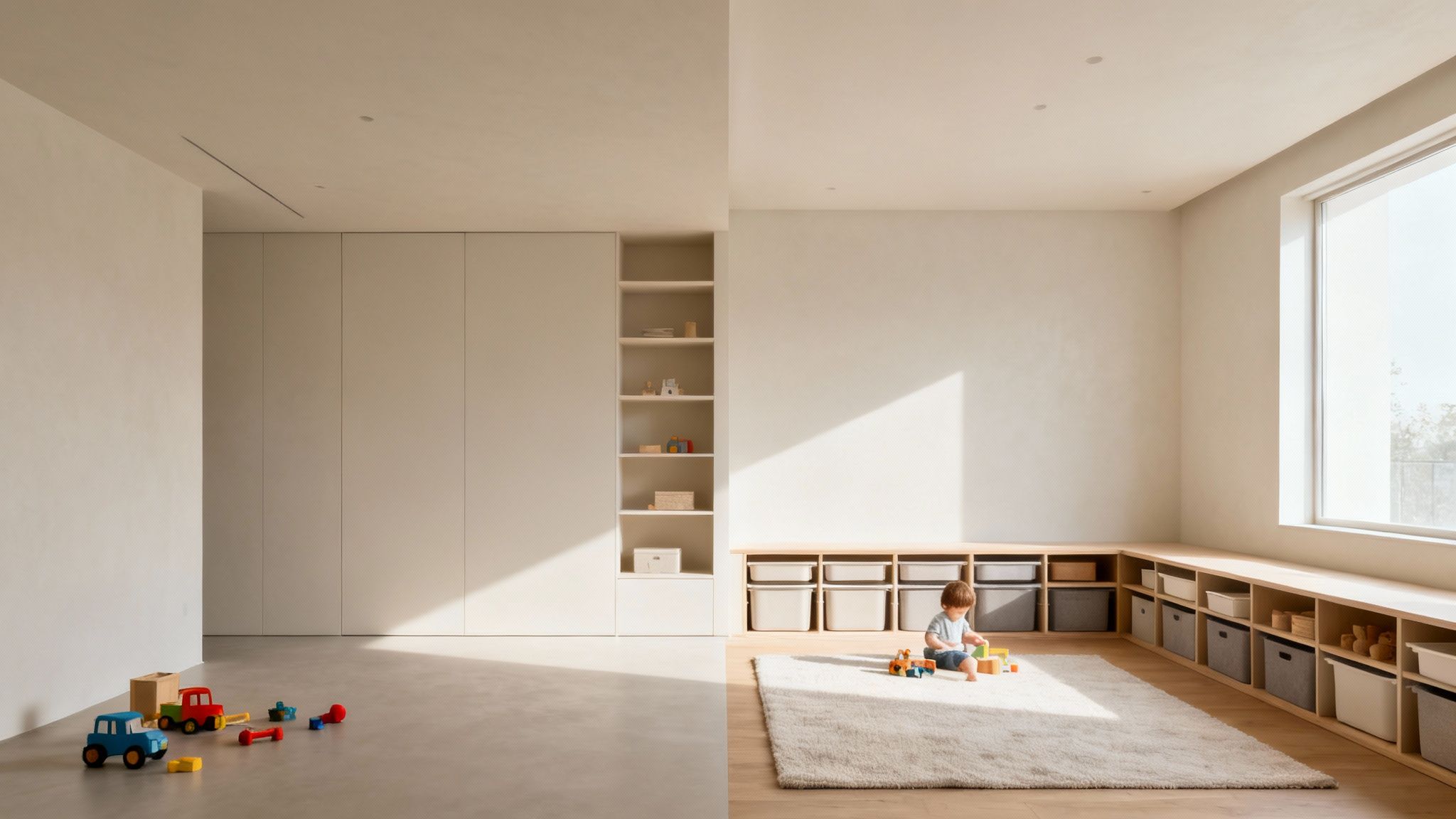
Let’s be honest for a second. That dream of a picture-perfect playroom often crashes head-on into the reality of toy chaos. This guide is about moving past the quick fixes and embracing a philosophy of 'functional aesthetics' for your kids' space.
We’re going to show you how thoughtful toy storage is about so much more than just cramming everything out of sight. It’s about teaching independence, sparking more focused play, and creating a space where creativity can actually breathe. Think of this as your roadmap to a playroom that's as beautiful as it is livable, packed with real strategies for real families.
Shifting Your Organizational Mindset
The first real step is to completely reframe how you think about toy organization. It’s not just another chore on the list; it's a chance to design a more peaceful and engaging world for your kids. When storage is just an afterthought, you end up with those overflowing bins and that constant feeling of being overwhelmed—and that goes for both you and your children.
When you approach it with intention, you can build a system that actually empowers your child to find what they need and, just as importantly, put it away.
The payoff is huge:
- Promoting Independence: When kids can reach their own toys, they learn to manage their stuff, building confidence and a sense of responsibility.
- Encouraging Focused Play: A jumbled mess is distracting. When toys are organized, kids can easily find what they’re looking for and dive into deeper, more imaginative play.
- Creating a Calmer Environment: A visually organized space is less overstimulating and stressful for everyone in the family.
The goal isn't just a tidy room at the end of the day. It's about designing a system that makes tidiness the path of least resistance for everyone.
This shift isn't just happening in our homes; it's a massive trend. The global toy storage market is projected to hit USD 18,909.52 million by 2035, a huge leap from its 2025 valuation. It’s clear that families everywhere are looking for better solutions.
To get your kids involved and thinking creatively, you could even try an activity like fixing the toy box with design thinking. It's a fun way to get them to solve their own organizational puzzles.
Right, before you even think about buying that perfect set of bins or installing a single shelf, we need to talk about the most important step: the toy audit.
This isn’t about some ruthless, minimalist purge. It's about taking a smart, honest look at what your kids actually play with. Trust me, skipping this part is the number one reason playroom makeovers fail. You end up with a beautifully organized collection of toys that nobody even likes.
First things first, you have to get everything out in the open. I mean everything. Dump out every basket, empty every closet, and pull things out from under the sofa. Pile it all up in the middle of the room. It’s a bit shocking, I know, but seeing the mountain of stuff gives you a real, unfiltered look at what you’re dealing with.
Start by Sorting Into Broad Piles
With your toy mountain assembled, it's time to start sorting. Don't overcomplicate it at this stage. You're just looking for broad, intuitive categories that make sense for how your kids play.
Think in terms of big groups like these:
- Building Stuff: LEGOs, Magna-Tiles, wooden blocks, anything they construct with.
- Art & Making: Crayons, paint, Play-Doh, craft kits, and all that glorious mess.
- Pretend Play: Dress-up clothes, dolls, action figures, play food—the works.
- Things That Go: Cars, trucks, trains, and anything else with wheels.
- Puzzles & Games: Board games, card games, and those chunky wooden puzzles.
This simple act of grouping turns total chaos into something you can actually tackle. It also immediately shows you where you have way too much of one thing (hello, 5 nearly identical Paw Patrol puzzles) and what might be missing.
Get Your Kids on Board (Without the Tears)
Bringing your kids into the process is a game-changer for making the new system stick. It gives them a sense of ownership and teaches them about making choices. But you have to handle it right.
Asking a toddler, "Do you want to keep this?" will almost always get you a "yes." They'll suddenly decide that broken crayon is their most prized possession.
Instead, frame it as making room for their absolute favorites. Try saying something like, "You loved this when you were a little smaller! How about we pass it on to another kid who would have so much fun with it now?"
Work together to make four distinct piles: Keep, Donate, Store Away (for Rotation), and Toss/Recycle. The 'Keep' pile is for the all-stars—the toys they reach for again and again. The 'Rotate' pile is your secret weapon for toys they like but have forgotten about. Tucking them away for a few months makes them feel brand new when they reappear.
This whole process ensures that every single toy that earns its spot back in the playroom is one that actually deserves to be there. You're setting the stage for a system that's built around your family, not just a bunch of stuff.
Matching Storage Solutions To Your Family's Needs
Okay, with a freshly curated toy collection in hand, you're in the perfect spot to pick storage solutions that actually work for your family and your home. The real goal here is to create a smart, versatile system by mixing different types of storage. It's how you build a playroom that’s not just functional, but looks great, too.
Forget the one-size-fits-all approach. The best playroom storage comes from a clever mix-and-match strategy. Think about it: open shelving is fantastic for showing off beautiful wooden toys or those impressive LEGO creations, instantly turning them into decor. On the other hand, cubby units are the champions of accessibility, perfect for toddlers who need to see and grab their favorites all on their own.
Deep bins and big baskets definitely have their place. They are your go-to for wrangling bulky collections like that mountain of stuffed animals or oversized building blocks. I love using soft, woven baskets to add a cozy texture to a room, while clear plastic bins are an absolute lifesaver for smaller, categorized items like LEGOs or art supplies—kids can see exactly what’s inside.
Choosing The Right Containers For The Right Toys
The secret to a system that actually sticks? Pairing the toy with the right container. This one simple move can stop the dreaded "dump and search," where an entire bin gets emptied just to find one tiny car. A little forethought here pays off big time.
Here are a few practical pairings I always recommend:
- Clear, shallow bins are perfect for LEGOs, Magna-Tiles, or craft supplies. Kids can spot the colors and shapes they need without having to dump everything on the floor.
- Soft, woven baskets work beautifully for plush toys or dress-up clothes. They’re gentle on the items and add a warm, inviting feel to the space.
- Sturdy, open-front bins are ideal for things like wooden blocks or toy vehicles. The open design makes it easy for little hands to grab what they want and—more importantly—put it back.
- Vertical wall shelving is a game-changer for displaying book collections or prized action figures. It draws the eye upward and frees up precious floor space.
By creating a designated home for each category of toy, you’re not just organizing; you’re teaching your child the foundational skills of tidiness and respect for their belongings.
This little decision tree is a great visual for the sorting process, helping you decide whether to keep, rotate, or let go of toys.
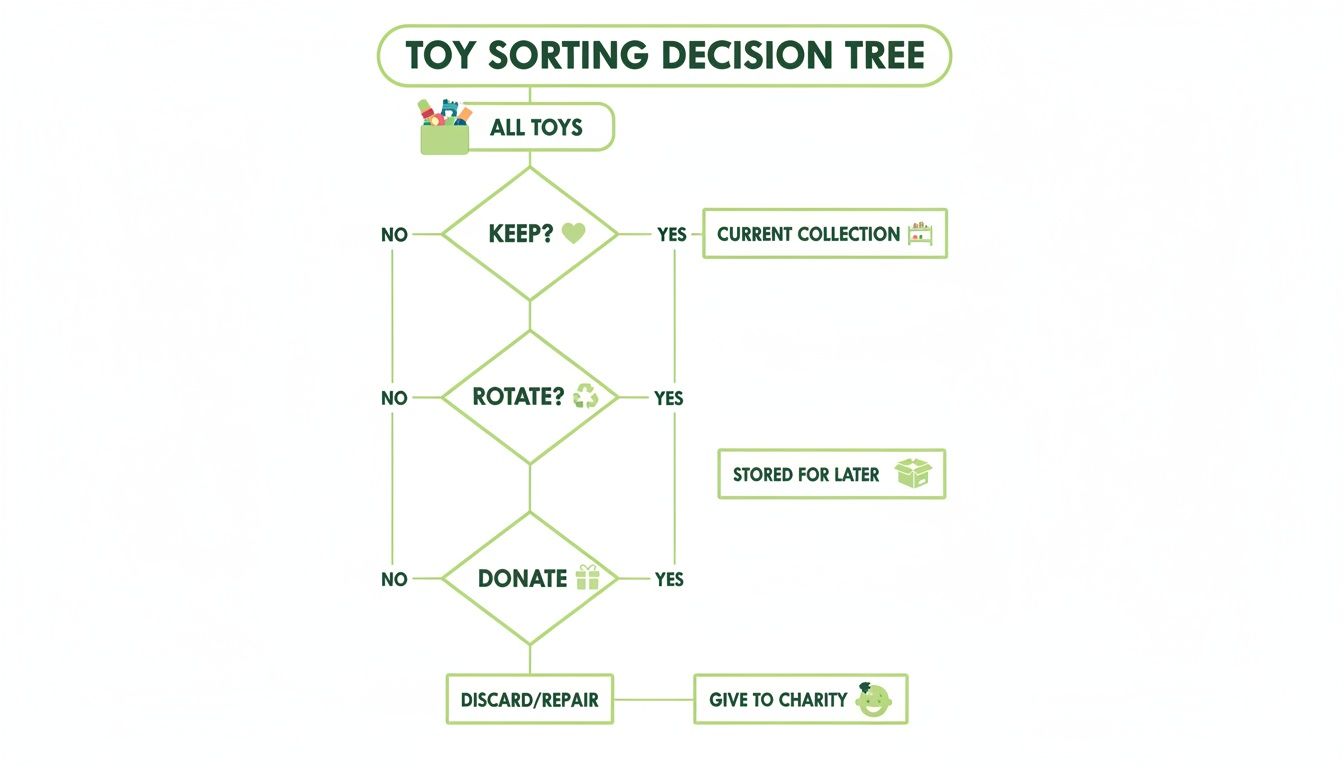
The key takeaway? Not every toy needs to be out all the time. A good rotation system is one of the most powerful tools you have for keeping the clutter under control.
Finding And Purchasing Your Storage
Finding the perfect storage pieces has never been easier, with the market full of fantastic options for every style and budget. To really nail your setup, it’s worth consulting a comprehensive guide to toys storage organizers to find solutions that truly fit your family's rhythm.
The way we shop for these items is changing, too. It’s no surprise that e-commerce is where it's at, with online sales for toy storage projected to see the highest growth through 2033. This shift means families everywhere have access to a much wider variety of solutions than what’s available at their local stores.
We’ve pulled together a quick comparison to help you weigh some of the most popular options.
Toy Storage Solution Comparison
| Storage Type | Best For | Child Accessibility | Aesthetic Value |
|---|---|---|---|
| Open Shelving | Displaying books, completed models, and beautiful toys | High (lower shelves), Low (upper shelves) | High |
| Cubby Units | Categorizing toys in bins, accessible play items | Excellent | Medium to High |
| Baskets & Bins | Bulky items (stuffed animals, blocks), loose parts | Excellent (if not overfilled) | High (especially woven) |
| Wall Solutions | Books, art supplies, small collectibles | Varies by height | High |
Each option has its strengths, and the most successful playrooms often use a combination of two or more of these solutions.
Ultimately, creating a playroom that stays organized is all about building a system that feels flexible and intuitive for your kids. For more ideas, you can check out our guide on the https://fluenttrends.com/blogs/news/best-toy-storage-solutions. By mixing shelving, bins, and baskets, you can design a space that not only looks great but also grows with your child and makes cleanup a natural part of playtime.
Designing Play Zones For Better Play And Easier Cleanup
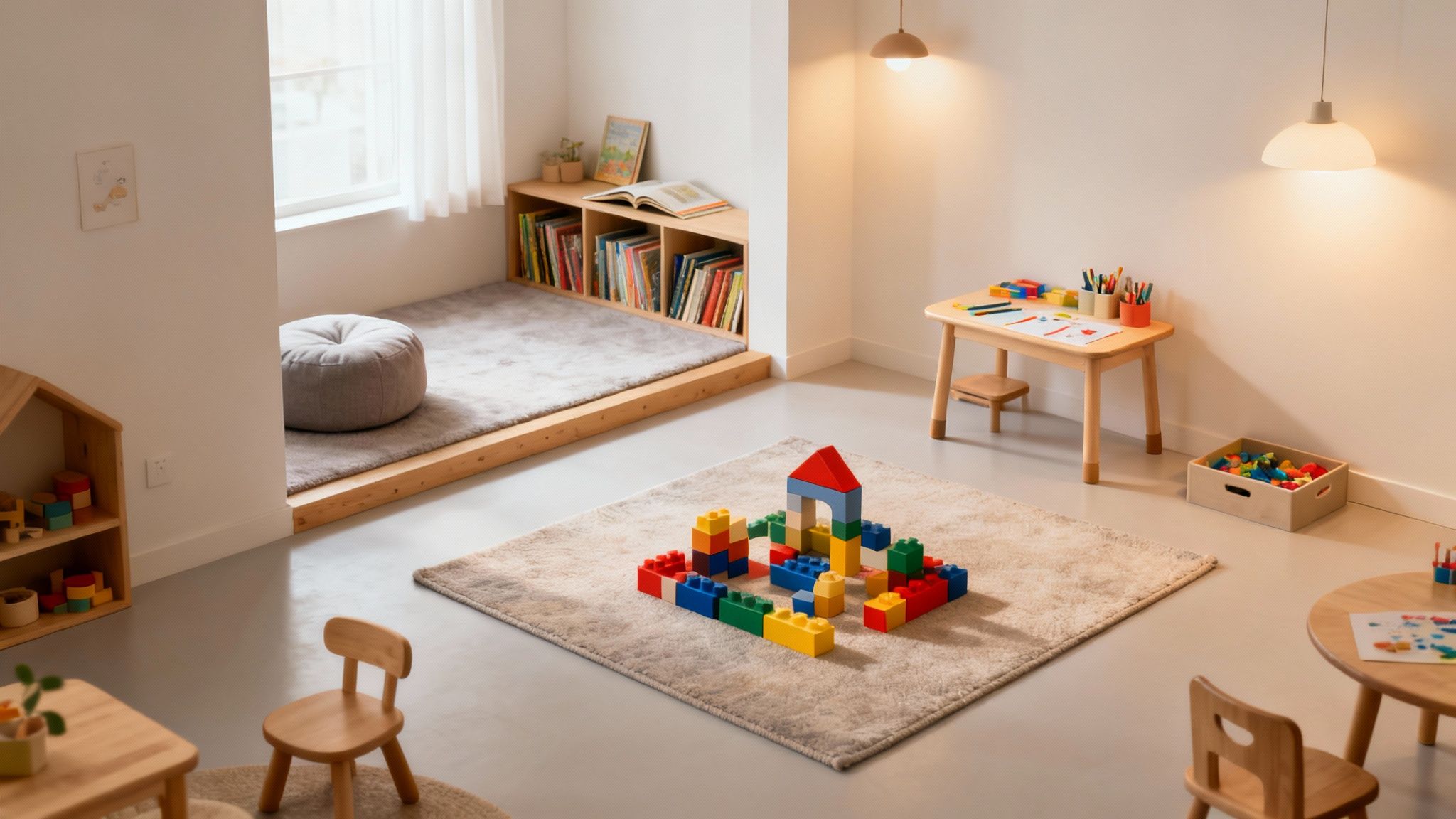
Fantastic organization is about so much more than just pretty baskets and bins. It’s about creating a space that actually works. By setting up specific "play zones," you can guide your kids toward more focused, imaginative play and make cleanup feel like a natural part of the game.
Forget the giant, chaotic toy box. Think of your playroom as a collection of thoughtful little stations. A cozy reading nook here, a construction site over there, and a dedicated spot for arts and crafts. When toys live right where they're used, kids are far more likely to get lost in an activity—and, more importantly, put things back where they found them.
Using Furniture To Define Your Zones
Your storage furniture is the key to making this happen. A simple bookshelf or a set of cubbies can act as a natural divider, visually separating one activity from another. This bit of structure is great for helping kids focus on one thing at a time instead of feeling overwhelmed by everything all at once.
Here's how to use furniture to create a natural flow:
- The Reading Nook: A low, front-facing bookshelf does double duty. It displays books invitingly while carving out a quiet corner. Just add a soft rug or a comfy beanbag chair, and you've signaled it's time to slow down.
- The Building Zone: Use a low-profile cubby system to house all the blocks, LEGOs, and Magna-Tiles. Laying a large, flat-weave rug in front of it helps define the "construction site" and keeps all those little pieces from migrating across the room.
- The Creative Corner: An art table with built-in drawers or a simple rolling cart is perfect here. It keeps paper, crayons, and paint supplies right at their fingertips, making it easy to start a project and even easier to clean it up.
This zone-based approach is one of the most effective toy storage ideas for a playroom because it builds organization right into the way your kids play. For more layout inspiration, our guide to kids' playroom organization ideas has you covered.
Prioritizing Safety In Your Playroom Design
As you start arranging furniture and setting up your zones, safety has to be your number one priority. A beautifully designed playroom is only great if it’s a secure space for your little ones to explore freely.
A beautiful playroom is useless if it isn't safe. Always, always anchor heavy furniture like bookshelves and dressers to the wall to prevent them from tipping over.
Beyond anchoring, look for storage with soft, rounded corners and stick to non-toxic, durable materials. Always double-check that bins and containers don't have small parts that could become a choking hazard for young children.
The demand for safe, quality storage is a huge deal for parents everywhere. In fact, North America currently holds over 35% of the plastic toy storage market share, driven by a preference for premium, child-safe products. By blending thoughtful zoning with a non-negotiable commitment to safety, you'll create a playroom that’s not just organized, but truly inspiring.
Creating Systems That Actually Last
A stunningly organized playroom is only a win if it stays that way. The real magic isn't in the initial tidying spree; it's in creating simple, sustainable habits that the whole family can stick with. This is where we get smart.
Two of the most powerful tools in my playbook are a great labeling system and a consistent toy rotation. These aren't just for making a parent's life easier—they’re designed to empower your kids to take ownership of their space.
When a child knows exactly where their favorite dinosaurs live, cleanup stops being a chore and turns into a simple matching game. It builds their confidence and makes the idea of a tidy room feel totally achievable.
Empower Kids With Smart Labeling
Think of labels as the secret code to your playroom's organization. They translate your brilliant system into a language your child can understand and use all on their own. The trick is to keep it visual and dead simple, especially for little ones who haven't started reading yet.
- Picture Labels for Pre-Readers: This is my go-to for the toddler and preschool crowd. Just snap a quick photo of the toys that go in a specific bin—a pile of LEGOs, a handful of toy cars—and tape it right on the front. It instantly turns tidying up into a scavenger hunt they can do themselves.
- Color-Coded Systems: Assign a color to each category of toy. Maybe all the building toys go in blue bins, art supplies live in red ones, and dress-up costumes get tossed into yellow baskets. It's a fantastic way to reinforce color recognition while making cleanup lightning-fast.
Here's my litmus test: a guest should be able to walk into the room and know exactly where to put a stray toy. When you hit that point, you’ve made the system truly effortless.
The Magic Of Toy Rotation
Toy rotation is, without a doubt, a game-changer. It cuts down on the visual noise and, maybe counterintuitively, makes kids play more. The idea is brilliantly simple: keep a curated selection of toys out and store the rest away. Every few weeks or months, you swap them. Suddenly, old toys feel brand new.
This has a massive impact on the quality of play. Research from early childhood experts has shown that children engage in longer, more creative play when they have fewer toys to choose from. Instead of bouncing from one thing to the next, they dive deeper and let their imaginations run wild.
To get started, you just need a spot for the "off-duty" toys. A few opaque bins tucked away in a closet, the garage, or even under a bed work perfectly.
How to Implement a Toy Rotation:
- Divide and Conquer: Start by grouping similar toys together. Put all the puzzles in one pile, all the vehicles in another, and so on.
- Pick Your 'Active' Roster: Choose just one or two items from each of those categories to keep out in the playroom.
- Store the Rest: Pack everything else into your designated bins and get them out of sight.
- Schedule the Swap: Set a recurring reminder on your phone to rotate the toys every month or two. When you bring out a "new" bin, the old one goes into storage.
By pairing clear, kid-friendly labels with a simple rotation, you build a self-sustaining system. The playroom stays more engaging, feels less cluttered, and requires way less daily effort from you.
Playroom Organization Questions We All Have
Let's be real. Even with the best plan and the prettiest bins, organizing a playroom brings up some tough questions. If you've ever felt like you're fighting a losing battle against clutter, especially after a birthday or holiday, you're not alone.
Getting ahead of these common hurdles is the key to creating a system that actually sticks. Instead of just reacting to the mess, we can build a space that’s genuinely easier to keep tidy.
How Do I Handle Toys With A Million Tiny Pieces?
Ah, the tiny-piece problem. We've all been there. LEGOs, Calico Critters, doll shoes, and puzzle pieces seem to have a life of their own, ending up everywhere except where they belong. The secret is containment that’s both secure and easy for little hands to manage.
Some of my go-to toy storage ideas for a playroom with lots of little parts involve clear containers with lids that snap on tight. Think small, stackable plastic boxes or those divided organizers you find in the craft aisle. This lets kids see exactly what's inside without dumping the entire thing on the floor.
For a massive LEGO collection, I’m a huge fan of the large, flat storage bags that open up into a play mat. When playtime is over, you just pull the drawstring, and every last brick is instantly corralled. It's a game-changer.
What If My Playroom Is Also My Living Room?
This is the reality for so many of us. When your playroom has to share space with your main living area, the goal is to find storage that doesn’t scream “playroom.” You want solutions that blend right in with your home's style.
Look for furniture that’s secretly great at hiding clutter:
- Storage Ottomans: These are absolute heroes for stashing bulky things like stuffed animals, dress-up clothes, or big sets of blocks.
- Credenzas or Media Consoles: A stylish unit with solid doors is perfect. You can hide all the colorful plastic bins and baskets behind a beautiful piece of furniture.
- Bookshelves with Baskets: Use the lower shelves for attractive, matching baskets to tuck toys away. The upper shelves can stay styled with books and decor.
The trick is to think of your storage as intentional furniture, not just plastic afterthoughts. Woven baskets, handsome wooden crates, or fabric-covered boxes can elevate the look of your living room while keeping everything tidy.
How Can I Get My Kids To Actually Clean Up?
This is the million-dollar question, isn't it? The secret is to make cleanup so simple and obvious that it’s almost easier to do it than not to. If your system is too complicated, it’s doomed from the start.
First, every single toy needs a logical, designated "home." No more guessing games. From there, make cleanup part of the daily rhythm. Give a five-minute warning before playtime is over, and then—this is the important part—clean up with them, especially when they're little.
Make it fun! Set a timer and race to see how fast you can put everything away. Turn it into a "matching game" with your picture labels. Or just blast a great cleanup song. The goal is to build a habit through consistency and positive energy, not to win a single battle through nagging.
At Fluent Trends, we believe an organized home is a happy home. Discover our curated collection of stylish storage baskets, furniture, and decor designed to bring calm and beauty to every room—including the playroom. Explore our storage solutions at Fluent Trends and start creating your clutter-free space today.