

A Smart Guide to Women's Fashion Brands
Donna MaloneWhen you hear the term "women's fashion brands," it's easy to picture a massive, overwhelming sea of clothing. But really, it’s a whole ecosystem of companies, each creating clothes and accessories for different tastes, needs, and budgets. It spans everything from the affordable basics you grab on a whim to the kind of exclusive, high-end pieces you dream about for years.
Learning to tell them apart is the key to finding things that not only fit your body but also your wallet and your personal style.
Understanding the Landscape of Women's Fashion Brands
Navigating the world of women's fashion can feel like exploring a huge, vibrant city with completely different neighborhoods. Each district has its own vibe, price range, and style—from the busy, crowded high streets to the quiet, exclusive avenues. Once you know the lay of the land, you can shop much smarter and build a wardrobe that actually works for you.
The global women's wear market is a behemoth, valued at around USD 1.10 trillion. That’s a staggering number, but the market isn't just one big blob. It’s broken down into distinct tiers, each one serving a different kind of customer with a unique mix of style, quality, and cost.
This pyramid gives you a quick visual of how it all stacks up, from the everyday brands most people wear to the aspirational luxury labels at the very top.
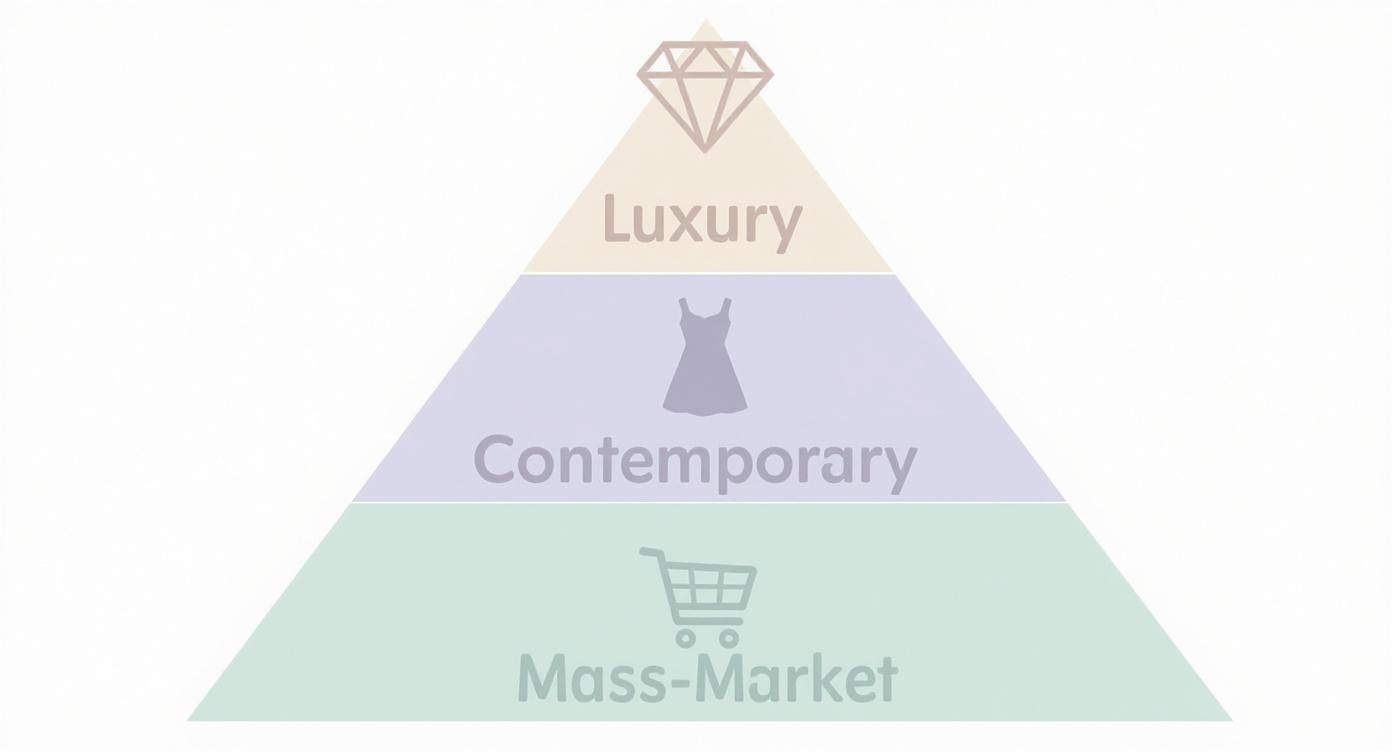
While the mass market makes up the biggest chunk, you can see how the contemporary and luxury tiers hold significant weight and influence over the entire industry.
The Four Key Tiers of Fashion
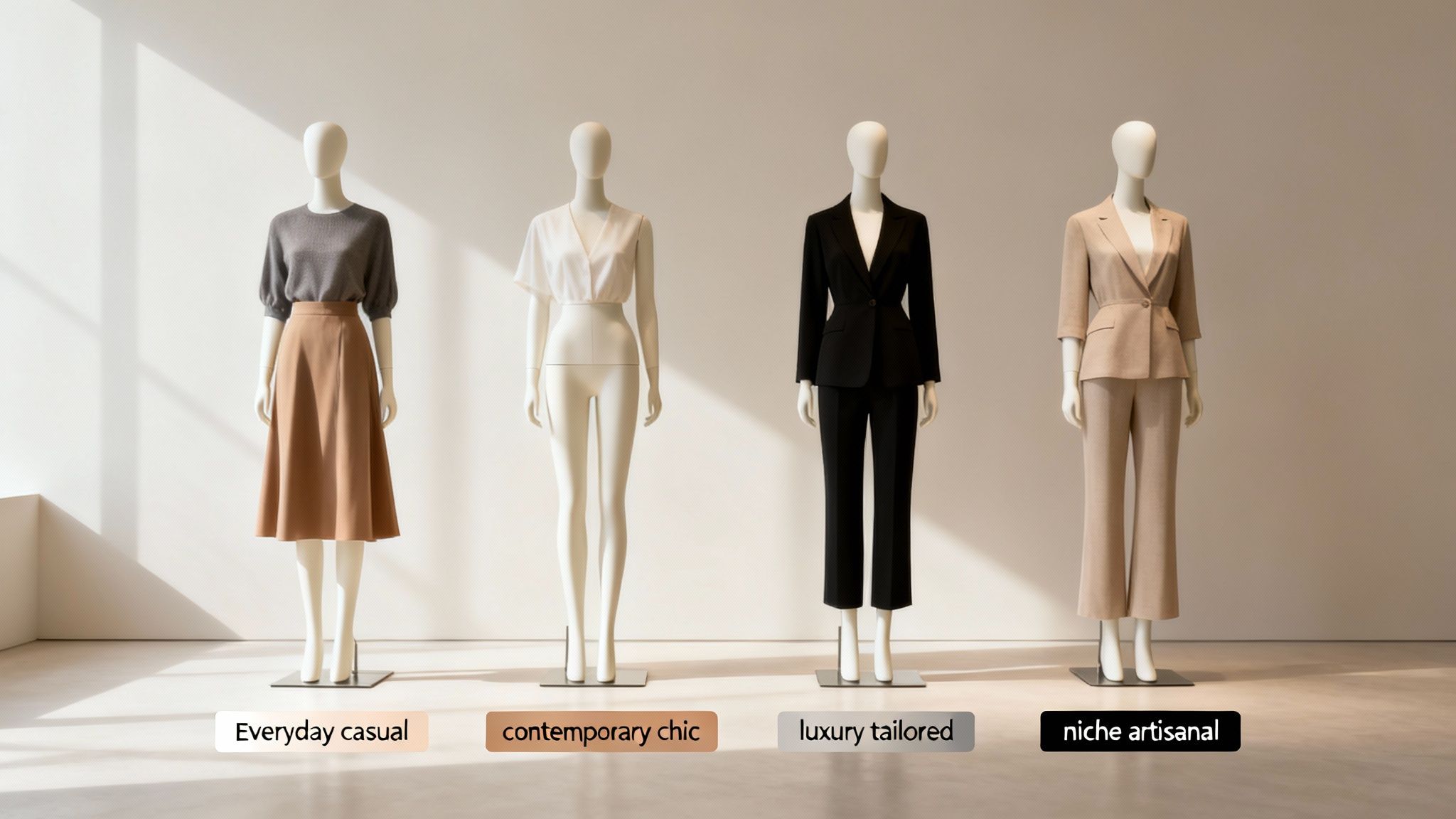
To really get a handle on your options, it helps to break down the fashion world into four main categories. Learning to spot them will completely change how you shop, whether you're browsing online or walking through a store.
Here's a quick look at the main categories you'll encounter.
| A Quick Guide to Fashion Brand Categories | |||
|---|---|---|---|
| Brand Category | Key Characteristics | Price Point | Brand Examples |
| Mass-Market | Trend-driven, affordable, widely available, fast production cycles. | $ | H&M, Zara, Old Navy, Target |
| Contemporary | A bridge between high street and high-end; quality materials and modern design. | $$ - $$$ | Ganni, Reformation, Anine Bing |
| Luxury/Designer | Exceptional craftsmanship, premium materials, strong brand heritage, investment pieces. | $$$$ | Chanel, Gucci, Prada, Dior |
| Niche/Independent | Unique aesthetic, often focused on sustainability or specific sizing, limited production. | $$ - $$$$ | Sezane, Dôen, Bode |
Now, let's unpack what each of these really means for you as a shopper.
Mass-Market Brands
These are the brands you see everywhere—the accessible, trend-focused labels in shopping malls and giant online stores. Think of them as the foundation of most wardrobes, offering affordable takes on what’s currently in style. They absolutely dominate the market, pulling in a massive 69.37% of all global sales. You can dig into more stats about the women's wear market on Mordor Intelligence.
Contemporary Brands
Sitting in that stylish sweet spot between the high street and high fashion, contemporary brands are the perfect middle ground. They deliver better quality fabrics and more unique designs than mass-market retailers, but at a price that feels aspirational, not impossible. This is where you find those special pieces that elevate your everyday look.
Luxury and Designer Brands
At the very top of the fashion food chain, you have the luxury houses. These brands are all about exquisite craftsmanship, the finest materials, and a powerful creative vision. A piece from a designer label is often seen as an investment—something that can hold its value for years because of its incredible quality and brand legacy.
Niche and Independent Brands
These are the hidden gems of the fashion world. Niche brands are often laser-focused on a specific look, an ethical way of producing clothes, or a particular community (like brands specializing in petite or plus sizes). They offer those truly unique pieces you won’t find on everyone else, giving you a chance to express your personality outside of mainstream trends.
Understanding these categories lets you move beyond just buying clothes and start building a wardrobe. You can decide where to invest—maybe in a timeless luxury coat—while saving on trendy, everyday basics from mass-market brands. This mix-and-match approach is the secret to a wardrobe that’s both functional and exciting.
How to Judge a Brand's True Quality
What's the real difference between that go-to piece you wear for years and the one that warps after a single wash? It all boils down to quality. Once you learn to spot the markers of good craftsmanship, you can look right past the slick marketing and see what a brand is really made of.
This is a game-changing skill. It lets you make smarter investments in your wardrobe, choosing pieces that will last for seasons, not just fleeting moments. It’s like being able to tell the difference between a flimsy movie set and a solid, well-built house; one is just for show, the other is built for life.
Inspect the Craftsmanship Like a Pro
The first place to look for quality is in the actual construction. You don’t need to be a professional tailor to spot the obvious signs of great (or not-so-great) work.
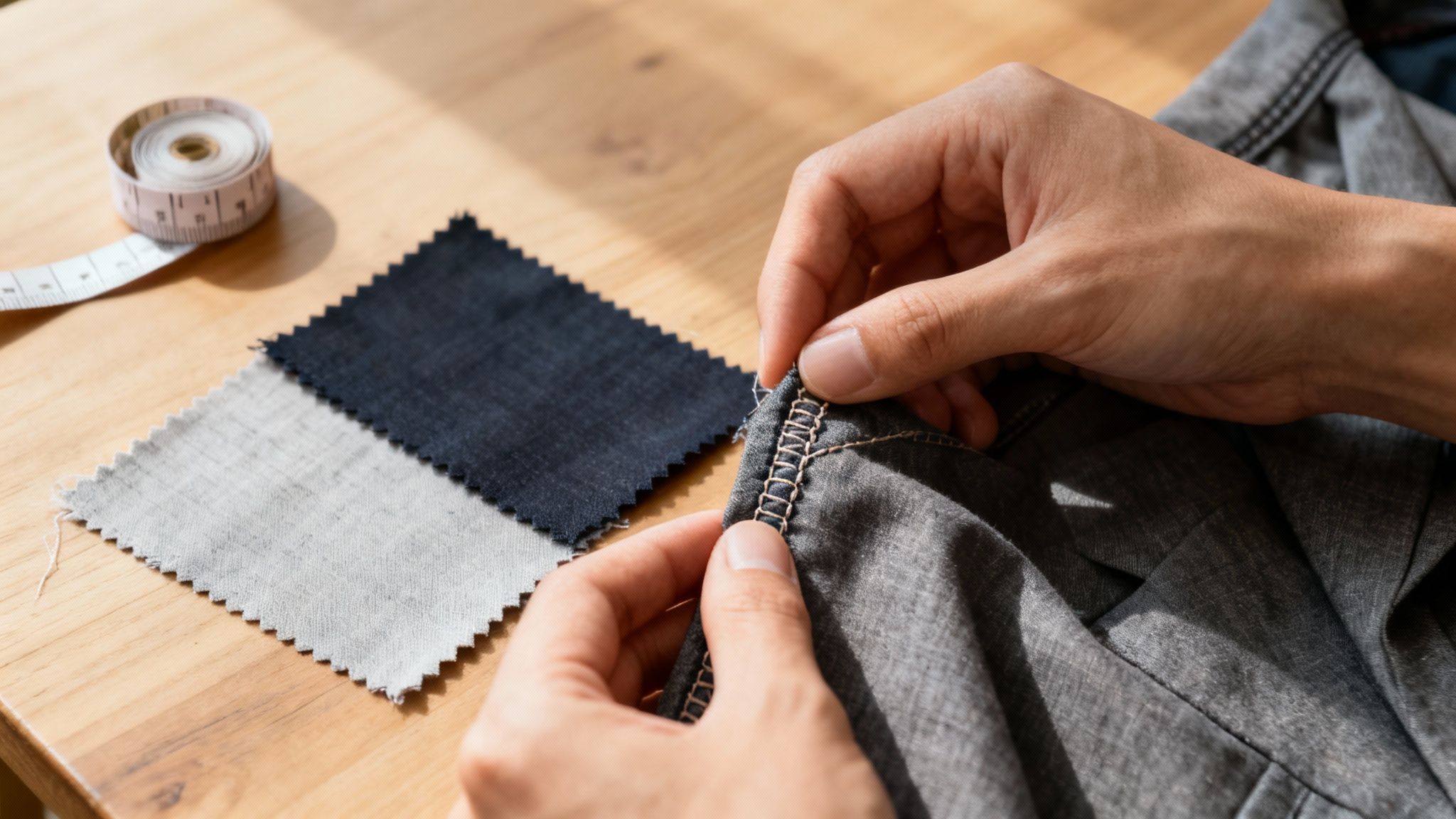
Start by checking the seams. Are they straight and flat? Do they pucker or pull? Give them a gentle tug. High-quality seams will feel secure and tight, with no hints of weakness.
Next, get up close and personal with the stitching. The number of stitches per inch (SPI) is a surprisingly telling detail. A higher stitch count usually means a stronger, more durable seam. A low stitch count is often a tell-tale sign that a garment was rushed through production on the cheap.
Finally, don’t forget the details most people miss:
-
Buttonholes: Look for clean, tightly stitched edges. They shouldn't look like they're ready to fray.
-
Zippers: A quality garment often features a sturdy, reliable zipper from a brand like YKK. It should glide smoothly without catching.
-
Lining: If the piece has a lining, is it made from decent fabric? Does it lie flat and smooth without bunching up inside?
Understand the Language of Fabrics
The material a garment is made from is everything. It dictates how it feels against your skin, how it drapes on your body, and ultimately, how long it will last. Many mass-market brands rely on synthetic blends like polyester or rayon because they’re inexpensive, but natural fibers generally offer better comfort and longevity.
Learning to read that little fabric composition tag is crucial. A sweater that's "100% Cotton" will almost always be more breathable and durable than a "Cotton/Poly Blend."
Price doesn't always equal quality, but quality almost always has a fair price. The cost often reflects better materials, skilled labor, and more durable construction methods. A higher price should be justified by tangible signs of superior craftsmanship.
Prioritize Sizing and Fit Consistency
A brand’s commitment to quality also shows up in its sizing. If you find a brand is all over the map with its sizing, that’s a major red flag—it points to a lack of quality control. The best women's fashion brands offer detailed size charts with actual body measurements, not just vague S/M/L labels.
Before buying, scroll through the customer reviews and look for comments on fit. Do people consistently say the items run true to size, or are the reviews filled with complaints about weird proportions? Brands that take the extra step to offer specific ranges, like petite or tall, usually show a deeper commitment to getting the fit right for their customers.
Evaluate Sustainability and Ethical Practices
These days, a brand’s quality isn't just about the finished garment; it's also about how it was made. More and more, shoppers are looking for brands that share their values, from using organic materials to ensuring fair wages and safe conditions in their factories.
Brands that are transparent about their supply chain are often the ones most confident in their quality. To dive deeper, you can learn more about how brands are embracing sustainable fashion for women in our guide.
Becoming a Smarter Online Fashion Shopper
Shopping for clothes online is a game of incredible choice and, let's be honest, a bit of a gamble. Without a fitting room, you’re placing your trust in photos and descriptions to get it right. Learning to navigate the digital aisles is the secret to building a wardrobe you truly love, minus the endless cycle of returns.
The numbers show just how much is at stake. Women make up a massive 69% revenue share of the clothing e-commerce market, buying clothes online about seven times a year. Even so, while online sales are expected to hit nearly 25% by 2025, most shopping still happens in person. That tells us there's a confidence gap when it comes to clicking "buy now."
Nailing an online purchase means you have to become a bit of a digital detective, hunting for clues that point to the perfect fit and quality you expect.
Decode Sizing Charts and Reviews
Think of a brand’s size chart as your map—but know that it doesn’t always show the whole territory. A simple S/M/L guide is a starting point, but the really trustworthy brands give you detailed measurements for the bust, waist, and hips in inches or centimeters.
Always, always measure yourself and compare. Once you’ve consulted the official chart, your next stop should be the customer reviews. This is where you get the real-world intel.
Look for comments from shoppers who share their own height and size; their context is gold. I always search for keywords like "true to size," "runs small," or "perfect length" to get an honest picture of how the garment fits an actual body, not just a mannequin.
Reading reviews is like having a team of personal shoppers who have already tried everything on for you. Their feedback can be the difference between a wardrobe favorite and a return package waiting by the door.
Scrutinize Product Photos and Descriptions
High-quality photos are non-negotiable. Good brands invest in clear, high-resolution images that show the item from every angle.
Get comfortable with the zoom function and play detective. Look closely at:
-
Fabric Texture: Can you see the weave? Does it look flimsy or like it has some substance?
-
Stitching and Seams: Check out the hemlines, collars, and cuffs. Are the stitches neat and even, or are they pulling?
-
Hardware Quality: What about the buttons, zippers, and clasps? Do they look cheap and plasticky or sturdy and well-made?
Beyond the pictures, dive into the material composition. A vague "cotton blend" description isn’t nearly as helpful as "95% Pima Cotton, 5% Spandex." That level of detail signals transparency and a real commitment to quality. If you want to dive deeper, you can find more smart online shopping tips that help you save money while building a killer wardrobe.
Master the Return Policy
Before you even think about adding an item to your cart, find the return policy. A difficult or expensive return process can turn a great find into a major headache.
Look for clear, customer-friendly terms. Does the brand offer free returns? What’s the return window—14 days or 30? Knowing this stuff upfront takes the risk out of the equation and gives you the confidence to try something new.
Online vs In-Store Shopping Showdown
Deciding where to shop comes down to what you value most—convenience or certainty. Here's a quick breakdown to help you decide which route is best for your next purchase.
| Feature | Online Shopping | In-Store Shopping |
|---|---|---|
| Convenience | Unbeatable. Shop 24/7 from anywhere. | Limited by store hours and location. |
| Selection | Virtually endless variety and access to global brands. | Limited to the inventory on the floor. |
| Sizing & Fit | A gamble. Relies on charts, reviews, and past luck. | Try before you buy for a perfect, confident fit. |
| Instant Gratification | Delayed. You have to wait for shipping. | Instant. You can wear your new purchase right away. |
| Returns | Can be a hassle with repackaging and shipping. | Simple and immediate, usually with a direct refund. |
| Price Comparison | Easy to compare prices across multiple retailers. | Much harder to compare prices on the spot. |
Ultimately, neither method is perfect. Online shopping offers unparalleled choice, while in-store shopping provides the tactile confidence that a screen just can't replicate. The smartest shoppers know how to use both to their advantage.
The Future Trends Shaping Women's Fashion
The world of women's fashion is changing, and it’s not just about what’s on the runway. The real shifts are happening behind the scenes, driven by new technology and, more importantly, a huge change in what we, as shoppers, actually care about.
It's no longer enough for a brand to just make beautiful clothes. We’re starting to ask tougher questions: Who made this? What is it made of? And what happens to it when I’m done with it? Understanding these bigger trends helps you build a wardrobe that doesn't just look good, but feels right, too.
The Unstoppable Rise of Sustainable Fashion
Without a doubt, the biggest conversation in fashion right now is about sustainability and ethical production. We've all become more aware of the industry's environmental toll, from the enormous amount of water used to grow cotton to the textile waste piling up in landfills.
This growing awareness has sparked a conscious consumer movement. It's a real force, with a staggering 73% of Millennial and Gen Z shoppers saying they’re willing to spend more on products that are made sustainably.
Brands are listening and adapting. You'll see this in a few key ways:
-
Smarter Materials: A big shift toward fabrics like organic cotton, Lyocell (often branded as Tencel), and textiles made from recycled plastics.
-
Transparent Supply Chains: Brands are being pushed to open up about where and how their clothes are made, ensuring factory workers are treated and paid fairly.
-
Less Waste: A move toward smaller production runs and innovative manufacturing techniques to cut down on waste.
This mindset is becoming central to the industry. For anyone looking to accessorize with the same values, checking out the Top Ethical Jewelry Brands shows just how far this movement has spread.
Embracing the Circular Economy
The old "buy it, wear it a few times, toss it" model is on its way out. In its place, something called the circular economy is taking hold. The whole idea is to keep clothes in use for as long as possible instead of letting them end up in the trash.
It completely changes how we think about owning clothes. Instead of a one-way ticket to the landfill, garments can have second, third, or even fourth lives. This is happening in two main ways:
-
Fashion Rental: Why buy a dress you'll only wear once? Services like Rent the Runway let you borrow designer pieces for a special event, giving you access to high-end fashion without the commitment or the high price tag.
-
Resale and Thrifting: The secondhand market is exploding. Platforms like The RealReal and Poshmark have made it incredibly easy to buy and sell pre-loved clothing, keeping fantastic pieces in rotation and out of landfills.
The rise of the circular economy is a win-win. It offers consumers access to a wider variety of styles at a lower cost while significantly reducing the environmental impact of their wardrobe. It’s smart, sustainable, and stylish.
Technology and Personalization
Technology is also completely reshaping how we shop. Brands are using AI and data not just to show you ads, but to create a genuinely personal experience that helps you find clothes you'll actually love and wear.
This is way more advanced than just getting recommendations based on your last purchase. We’re talking about virtual try-on tools that let you see how an outfit looks on your body, size-recommendation engines that get it right the first time, and even made-to-order clothing. It’s a smarter way to shop that helps cut down on the massive problem of online returns while making sure you end up with a perfect fit.
Creating Harmony Between Your Wardrobe and Your Life

Great style is more than just the clothes you put on; it’s a feeling that carries through your entire life. When your closet and your home feel connected, you create a sense of cohesion that’s deeply personal and incredibly satisfying. This isn't about making sure your blazer matches your armchair, but about aligning the overall mood, textures, and colors you love across every part of your world.
Think of it as your personal aesthetic. The same eye that draws you to a beautifully simple linen dress is probably the same reason you’re drawn to clean, uncluttered spaces and natural materials in your home. Once you pinpoint these core preferences, you can start making choices that feel truly you.
Translating Style from Closet to Home
The same instincts that guide your choices in women's fashion brands can absolutely be applied to your living space. The trick is to look for the common threads that are already there in your wardrobe.
What's your go-to color palette? If you find yourself constantly reaching for earthy tones like rust, olive, and cream, you can use those same shades to build a warm, inviting atmosphere in your living room with a few well-chosen pillows, a cozy throw, or an area rug.
Now, think about the feel of the fabrics you love.
-
Soft and Cozy: Is your closet a haven of cashmere sweaters and soft-spun cotton? Bring that same comforting vibe home with plush velvet cushions or a chunky knit blanket draped over the sofa.
-
Sleek and Modern: If you lean toward sharp, structured blazers and silk tops, you can mirror that aesthetic with smooth leather accents, glass tabletops, and polished metal fixtures.
-
Natural and Bohemian: For those who live in linen and woven sandals, that breezy feel translates perfectly to rattan furniture, jute rugs, and handcrafted ceramic pieces.
Your home should feel like a natural extension of your personal style. When the things you wear and the space you live in tell the same story, you create a powerful sense of self-expression and comfort.
Building a Wardrobe for Your Real Life
Of course, this connection is a two-way street. Your day-to-day life should be the ultimate guide for your fashion choices. It just doesn't make sense to have a closet full of stilettos and silk if your reality involves chasing after kids or commuting on the subway.
Instead, build your wardrobe around pieces that actually serve your needs. If you work from home, that might mean investing in high-quality loungewear and elevated basics that are comfortable but still look put-together for a surprise video call. If your weekends are all about getting outdoors, prioritize durable, functional pieces from brands that get performance wear right.
By consciously connecting these two worlds, you’re doing more than just building a wardrobe or decorating a house. You're curating a life that is a seamless, beautiful reflection of who you are. To dive deeper into finding that signature look, check out our comprehensive guide to women's fashion and discover the styles that speak to you.
Your Top Questions, Answered
Stepping into the world of women's fashion can feel a bit overwhelming. With so many brands, price points, and styles, it's easy to get lost. So, let's clear things up.
Think of this as your personal cheat sheet for navigating the fashion landscape. We'll tackle the most common questions shoppers have, giving you the confidence to build a wardrobe that feels like you.
How Can I Spot Quality When Shopping Online?
It's tough, right? You can't feel the fabric or see the stitching up close. But you can become a bit of a digital detective. The secret is knowing where to look on the product page.
High-resolution photos are your first clue. Really get in there and use the zoom function. Look closely at the seams, the texture of the fabric, and the finish on things like buttons and zippers. A brand that’s proud of its quality will give you crystal-clear images.
Next, read the product description like a pro. Vague language like "cotton blend" can be a red flag. What you're looking for is specificity—think "100% Pima Cotton" or "Tencel™ Lyocell." When a brand is transparent about its materials, it's usually a good sign they're using the good stuff.
Finally, use customer reviews to your advantage. Don't just glance at the star rating. Search the reviews for keywords like "durable," "stitching," "fabric quality," and "after washing." This gives you the real scoop on how a piece holds up in the wild, not just on the digital hanger.
What Is the Best Way to Discover Niche Brands?
If you want to find those hidden gems—the cool independent or sustainable brands—you have to look beyond a simple Google search. Social media is your best friend here. On Instagram or TikTok, try searching for specific hashtags like #SlowFashion, #EthicalStyle, or #IndependentDesigner. You'll start to uncover what real people with great taste are actually wearing.
Another fantastic tactic is to follow fashion editors, publications, or influencers who focus on niche or sustainable style. They do a lot of the curating for you, often introducing their audience to incredible emerging labels you wouldn't have found otherwise.
Exploring online marketplaces dedicated to independent designers is like visiting a curated craft fair from your couch. Sites like The Helm or Made Trade do the hard work for you, gathering unique and ethical brands all in one place.
How Do I Find Brands That Fit My Body Type?
Ah, the million-dollar question. Sizing is notoriously inconsistent across the industry. Your best bet is to seek out brands that make inclusivity a priority. A great place to start is by looking for labels that offer dedicated collections like "Petite," "Tall," or "Plus" right on their website. And a detailed size chart that provides actual body measurements—not just S, M, L—is a massive green flag.
Once again, customer reviews are your secret weapon. Filter them to find people who mention their height, weight, or general body shape. This is where you get the real-world intel that a size chart just can't give you, helping you understand how a brand's clothes actually fit on different bodies.
Is an Expensive Designer Brand Always Worth It?
Honestly? Not always. While high-end luxury brands often use beautiful materials and feature top-notch craftsmanship, you're paying for a lot more than just the garment. A huge chunk of that price tag covers their marketing, extravagant runway shows, and the prestige of the brand name itself.
The smart money is often on contemporary brands, many of which offer similar quality without the four-figure markup. The best approach is to judge each piece on its own merits, not the label sewn inside. A beautifully constructed piece from a contemporary brand, made with quality fabric, is a much wiser investment than a trendy designer item that's all flash and no substance. Always put great construction before brand cachet.
At Fluent Trends, we believe the principles of great design don't stop at your closet. They should flow through your entire home. Discover our curated collection of designer-approved furniture and décor to create a living space that truly reflects your personal style as well as our collection of fashion, beauty, and accessories and more. Explore our collections today.