

Finding the Best Websites for Home Decor A Curated Guide
Donna MaloneWhen someone asks me for the best websites for home decor, the answer isn't a simple list. It’s more about knowing what you’re looking for. You have the giants like Wayfair for sheer variety, the creative hubs like Etsy for that perfect handmade touch, and then you have curated boutiques like ours at Fluent Trends for unique, designer-level pieces.
The real trick is learning how to cut through the noise and spot the stores that truly align with your style, quality standards, and budget.
How to Find Quality Home Decor in a Crowded Online World
Let's be honest, shopping for home decor online can feel like wading through a massive, disorganized flea market. There are treasures hidden everywhere, but without a clear strategy, you’ll likely end up overwhelmed, exhausted, and with a cart full of things you don't actually love.
This guide is your game plan. We’re not just going to hand you a list of links; we're going to show you how to shop smarter. The goal is to move you from mindless scrolling to confident, intentional buying. It all starts with understanding the different kinds of stores out there.
Understanding the Online Decor Marketplace
Not all online decor shops are built the same. They each serve a different purpose, and knowing the lay of the land is the first step to finding what you need quickly.
- Budget-Friendly Marketplaces: Think of these as the big-box retailers of the internet. They offer an almost endless selection at really competitive prices.
- Curated Boutiques: This is where shops like Fluent Trends come in. We do the hard work for you, hand-selecting items that meet a specific aesthetic and a high bar for quality.
- Artisan and Handmade Platforms: Here’s where you’ll discover those truly one-of-a-kind pieces made by actual creators. Perfect for adding personality and a story to your space.
The online home decor market is absolutely booming, hitting an incredible $747.75 billion globally. It's even projected to climb to $802.26 billion, which tells you one thing: online is where everyone is shopping. This explosive growth is precisely why curated shops are thriving. In a sea of over 28 million eCommerce sites, a clear point of view and a commitment to quality make all the difference. You can find more insights on the home decor market's growth over on Fortune Business Insights.
Defining Your Personal Style and Budget
Before you even think about opening a new browser tab, the most important work happens right where you are. We need to create a map and a compass for your home decor journey: your personal style and your budget. Without these, it’s all too easy to get swept away by endless options, making impulse buys that leave your home feeling more cluttered than curated.
Think about it like going to the grocery store. If you walk in without a list or a meal plan, you’re probably walking out with a cart full of random snacks and nothing for dinner. It's the exact same idea here. Taking a moment to define your aesthetic ensures every piece you consider actually fits into the bigger picture.
Clarify Your Vision and Set Your Budget
First things first, let's get clear on your vision. Start by asking yourself how you want your home to feel. Are you craving the calm, clean lines of minimalism? The cozy, layered textures of a modern farmhouse? Or maybe the free-spirited, eclectic energy of bohemian decor?
A great way to figure this out is to create a mood board on a platform like Pinterest. Just start saving images that catch your eye. You'll quickly see a pattern emerge. If you want a little more guidance, our guide on finding your home decor style can walk you through it step-by-step.
Once you have a better sense of your style, it's time to set a realistic budget. This isn't about limiting yourself; it's about empowering your search. A clear budget immediately helps you narrow down the best websites for home decor, focusing your attention on stores that align with what you're ready to spend. It saves you from the heartache of falling for a piece that's way out of reach.
The sheer scale of the online marketplace is staggering. You're not just browsing a few stores; you're navigating a digital world with millions of options and thousands of new sites popping up every single day.
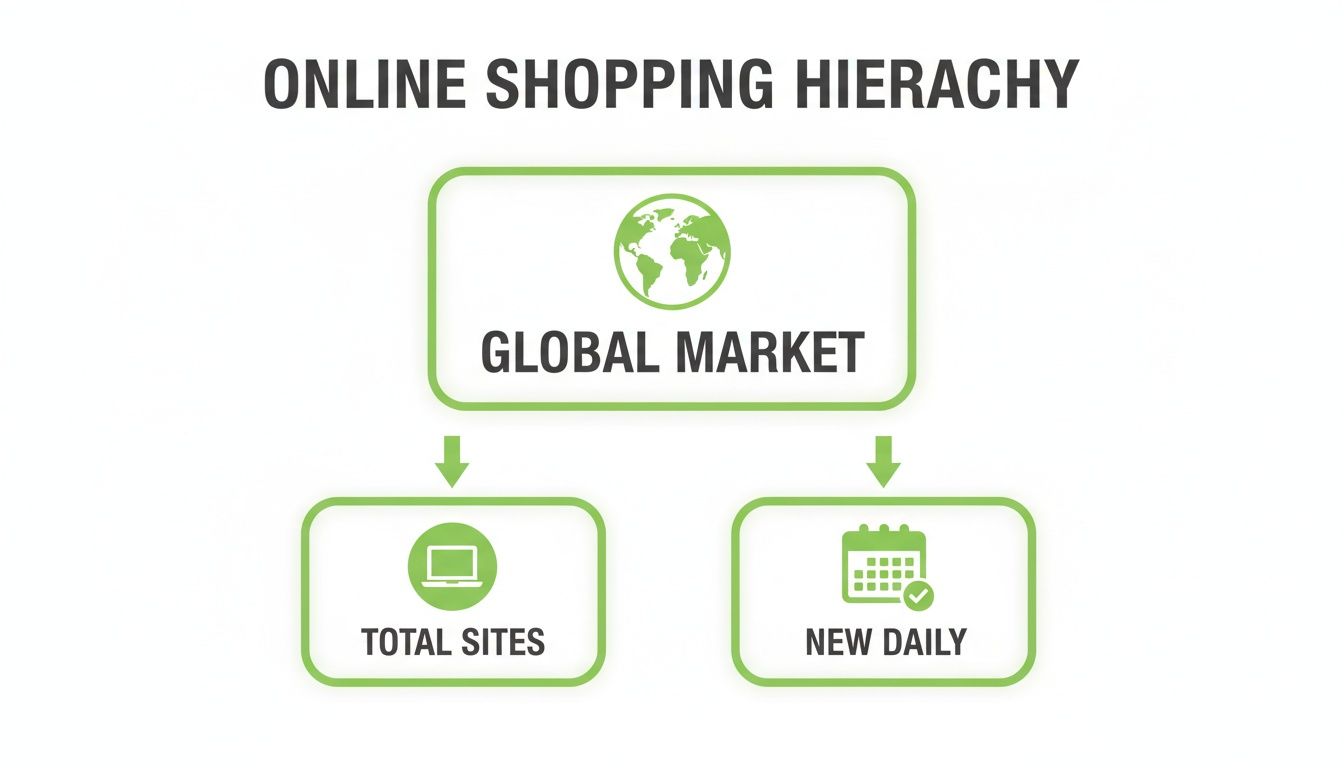
This is precisely why having a plan is non-negotiable. With so much noise out there, your style and budget are the tools that will help you cut through it and find exactly what you need.
Match Your Needs to the Right Retailer
With your style defined and your budget set, you can now start looking for the right type of retailer. Not every home decor website is the same, and knowing their specialty will save you a ton of time and scrolling.
The table below breaks down the main categories of online home decor stores to help you pinpoint where you should start your search.
Home Decor Website Categories at a Glance
| Website Category | Price Point | Best For | Example Shopper |
|---|---|---|---|
| Budget-Friendly | $ - $$ | Everyday basics, trendy accent pieces, and outfitting a first home. | Someone looking for stylish finds without a huge investment; great for seasonal updates. |
| Boutique & Curated | $$ - $$$ | High-quality, unique pieces with a distinct aesthetic. | The design-conscious shopper who values quality and a specific style, like what you find at Fluent Trends. |
| Handmade & Artisan | $ - $$$ | One-of-a-kind items, personalized gifts, and supporting independent makers. | Anyone seeking pieces with a personal story and unique character that you can't find anywhere else. |
| Sustainable & Ethical | $$ - $$$$ | Eco-friendly materials, fair trade practices, and conscious consumerism. | Shoppers who prioritize the environmental and social impact of their purchases. |
| Luxury & High-End | $$$$+ | Investment furniture, designer collaborations, and heirloom-quality decor. | Someone looking for statement pieces and world-class craftsmanship from renowned brands. |
By aligning your personal needs with the right store category, you transform a potentially overwhelming search into a focused, enjoyable hunt. Instead of sifting through thousands of irrelevant items, you’re going straight to the places that have exactly what you’re looking for.
What Separates a Good Online Store from a Great One
Anyone can build a beautiful homepage these days, but that’s just window dressing. A truly great online home decor store isn’t just about what it sells, but how it sells it.
A good store shows you a product. A great one gives you the confidence to buy it without ever seeing it in person. It’s a huge leap of faith, and the best brands earn it.
Think of it like buying a car. You wouldn't just look at one glamour shot taken from a distance. You’d want to walk around it, peek under the hood, and see the service history. The same rules apply when you’re about to drop your hard-earned cash on a new sofa or even a small decorative vase.
Uncovering the Hallmarks of Quality
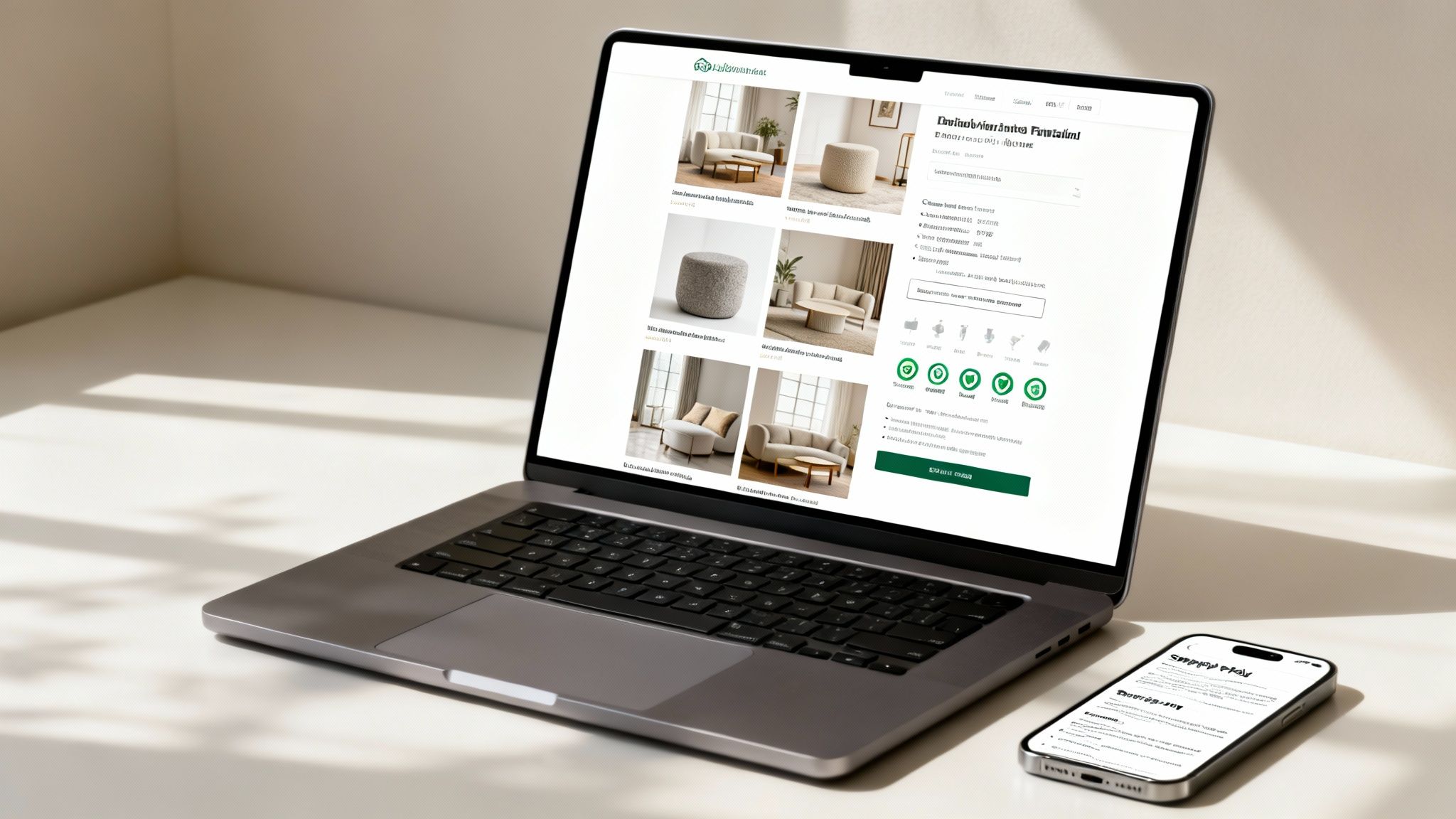
So, what are the tell-tale signs of a quality operation? The first one is a biggie: crystal-clear product transparency. This goes way beyond a single, perfectly styled photo. The best shops give you every single detail, leaving no room for nasty surprises.
Here's what to look for on the product page:
- High-Resolution Imagery: You need to see the item from every conceivable angle—front, back, side, and super close-up. The really great stores even include lifestyle shots to show you the scale in a real room, or videos so you can see how a fabric moves.
- Detailed Material Specifications: Vague descriptions are a major red flag. A great store will tell you it's "solid acacia wood," not just "wood." They’ll specify "100% Belgian flax linen," not just "fabric."
- Precise Dimensions: Measurements should be exact and impossible to miss. The top-tier sites even provide diagrams with every key dimension mapped out, so you can pull out your tape measure at home and know for sure if it will fit.
This level of detail is more than just good marketing; it's a sign that the retailer stands behind what they sell. They aren't trying to hide shoddy craftsmanship behind blurry photos.
Trust Signals Beyond the Product Page
Beyond the product itself, you need to know the store's operations are solid. This is where you put on your digital detective hat and read the fine print. A trustworthy retailer like Fluent Trends makes this information dead simple to find and understand.
"A great online store builds trust through radical transparency. Clear return policies, honest customer reviews, and secure checkout processes are not just features—they are promises to the customer that their satisfaction is the top priority."
Before you even think about adding to your cart, do a quick check for these things:
- Clear Shipping and Return Policies: Are shipping costs laid out plainly? What's the return window? Are there any sneaky restocking fees? If you have to dig for this info, walk away.
- Secure Payment Options: Look for the logos you know and trust, like Shopify Payments, PayPal, or Apple Pay. This is your assurance that your financial information is locked down tight.
- Unfiltered Customer Reviews: Real reviews—both the glowing and the critical—are a goldmine. They give you the unfiltered truth about product quality, durability, and what it’s really like to deal with their customer service.
Looking at curated lists can also give you a great benchmark for what to expect. For example, a guide to the top indoor plant retailers will almost always feature businesses that nail these areas of transparency and trust. Once you learn to spot these signals, you'll be able to shop online with total confidence.
Why Great Website Design Matters for Your Search
We’ve all been there. You click on a link hoping to find the perfect armchair, only to land on a website that’s clunky, slow, and impossible to navigate. It’s more than just a minor headache—it's a digital dead-end that kills your inspiration and wastes your time.
When you're searching for the best home decor websites, the quality of the site itself is just as important as the products it sells. It’s the difference between an exciting discovery and a frustrating, dead-end chase.
Think of a website's user experience (UX) like the layout of your favorite boutique. If the aisles are cluttered, the lighting is dim, and nothing has a price tag, you’re not going to stick around for long. The same is true online. A smooth, well-thought-out shopping journey turns the hunt from a chore into a genuine pleasure, especially on our phones, where most of us browse these days.
From Frustration to Inspiration
A truly great website experience isn't about flashy gimmicks. It's built on a few key pillars that help you find exactly what you want, quickly and easily.
- Intuitive Navigation: Menus should just make sense. You shouldn't have to guess whether "Outdoor Rugs" are hiding under "Garden" or "Textiles." It should be obvious.
- Powerful Search Filters: This is a non-negotiable. The ability to filter thousands of options by color, size, material, and price is what lets you zero in on a handful of perfect contenders in seconds.
- Fast-Loading Pages: Life’s too short for slow websites. When product images take forever to load, you lose your momentum. A snappy, responsive site respects your time and keeps the creative juices flowing.
A website’s design is the ultimate gatekeeper to a sale. When a platform invests in its digital storefront, it’s not just improving aesthetics—it's building a foundation of trust and usability that makes customers feel confident and valued.
The Immediate Impact of Good Design
The link between great design and trust is incredibly strong, and it forms almost instantly. Your brain makes a snap judgment about a site’s credibility in a fraction of a second, which heavily influences whether you stay or bounce.
For online boutiques like Fluent Trends, which focus on medium-to-high-ticket furniture and decor, creating a polished and captivating experience is absolutely essential.
Recent data shows just how critical this is: 94% of a user's first impressions are design-related, and a staggering 88% of online shoppers say they won't return to a site after a bad experience. This isn't just trivia; it proves that a well-designed website is a fundamental requirement for any brand that wants to succeed in the competitive online decor market. You can explore more data on how website trends influence shoppers to see the full picture.
Actionable Strategies for Smarter Decor Shopping
Okay, so you’ve found a few websites you love. That’s a great start. But knowing where to shop is only half the battle—knowing how to shop is what really makes the difference. It's the secret to getting incredible quality without draining your bank account. This is where you shift from being a casual browser to a savvy buyer who rarely, if ever, pays full price.
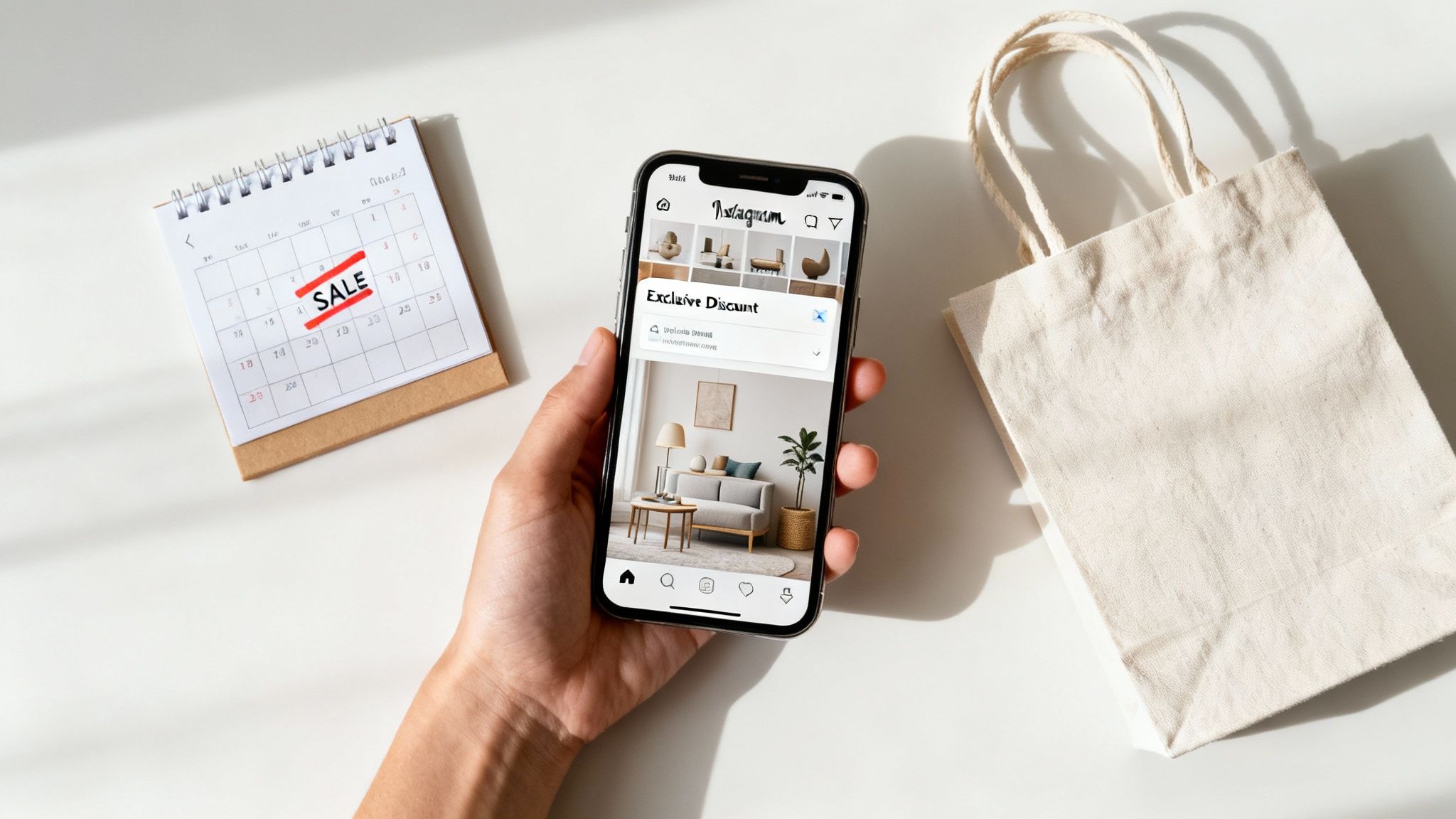
One of the easiest tricks in the book? Sign up for the brand’s newsletter. Seriously. Most retailers will instantly send you a 10-15% discount just for joining their email list. You'll also get a heads-up on upcoming sales and exclusive promo codes before anyone else, putting you at the front of the line for the best stuff.
Time Your Purchases and Master Shipping
Timing is everything in the world of decor. Big-ticket items almost always go on sale during major holiday weekends—think Memorial Day, Labor Day, and of course, Black Friday. If you’ve been dreaming of a new sofa, holding out for one of these sales can literally save you hundreds. Our guide on how to choose a sofa can help you get your research done ahead of time so you’re ready to pounce when the price drops.
And please, always figure out the shipping costs before you fall in love with an item. Nothing sours a great deal faster than a sky-high shipping fee tacked on at the end.
- Check for a Free Shipping Threshold: Lots of sites will ship for free once your cart hits a certain total.
- Look for Flat-Rate Shipping: This is a lifesaver for heavy furniture, often much cheaper than paying by weight.
- Factor It In: Always add the shipping cost to the item's price to see what you’re really paying. It’s the only way to do a true apples-to-apples comparison.
Use Social Media as a Shopping Tool
Don't just scroll on Instagram and Pinterest for inspiration—use them as active shopping tools. Follow your favorite brands (like Fluent Trends!) to see how their new arrivals look in real homes, not just sterile product shots. Brands also love to reward their followers with exclusive flash sales and discount codes dropped right in their posts or stories.
This isn't just a niche habit; it's how people shop now. A staggering 78% of local mobile searches result in a purchase within 24 hours, particularly for considered buys like home furnishings. That's a huge number, and it shows just how much people rely on curated platforms to find quality pieces they trust. If you want to dive deeper, you can find more stats on shopper behavior on invoca.com. With these simple strategies, you can shop with total confidence and bring home that designer look you've been wanting, without the designer price tag.
Building Your Home with Confidence and Style
You’re now officially armed with a framework for navigating the wild world of online decor. The journey from an empty room to a home you love isn't about finding one single "best" website—it's about knowing how to spot the right shops for your specific vision and budget. It’s about becoming a savvy, confident shopper who can recognize real quality from a mile away.
Think of it like cooking a great meal. Your personal style is the star ingredient, your budget determines the serving size, and all those quality signals we talked about—like crisp product photos and clear return policies—are the spices that ensure it all comes out perfectly. Each step builds on the last, giving you a reliable process you can use for any room, any time.
Your Simple Shopping Workflow
To pull it all together, here’s a straightforward game plan for your next decor hunt:
- Define Your Foundation: Get clear on your style and set a realistic budget before you start browsing.
- Identify Quality Signals: Look closely at product pages for material details, exact dimensions, and photos from every angle.
- Verify Trustworthiness: Check for secure checkout and read the shipping and return policies before you get too attached to an item.
- Shop Strategically: Use filters to your advantage and sign up for newsletters to catch the best deals.
When you focus on curation, quality, and transparency, shopping becomes less of a guessing game and more of a creative act. You’re not just buying another thing; you’re investing in the story of your home.
Stores like Fluent Trends are a perfect example of this philosophy in action. Their curated collections of designer-approved furniture and handcrafted tabletop essentials are built on these high standards. They’ve already done the hard work of sourcing for you, presenting pieces made from quality materials with a distinct aesthetic, so you can shop with total confidence.
And if you're starting with a completely blank canvas, finding practical strategies for staging empty rooms can spark inspiration and give you concrete ideas. With this knowledge, you're ready to explore the best websites for home decor, find pieces you absolutely love, and build a home that truly reflects who you are.
Frequently Asked Questions
Even the most seasoned online shoppers run into questions when buying home decor. It's totally normal. Here are a few quick answers to the things we get asked about most, so you can shop with a little more peace of mind.
How Can I Judge Color and Scale Accurately?
This is the classic online shopping dilemma, isn't it? For color, your best friend is customer photos in the reviews. They show you what that "greige" sofa really looks like in a living room, not under perfect studio lights. For big-ticket items, see if the site offers fabric swatches. It's usually a small price to pay to avoid a major color catastrophe.
When it comes to size, never, ever trust the photos alone.
Always grab a tape measure and use the product dimensions to mark out its footprint on your floor. This simple step is the only way to prevent that "oh, that's way bigger than I thought" moment.
What Should I Do If an Item Arrives Damaged?
Okay, don't panic, but do act fast. The moment you spot a problem, take clear photos of the damage and the box it came in—the more angles, the better. Then, get in touch with customer service right away, ideally within 24-48 hours. Most stores have a pretty tight window for reporting shipping damage.
Have your order number and those photos ready. Any decent store will have a clear process to get you a replacement or a refund without a massive headache. This is why checking the damage policy before you buy is always a smart move.
How Can I Spot Fake Reviews?
Fake reviews are getting sneakier, but you can usually spot them. Be skeptical of super vague praise like "Love it!" or reviews that use weird, clunky language. Another dead giveaway is a sudden flood of glowing five-star reviews all posted on the same day.
I always look for the "verified purchase" badge. More importantly, I trust detailed reviews from real people who mention specific things they like or dislike. Honest feedback is rarely perfect; it's balanced and gives you the full picture.
At Fluent Trends, our goal is to take the guesswork out of shopping. We're here to help you find pieces you'll love with confidence. Start exploring our curated collection of designer-approved furniture and decor today.