

Ethical Fashion and Home Decor Guide for 2026
Yuatinia LeakTable of Contents
- What Ethical Fashion and Home Decor Really Means
- The Environmental Impact of Fast Fashion and Disposable Decor
- How to Build an Ethical Capsule Wardrobe
- Sustainable Materials to Look For in Fashion and Decor
- The Benefits of Artisan-Made Furniture in a Modern Home
- Ethical Fashion Certification Standards Worth Knowing
- How to Spot Greenwashing in Retail
- Shopping Preloved and Vintage Without Compromising Style
- Eco-Friendly Home Decor Materials: Bamboo, Cork, and Rattan
- Caring for Clothes and Decor to Extend Their Lifespan
- End-of-Life Product Management for a Circular Economy
- Budget-Conscious Ethical Living Without Compromise
- Regional Sourcing and Your Carbon Footprint
- Frequently Asked Questions
Last Updated: September 15, 2026
What Ethical Fashion and Home Decor Really Means
Ethical fashion is the practice of designing, producing, and buying clothing and home goods in ways that protect people and the planet. At Fluent Trends, we see it as a commitment to fair wages, safe working conditions, and materials that do not poison soil or water.
That definition matters because the market has stretched the word "ethical" until it means almost nothing. A brand can slap a leaf on a label and call itself sustainable without changing a single supplier. The real test is traceability. Can the maker name the farm, the dye house, the workshop? If not, the claim is decoration.
Conscious consumerism is not about guilt. It is about use. Every purchase is a vote for a supply chain, and a well-informed vote changes what factories choose to produce.
This guide from Fluent Trends walks through materials, certifications, greenwashing traps, and end-of-life planning. Below, we show you exactly how to build a home and wardrobe that reflect your values without sacrificing style.
The Environmental Impact of Fast Fashion and Disposable Decor
Fast fashion is a production model built on speed: new styles weekly, low prices, and garments designed to be replaced within a season. The same logic now drives home decor, where trend cycles push shoppers to refresh a living room every year or two.
The consequences compound in three places.
- Textile waste. Discarded clothing and household textiles pile up in landfills and export markets faster than they can decompose.
- Resource intensity. Conventional cotton and synthetic fibers demand enormous water and energy inputs across growing, dyeing, and finishing.
- Labor pressure. To hit low price points, factories compress wages and deadlines, which erodes the labor rights that fair trade systems exist to protect.
Disposable decor follows the same script. Flat-pack furniture with particle board and veneer rarely survives a move, let alone a decade. When it fails, it becomes bulky waste that no recycling stream handles well.
The Environmental Protection Agency's textile waste data tracks how much of this material ends up in landfills each year. The trend line is not encouraging.
Buying less, and buying better, is the only durable answer. Quality over quantity is not a slogan here. It is the math.
How to Build an Ethical Capsule Wardrobe
An ethical capsule wardrobe is a small, cohesive set of garments you wear often, chosen for durability and versatility. The number matters less than the intent behind each item.
The goal is not minimalism for its own sake. It is a wardrobe where every piece earns its place, so you stop buying replacements you never needed.
Start With What You Own
Before buying anything, empty the closet and sort every item into three piles: keep, repair, release. This step costs nothing and usually reveals you already own more than you thought.
Note what you actually wear across two weeks. Most people find a small fraction of their closet does the work. That pattern tells you what to buy and, more usefully, what to stop buying.
Choose Natural Fibers That Last
Natural fibers such as organic cotton, linen, wool, and jute age gracefully and biodegrade at end of life. They also hold shape better than most synthetic blends, which means fewer replacements over time.
Look for organic textiles where possible. Organic certification limits synthetic pesticide use in the growing phase, which protects both farm workers and waterways.
Build around a neutral base: two pairs of well-cut trousers, a few linen shirts, one structured wool coat. Add color through accessories, which are easier to source ethically and easier to replace.
Run the Cost-Per-Use Math Before You Buy
Cost per use is the only metric that survives contact with a real budget. Divide the purchase price by the number of times you expect to wear the item. A coat worn three hundred times beats a cheap one worn twenty, even at several times the price.
A common pattern is that the cheapest purchases turn out to be the most expensive per wear. Fast-fashion tops worn a handful of times before they pill or lose shape carry a higher true cost than a well-made shirt worn for years.
Tracking cost per use for one month on your five most-worn items reframes the entire budget conversation. The data rarely supports the bargain that felt smart at checkout.
Sequence Your Spending Like a Portfolio
Ethical living does not require a large budget. It requires sequencing: spend where durability pays back, save where it does not.
- Spend: outerwear, shoes, a sofa, a dining table, bedding.
- Save: accent pillows, seasonal decor, trend-driven accessories.
- Repair first: anything with solid construction and a small fault.
- Buy preloved: furniture, rugs, and occasion wear.
This is the piece most capsule guides skip. They tell you to buy less and buy better, then hand you a list of expensive basics. The budget-conscious version asks a harder question. Which categories actually reward the higher spend?
Build the Capsule Around Your Actual Life
A capsule built for someone else's life will fail. Count the days you spend in office attire, casual settings, and formal events. Let that ratio set the piece count for each category.
A remote worker needs three good shirts more than three blazers. A parent needs washable fabrics more than dry-clean-only wool. The capsule should mirror the week you actually live, not the one in the lookbook.
Budget-conscious ethical living is not about deprivation. It is about redirecting money from volume to value, and letting the math decide where the value sits.
Sustainable Materials to Look For in Fashion and Decor
Sustainable materials are those produced with lower environmental impact across their full lifecycle, from raw fiber to disposal. The label on the tag is only the starting point. You need to know how the material was grown, processed, and finished.
Here is how the most common options compare.
| Material | Best For | Key Strength | Watch For |
|---|---|---|---|
| Organic cotton | Apparel, bedding | Lower pesticide use, soft hand | Blends that hide synthetic content |
| Linen | Shirts, tablecloths, upholstery | Durable, low water input | Heavy chemical finishing |
| Wool | Outerwear, throws | Long lifespan, repairable | Non-mulesed sourcing claims |
| Jute | Rugs, hanging loops | Biodegradable, fast-growing | Rough finish if poorly processed |
| Reclaimed wood | Furniture, shelving | Diverts waste, unique grain | Hidden adhesives or finishes |
| Bamboo | Storage, textiles | Rapid regrowth | Viscose processing chemicals |
Natural fibers are not automatically ethical. A linen shirt sewn in a sweatshop is still a sweatshop product. Material and labor standards move together.

The Federal Trade Commission's Green Guides set the rules for how environmental claims can be marketed. They are worth reading before you trust any "eco" label at face value.
The Benefits of Artisan-Made Furniture in a Modern Home
Artisan-made furniture delivers three things mass production cannot: longevity, character, and a traceable supply chain. A handcrafted piece is built by a named maker, often with traditional joinery that outlasts glued and stapled construction.
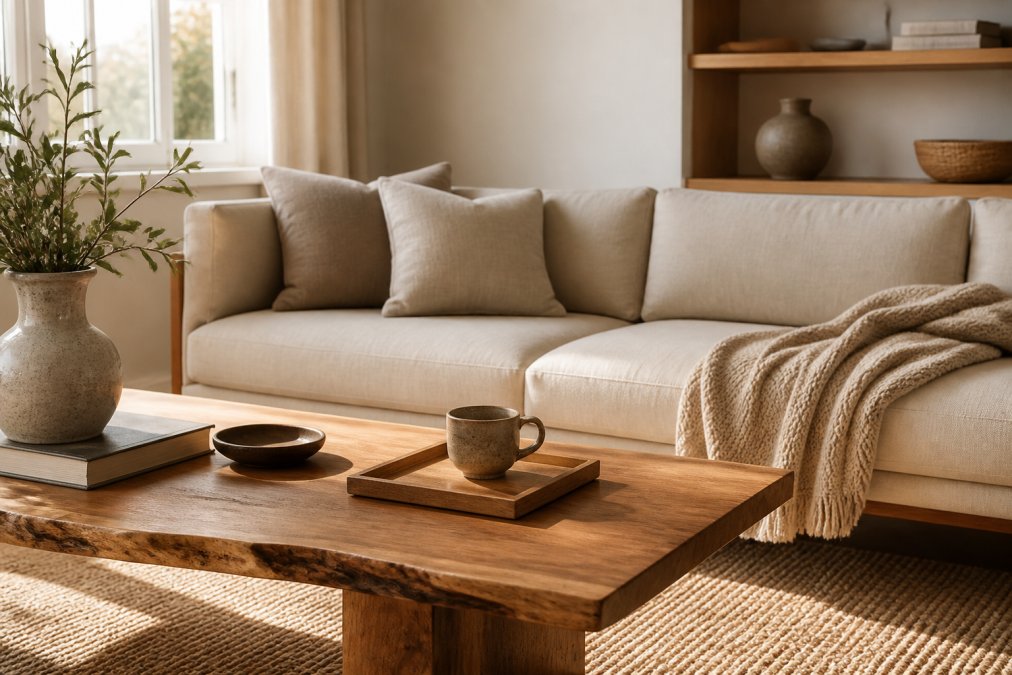
The longevity argument is the practical one. A solid wood table can be sanded and refinished for decades. A veneered table from a big-box retailer often cannot survive a single water ring. Over time, the artisan piece frequently costs less per year of use.
There is a cultural argument too. Many artisan traditions, from ceramics to weaving, survive only because someone keeps buying the work. Ethical manufacturing keeps those skills employed.
A common mistake is assuming artisan means rustic. Well-made handcrafted pieces sit comfortably in modern minimalist interiors when the lines are clean and the palette is restrained. The texture does the work that pattern would otherwise do.
Regional Sourcing Changes the Carbon Math
Most guides treat artisan furniture as an aesthetic choice. The stronger argument is logistical. Regional sourcing shortens the distance goods travel, which lowers the transport emissions attached to each piece. It also shortens the supply chain, which makes labor and material claims easier to verify.
Transport is only part of the footprint. A locally made item produced with high-energy methods can still carry a heavier total impact than an imported one made efficiently. Distance is a useful proxy, not a complete answer.
What regional sourcing does reliably deliver is accountability. A maker within your region is easier to visit, question, and hold to a standard. That transparency has value beyond emissions.
For globally sourced artisan goods, look for consolidated shipping and sea freight where available. A handcrafted piece made by a fair-wage workshop and shipped by sea often outperforms a mass-produced local alternative on total impact.
The honest position: no purchase is carbon-neutral. The goal is to reduce, then offset what remains through verified programs.
Read the Certification, Not the Story
Artisan marketing leans hard on narrative. The story matters, but it is not a substitute for verification. Third-party certifications are what turn a claim into an auditable fact.
- Fair trade programs audit wages, hours, and worker safety, and some guarantee a premium paid directly to producer communities.
- Forest stewardship certifications verify that wood comes from responsibly managed sources rather than clear-cut operations.
- Organic textile certifications confirm that a stated percentage of the material is organically grown and traceable through the supply chain.
Certification is not a finish line. A brand can be certified on one product line and silent on the rest of its catalog. Ask which specific items carry the mark, and ask for the audit scope.
Where a claim involves a regulated term, check the official source rather than the brand's website. Marketing copy is not a legal document.
What to Inspect Before You Commit
Joinery is the first thing to check. Dovetails, mortise-and-tenon joints, and doweled frames signal a piece built to be repaired. Staples and glue blocks signal a piece built to be replaced.
Finish is the second. Non-toxic oils and waxes are the better choice indoors, especially in bedrooms and nurseries. A finish that off-gasses for weeks is a warning sign, not a patina.
Provenance is the third. A maker who can name the workshop, the wood source, and the finishing method is a maker worth buying from. If the answer is a warehouse and a catalog number, the artisan label is decoration.
This is the angle most guides miss. They sell the romance of handcrafted furniture without giving you the tools to verify it. The romance is real. Verification makes it ethical.
Ethical Fashion Certification Standards Worth Knowing
Ethical fashion certification standards are third-party programs that verify labor conditions, material sourcing, and environmental practices against published criteria. They matter because self-declared claims carry no accountability. An independent auditor does.
The certifications you will encounter most often fall into three groups:
- Labor and fair trade. These programs audit wages, hours, and worker safety, and some guarantee a premium paid directly to producer communities.
- Organic and fiber content. These verify that a stated percentage of the material is organically grown and traceable through the supply chain.
- Animal welfare. These set standards for how wool, leather, and other animal-derived materials are sourced.
Certification is not a finish line. A brand can be certified on one product line and silent on the rest of its catalog. Ask which specific items carry the mark.
Where a claim involves a regulated term, check the official source rather than the brand's website. Marketing copy is not a legal document.
How to Spot Greenwashing in Retail
Greenwashing is the practice of making a product look more environmentally responsible than it is. It works because most shoppers do not have time to audit a supply chain. Vague language is cheap to produce.
These are the patterns that show up again and again.
- Vague adjectives. "Natural," "green," and "eco-conscious" mean nothing without a defined standard behind them.
- Irrelevant claims. "CFC-free" on a product that never contained CFCs is technically true and completely meaningless.
- Hidden trade-offs. A recycled-plastic chair made in a coal-powered factory is one improvement wrapped around a larger problem.
- False labels. A brand can invent its own badge and make it look official. Real certifications have verifiable registries.
The FTC's guidance on environmental marketing claims gives regulators the tools to challenge deceptive claims. Enforcers use it, and so should you.
A useful habit: replace "is this sustainable?" with "compared to what?" A brand that can answer the comparison question is usually the one telling the truth.
Shopping Preloved and Vintage Without Compromising Style
Preloved and vintage shopping is the single fastest way to cut the environmental impact of your wardrobe and home. No new material is grown, no new garment is sewn. No additional shipping emissions are created for the item itself.
Vintage is not a compromise. Mid-century walnut sideboards, hand-knotted rugs, and well-cut wool coats from decades past routinely outperform modern equivalents.
Where to look:
- Estate sales for furniture and tableware with real provenance.
- Consignment shops for tailored clothing in current silhouettes.
- Online marketplaces for specific makers, though inspect photos closely.
- Local auctions for rugs and lighting, often at a fraction of retail.
The main friction is condition. Learn to assess joints, seams, and finishes before you buy. A loose chair leg is a five-minute fix. A cracked frame is a project.
Upcycling extends the same logic. Reupholstering a solid sofa costs less than a comparable new one and keeps quality materials in circulation.
Eco-Friendly Home Decor Materials: Bamboo, Cork, and Rattan
Eco-friendly home decor materials are those that regenerate quickly, process with low toxicity, or divert waste from landfills. Bamboo, cork, and rattan all qualify, though each has trade-offs worth understanding.
Bamboo grows fast and needs little intervention to thrive. It works well for storage, flooring, and textiles. The catch is processing. Bamboo viscose involves chemical steps that vary widely in how responsibly they are handled.
Cork is harvested from living trees without felling them, and the bark regrows on a multi-year cycle. It is naturally insulating and works for coasters, flooring, and wall panels. It is not suited to high-moisture areas.
Rattan is a climbing palm that regenerates quickly and takes stains and finishes well.
Caring for Clothes and Decor to Extend Their Lifespan
The care routine is unglamorous and effective.
End-of-Life Product Management for a Circular Economy
| Item Type | Best End-of-Life Path | Why |
|---|---|---|
| Natural fiber apparel | Textile recycling or compost | Biodegrades cleanly |
| Solid wood furniture | Resale, donation, refinishing | Retains value and material |
| Ceramics and glass | Donation or local recycling | Durable, long-lived |
| Synthetic blends | Textile recycling programs | Does not biodegrade |
| Electronics and lighting | Certified e-waste recyclers | Recovers metals safely |
Budget-Conscious Ethical Living Without Compromise
Regional Sourcing and Your Carbon Footprint
Frequently Asked Questions
What defines ethical fashion and home decor?
Ethical fashion and home decor means products made with respect for people and the planet. That includes fair wages, safe working conditions, and materials that do not harm the environment. It also covers supply chain transparency, so you can trace where a piece came from. Brands that support artisan-made goods and women-owned businesses often sit at the center of this definition. The goal is quality over quantity, with pieces built to last rather than be replaced each season.
How can I identify truly sustainable brands?
Look for third-party certifications such as Fair Trade Certified, GOTS for organic textiles, and B Corp status. Check whether the brand publishes its supply chain details, names its makers, and explains where materials come from. Vague claims like 'eco-friendly' without proof are a warning sign. A trustworthy brand will answer direct questions about labor practices and environmental impact. If the information is hard to find, that silence usually tells you something.
Why is artisan-made decor considered more ethical?
Artisan-made decor supports individual makers and preserves traditional craft techniques. These pieces are often produced in small batches, which reduces waste compared to mass manufacturing. Artisans typically earn fair wages and work in safer conditions than factory workers. Handcrafted items also tend to last longer because of the care put into each piece. Choosing artisan goods keeps cultural heritage alive and directs money to local communities rather than large supply chains.
What certifications should I look for in ethical products?
The most reliable certifications include Fair Trade Certified, GOTS (Global Organic Textile Standard), OEKO-TEX for non-toxic textiles, and B Corp for overall social and environmental performance. FSC certification matters for wood and paper products. Each one verifies a specific claim, so no single label covers everything. Look for the certification that matches what matters most to you, whether that is labor rights, organic materials, or low chemical use.
How do I transition to a more sustainable lifestyle?
Start by auditing what you already own and use. Most people find they need far less than they buy. When you do purchase, choose natural fibers like organic cotton, wool, and linen, and opt for reclaimed or responsibly sourced wood. Build a capsule wardrobe around versatile pieces. For decor, pick artisan-made items that carry meaning and last decades. Small, consistent shifts matter more than a complete overhaul done overnight.
Is ethical fashion and home decor more expensive?
The upfront cost is often higher because fair wages and quality materials are not subsidized by exploited labor. However, the cost per use is typically lower. A well-made linen tablecloth or hand-spun merino throw can last years, while cheap alternatives need replacing every season. When you factor in durability and the absence of hidden environmental costs, ethical pieces often deliver better long-term value than fast-fashion equivalents.