

How to Build a Slow Fashion Home Decor Plan
Yuatinia LeakLast Updated: November 3, 2026
Quick Summary
Slow fashion in home decor means furnishing with fewer, better-made pieces and buying them over time. A slow fashion home favors quality, craft and repairability over speed and convenience. You buy on purpose, not all at once.
- Slow decorating furnishes a room in layers instead of filling it in one weekend.
- Sheesham wood scores around 1,410 lbf on the Janka hardness scale, harder than teak at about 1,000 lbf.
- Check for named materials, third-party certifications and a clear return policy before buying.
- OEKO-TEX STANDARD 100 tests textiles for harmful substances and is a real signal.
- Use a swap ladder: replace one weak piece at a time and fund the next with the one you let go.
Table of Contents
- What Slow Fashion in Home Decor Actually Means
- How Slow Decorating Changes the Way You Buy
- Choosing Sustainable Home Decor Without the Greenwashing
- Why Durable Furniture for Daily Use Beats Trend Pieces
- How to Spot Ethical Home Decor Brands You Can Trust
- Materials That Fit a Slow Fashion Home
- How to Decorate Slowly on a Realistic Budget
- Caring for Your Pieces So They Last Decades
- Mixing Slow Pieces Into Furniture You Already Own
- Start Your Slow Fashion Home With Fluent Trends
- Frequently Asked Questions
What Slow Fashion in Home Decor Actually Means
Slow fashion in home decor is the practice of furnishing a space with fewer, better-made pieces and buying them over time. It borrows its logic from slow food and slow fashion. You choose quality over speed, and craft over convenience.
At Fluent Trends, we explain it this way. A slow home is not a showroom. It is a collection that grows with you.
Here is the part most guides miss. Slow decorating is not about spending more. It is about buying on purpose.
The difference between fast furniture and heirloom pieces comes down to three things:
- How the piece is made
- What it is made from
- Whether it can be repaired
Fast furniture is built to be replaced. Heirloom pieces are built to be lived with.
How Slow Decorating Changes the Way You Buy
Slow decorating flips the buying process. Instead of filling a room in a weekend, you furnish it in layers. You buy the pieces you need first. You add the rest as you find them.
Curating a home over time is the whole point. It is decorating over time, not decorating on a deadline.
That shift changes your questions. You stop asking "what is cheapest?" You start asking "will this still work in ten years?"
A few habits follow naturally:
- Measure your space before you shop
- Wait a week before any big purchase
- Buy for the room you have, not the room you wish you had
- Keep a running list of pieces you actually need
This is mindful consumption in practice. It slows the cycle. It also cuts the number of things you regret buying.
Choosing Sustainable Home Decor Without the Greenwashing
Sustainable home decor is furniture and decor made with materials and methods that limit harm to people and the planet. The tricky part is telling real claims from marketing noise.
A common mistake is trusting a label without checking it. Many brands use words like "natural" or "eco" with no proof behind them.
Here is how we check a brand before we buy:
- Look for named materials, not vague ones
- Ask where the material comes from
- Check for third-party certifications
- See if the brand lists its makers or purveyors
- Confirm a return policy exists
For a deeper walkthrough, our guide on how to verify ethical home decor breaks down the exact questions to ask.
One certification worth knowing is OEKO-TEX. It tests textiles for harmful substances (OEKO-TEX® STANDARD 100). If a brand carries it, that is a real signal, not a slogan.
Why Durable Furniture for Daily Use Beats Trend Pieces
Durable furniture for daily use wins because it survives real life. Trend pieces look good in photos. They often fail under daily wear.
Wood hardness is the clearest example. On the Janka hardness scale, sheesham wood scores around 1,410 lbf. Teak scores about 1,000 lbf. That means sheesham resists dents and scratches better than teak.
Density matters too. Properly seasoned sheesham resists warping and twisting. Its joints stay tight for decades. The heartwood also fights off termites and fungi on its own, with no harsh chemical treatment.
Joinery tells you the rest. Look for:
- Dovetail or mortise-and-tenon joints
- Solid wood, not veneer over particleboard
- Hardware that can be tightened or replaced
- Finishes that can be touched up
We cover this in more depth in our bouclé fabric durability review. It helps you judge whether a trendy fabric actually holds up.
How to Spot Ethical Home Decor Brands You Can Trust
Ethical home decor brands show their work. They name their materials. They explain their sourcing. They do not hide behind stock photos and vague promises.
Ask these questions before you commit:
- Does the brand say who makes its pieces?
- Does it name its purveyors?
- Are certifications listed and checkable?
- Is the return policy clear?
- Do the photos match the described materials?
We source from reputable purveyors. That means we research who we buy from, rather than claiming a direct relationship we do not have. You should expect the same honesty from any brand.
Our guide to ethical women-owned home brands shows what a trustworthy brand profile looks like.
Watch out: a brand that cannot name a single material or maker is usually hiding something.
Materials That Fit a Slow Fashion Home
Materials that fit a slow fashion home are natural, durable, and easy to care for. They age well instead of wearing out.
Hand Carved Sideboard Cabinet | Reclaimed Acacia Wood →
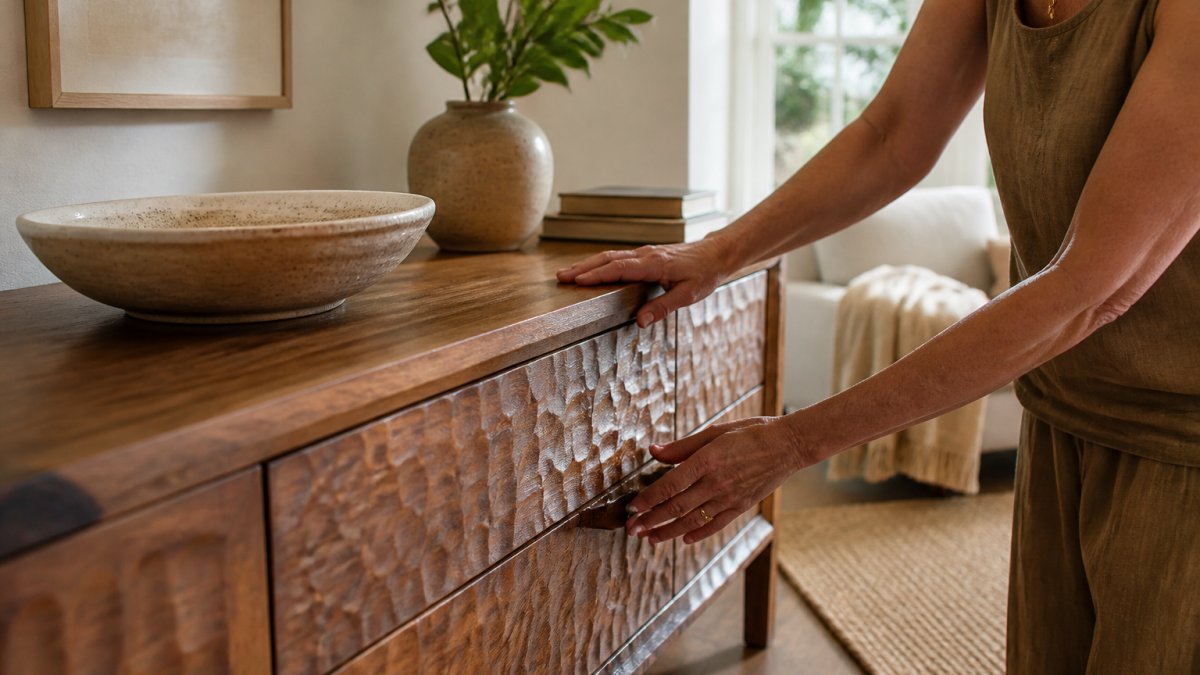
Here is what we look for: Hand Carved Sideboard Cabinet | Reclaimed Acacia Wood

- Acacia wood for solid, character-rich furniture. It takes hand carving well and holds detail for years.
- Sheesham wood for hardness and stability. On the Janka hardness scale, sheesham scores around 1,410 lbf. Teak scores about 1,000 lbf. That makes sheesham harder and more scratch-resistant than teak. It absorbs daily impacts without chipping or splitting. Once properly seasoned, it resists warping and twisting. Its joints stay tight for decades. The heartwood also fights termites and fungi on its own, with no harsh chemical treatment.
- Organic cotton for soft, low-impact textiles that wash well and soften over time.
- Bouclé for texture that holds up to daily use without pilling fast.
- Bone inlay for handcrafted detail that turns a plain surface into a focal point.
- Milk and casein fiber for a soft, breathable handle that feels cool and wears gently.
- Portugal-woven bedding for long-lasting weave quality that survives repeat washing.
- Hypoallergenic fills and finishes for sensitive sleepers who react to dust and common irritants.
These materials share one trait. They are built to last.
Watch out: a material name on a label means little without a certification or a clear source behind it.
Here is the short version of what we look for in a slow home.
| Material | Best for | Key fact |
|---|---|---|
| Acacia wood | Solid, character-rich furniture | Takes hand carving well and holds detail for years |
| Sheesham wood | Hardness and stability | Scores around 1,410 lbf on the Janka hardness scale |
| Teak | Comparison point | Scores about 1,000 lbf on the same scale |
| Organic cotton | Soft, low-impact textiles | Washes well and softens over time |
| Bouclé | Texture in daily use | Holds up without pilling fast |
| Bone inlay | Handcrafted detail | Turns a plain surface into a focal point |
| Milk and casein fiber | Soft, breathable handle | Feels cool and wears gently |
| Portugal-woven bedding | Long-lasting weave quality | Survives repeat washing |
How to Decorate Slowly on a Realistic Budget
Slow decorating on a budget is possible. You just have to be patient and picky.
The real trick is a swap ladder. You replace one weak piece at a time, and you fund the next piece with the one you let go. That keeps cash moving without a big lump sum.
Start with the pieces you use every day. A bed, a sofa, a dining table. Spend there first.
Then follow this order:
- List what you truly need
- Set a monthly amount you can spend
- Buy one solid piece at a time
- Fill gaps with what you already own
- Save for the statement piece last
You can stretch a budget by buying materials that age well instead of replacing them.
Thrift stores, estate sales, and local makers stretch a budget further. So does repairing what you have. A reupholstered chair costs less than a new one and keeps a good frame out of the landfill.
Check the joinery before you buy, since a low price does not always signal lasting quality.
The trick is to stop chasing trends. A timeless piece never goes out of style, so you buy it once.
Caring for Your Pieces So They Last Decades
Care is where slow decorating earns its keep. A well-made piece can last decades with simple habits.
Keep these routines:
- Dust wood with a soft cloth
- Keep furniture out of direct sun
- Blot spills right away
- Vacuum natural rugs with suction only
- Rotate rugs every six months for even wear
- Store textiles clean and dry
Watch out: soaking a natural fiber rug can warp it. Blot, do not scrub.
Small repairs save big money. Tighten a loose screw. Touch up a scratch. Reupholster instead of replacing.
Mixing Slow Pieces Into Furniture You Already Own
You do not need to start over. Slow decorating works best as a blend.
Keep the fast pieces that still function. Add slow pieces around them, one at a time. A new sideboard can lift an old sofa. A handwoven rug can warm a whole room.
Try this approach:
- Pick one anchor piece per room
- Match tone, not exact style
- Use texture to tie old and new together
- Hide weaker pieces with throws or art
- Replace the weakest item first
This is how a curated home comes together. It looks personal, because it is.
Start Your Slow Fashion Home With Fluent Trends
Building a slow fashion home is a choice you make one piece at a time. Start with something you will use daily and keep for years.
At Fluent Trends, we source from reputable purveyors. Our pieces are built to last, from reclaimed acacia sideboards to Portugal-woven bedding.
Here is what we offer:
- Ethically made, sustainably sourced goods
- Handcrafted details you will not find in mass production
- Materials chosen for durability and comfort
Ready to begin? Explore our sustainable luxury home decor picks and add your first lasting piece this season.
Frequently Asked Questions
What is an example of slow fashion for the home?
A good example is a hand-carved reclaimed acacia wood sideboard instead of a particleboard cabinet from a big-box store. The acacia piece is solid, repairable, and gets better with age. Pair it with a handwoven sisal rug and organic cotton throws. That is the core of slow fashion home decor: fewer pieces, chosen well, kept for years.
How can I tell whether home decor is made to last?
Look at the material and the joinery. Solid wood like acacia or sheesham holds up far better than veneer or engineered wood. Sheesham scores around 1,410 lbf on the Janka hardness scale, which means it resists dents and scratches better than teak at roughly 1,000 lbf. Check for tight joints, real hardware, and a finish that can be touched up. Ask whether replacement parts or care instructions are available.
How can I decorate slowly without replacing everything?
Start with what you already own. Keep the pieces that still work and add one or two intentional items each season. A single handwoven rug or a hand-carved sideboard can shift the feel of a whole room. Move things around before you buy. If a piece is structurally sound, refinish or reupholster it instead of tossing it. Slow decorating is about editing, not emptying the room.
What should I look for when choosing ethical home decor brands?
Look for clear material sourcing, named purveyors, and certifications like OEKO-Tex for textiles. A brand should tell you where materials come from and how pieces are finished. Check whether they support women-owned businesses or artisan communities. Avoid vague claims like eco-friendly with no detail. Ask about return policies and shipping transparency. Real ethical home decor brands answer these questions without pressure.
The challenge is simple. Buy less, choose better, and let your home grow slowly. Get started with Fluent Trends and furnish a space that lasts.
